Miracle question
奇迹问句
A question used in Solution-focused brief therapy: the client imagines that a miracle happens overnight while they sleep and solves the problem that brought them in, then describes what they would notice the next morning that tells them so.[1][2]
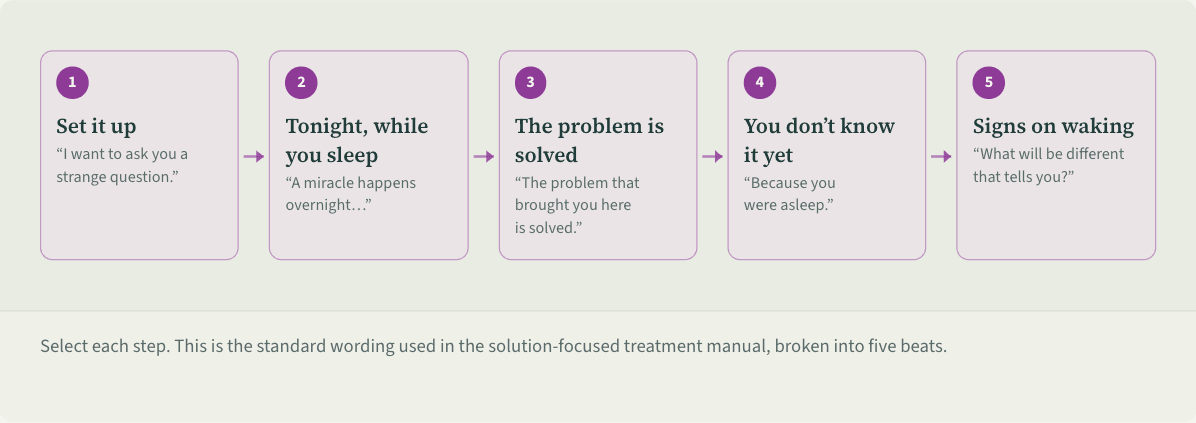
Five connected boxes: set it up, tonight while you sleep, the problem is solved, you don’t know it yet, signs on waking, each with the matching words.
 Save as image (PNG)
Key points
- The standard wording comes from de Shazer’s 1988 book and is still used in the treatment manual. It opens by saying “I want to ask you a strange question.”[1][2]
- Its purpose is to draw out a detailed, observable picture of the client’s preferred future, which then becomes a clear goal.[2]
- A useful answer describes what will be present rather than what will be gone, names a small first step rather than an end state, and includes what others would notice.[2]
- In a randomized experiment with 246 people, miracle and exception questions lowered negative mood more than problem-focused questions, while scaling questions produced more action steps.[3]
An example
Ms. Wang says she and her daughter argue every morning. The counselor asks the miracle question. Ms. Wang says she would greet her daughter calmly and her daughter would sit down for breakfast. The counselor then helps her find recent mornings when a little of this already happened.
Misreadings and limits
It is not a wishing exercise; the point is concrete, observable detail.[2] It is often read out as a rigid script; Shilts and colleagues argue it works better when developed together with the client, even if that means slowing down.[4]
Sources
- 1 de Shazer, S. (1988). Clues: Investigating solutions in brief therapy. W. W. Norton. View source
- 2 Beauchemin, J., De Jong, P., Eads, R., Franklin, C., González-Suitt, K., Guyton, N., Kim, J. S., Langer, S., Lee, M. Y., & Yates, H. T. (2025). Solution focused therapy treatment manual for working with individuals (3rd ed.). Solution Focused Brief Therapy Association (SFBTA Research Committee). View source
- 3 Neipp, M.-C., Beyebach, M., Sanchez-Prada, A., & Delgado Álvarez, M. del C. (2021). Solution-focused versus problem-focused questions: Differential effects of miracles, exceptions and scales. Journal of Family Therapy, 43(4), 728–747. doi:10.1111/1467-6427.12345
- 4 Shilts, L., Rambo, A. H., & Huntley, E. (2003). The collaborative miracle: When to slow down the pace of brief therapy. Journal of Systemic Therapies, 22(2), 65–. doi:10.1521/jsyt.22.2.65.23348
Last checked against sources: October 26, 2026