Cortisol
皮质醇
What is cortisol?
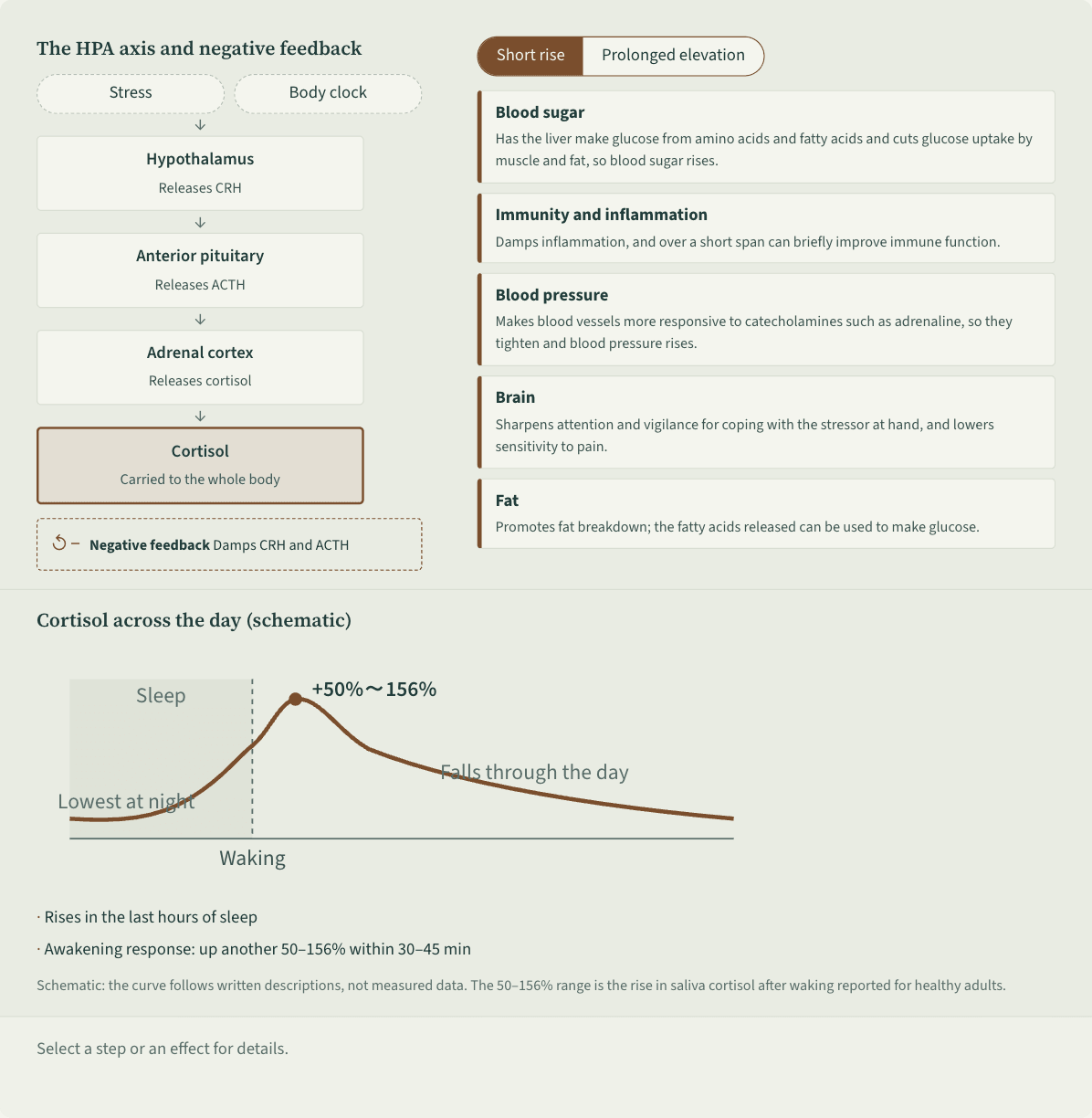
Cortisol is the main glucocorticoid hormone of the adrenal cortex, often called the stress hormone.[1][2] The hypothalamus signals the pituitary, which signals the adrenal cortex to release it: the hypothalamic–pituitary–adrenal (HPA) axis. Cortisol in turn damps the hypothalamus and pituitary, a negative feedback loop.[1]
The HPA axis and negative feedback
Cortisol across the day (schematic)
- Rises in the last hours of sleep
- Awakening response: up another 50–156% within 30–45 min
Schematic: the curve follows written descriptions, not measured data. The 50–156% range is the rise in saliva cortisol after waking reported for healthy adults.
Two-part schematic. On the left, the HPA axis loop: two inputs, stress and the body clock, point to the hypothalamus; the hypothalamus releases CRH, with an arrow to the anterior pituitary; the pituitary releases ACTH, with an arrow to the adrenal cortex; the adrenal cortex releases cortisol, which travels in the blood to the whole body. Two dashed arrows run from cortisol back to the hypothalamus and pituitary, labeled negative feedback. Below cortisol, five effects are listed: blood sugar, immunity and inflammation, blood pressure, brain, and fat, with a switch between short-rise and prolonged-elevation descriptions. On the right, a schematic daily curve: lowest at night, rising in the last hours of sleep, rising sharply again in the 30 to 45 minutes after waking (the cortisol awakening response), then falling through the day.
 Save as image (PNG)
This figure image is licensed CC BY 4.0: reuse it with credit and a link back to this page. How to reuse
Key points
- Cortisol follows a daily rhythm: it starts rising in the last hours of sleep, peaks around waking, drifts down through the day and is lowest at night.[1]
- In the 30–45 minutes after waking it rises sharply again: the cortisol awakening response. This rise is unrelated to cortisol levels later that day and to responses to lab stressors.[3]
- It has the liver make glucose, raising blood sugar; it damps inflammation and immune activity; and it makes blood vessels more responsive to catecholamines such as adrenaline, raising blood pressure.[1]
- Short bursts supply energy, briefly boost immunity and dull pain.[2] Prolonged elevation weakens immunity and is linked to mood problems, poorer memory and attention, and more visceral fat.[1][2]
An example
In a sleep study, Lin gives a saliva sample as soon as she wakes and every 15 minutes after. Seeing her cortisol clearly higher half an hour after waking, she worries she is too stressed. The researchers explain this is the normal cortisol awakening response, and that a first sample taken over 15 minutes late would distort it.[3]
Misreadings and limits
Cortisol is often cast as a bad hormone, and long-term stress is said to wear out the adrenal glands, a supposed condition called adrenal fatigue. Yet too little cortisol causes disease too, and short rises are a normal adaptation.[1][2] A systematic review of 58 studies found no evidence that adrenal fatigue exists.[4]
Sources
- 1 Kaur, J., Gandhi, J., & Sharma, S. (2025). Physiology, cortisol. StatPearls. StatPearls Publishing (last update December 1, 2025). View source
- 2 Spielman, R. M., Jenkins, W. J., & Lovett, M. D. (2020). 14.1 What is stress?. Psychology 2e. OpenStax. View source
- 3 Stalder, T., Kirschbaum, C., Kudielka, B. M., Adam, E. K., Pruessner, J. C., Wüst, S., Dockray, S., Smyth, N., Evans, P., Hellhammer, D. H., Miller, R., Wetherell, M. A., Lupien, S. J., & Clow, A. (2016). Assessment of the cortisol awakening response: Expert consensus guidelines. Psychoneuroendocrinology, 63, 414–432. doi:10.1016/j.psyneuen.2015.10.010
- 4 Cadegiani, F. A., & Kater, C. E. (2016). Adrenal fatigue does not exist: A systematic review. BMC Endocrine Disorders, 16, 48. doi:10.1186/s12902-016-0128-4
Last checked against sources: October 27, 2026