Neurotransmitters
神经递质
What are neurotransmitters?
Neurotransmitters are the nervous system’s chemical messengers. A neuron releases them into the synaptic cleft, where they bind to matching receptors on the next neuron; leftovers are broken down or pumped back into the sending neuron, a process called reuptake.[1]
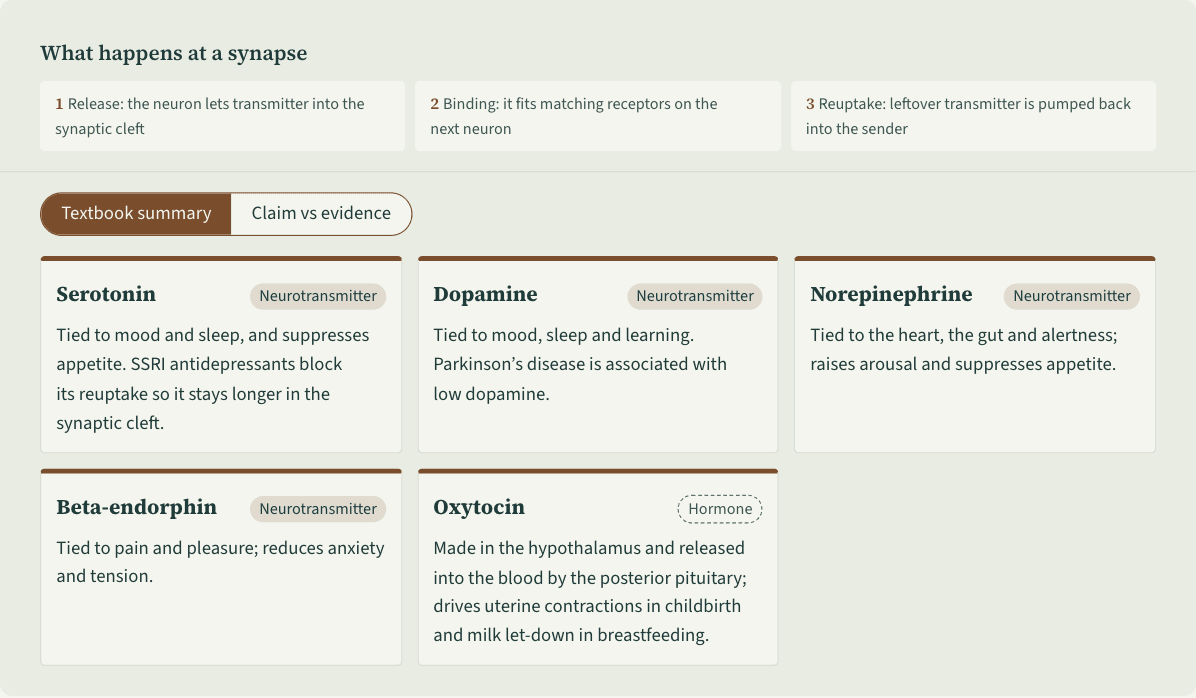
What happens at a synapse
- Release: the neuron lets transmitter into the synaptic cleft
- Binding: it fits matching receptors on the next neuron
- Reuptake: leftover transmitter is pumped back into the sender
-
Serotonin Neurotransmitter
Tied to mood and sleep, and suppresses appetite. SSRI antidepressants block its reuptake so it stays longer in the synaptic cleft.
Popular claim
Depression is a chemical imbalance caused by low serotonin.
What the evidence says
Moncrieff and colleagues (2022) pooled 17 reviews and large studies and found no consistent evidence. Jauhar and colleagues (2023) replied that lowering serotonin does not depress healthy people but clearly lowers mood in people recovered from depression; they too reject the idea that depression comes from a shortage of a single transmitter.
-
Dopamine Neurotransmitter
Tied to mood, sleep and learning. Parkinson’s disease is associated with low dopamine.
Popular claim
The pleasure chemical: more dopamine, more happiness. Even the textbook table lists “increased pleasure.”
What the evidence says
Berridge and Robinson found that dopamine mainly amplifies wanting. Dopamine-depleted rats stopped seeking food yet still showed normal liking reactions to sweetness, and lowering dopamine in people did not reduce their pleasure ratings of food or drugs.
-
Norepinephrine Neurotransmitter
Tied to the heart, the gut and alertness; raises arousal and suppresses appetite.
Popular claim
Often listed alongside the happy chemicals.
What the evidence says
The textbook groups it with alertness and arousal, not with pleasure.
-
Beta-endorphin Neurotransmitter
Tied to pain and pleasure; reduces anxiety and tension.
Popular claim
The body’s own painkiller and happy hormone.
What the evidence says
Broadly supported: opioid signals amplify liking in a few brain “hedonic hotspots.” But the hotspots are tiny and easily disrupted, which the researchers suggest may be one reason intense pleasures are rarer than intense desires.
-
Oxytocin Hormone
Made in the hypothalamus and released into the blood by the posterior pituitary; drives uterine contractions in childbirth and milk let-down in breastfeeding.
Popular claim
The love hormone, the cuddle hormone.
What the evidence says
Its established roles are in childbirth and breastfeeding. Textbooks say only that it is “thought to” aid parent–infant bonding and feelings of love and closeness.
Five cards. Serotonin: the textbook ties it to mood and sleep; the popular claim is that depression comes from low serotonin, which a pooled review found no consistent evidence for, while critics note that lowering it drops mood in people recovered from depression. Dopamine: tied to mood and learning; popularly the pleasure chemical, but research shows it mainly amplifies wanting, not liking. Norepinephrine: tied to alertness and arousal; raises arousal and suppresses appetite. Beta-endorphin: tied to pain and pleasure; opioid signals in small brain hotspots amplify liking. Oxytocin (a hormone): made in the hypothalamus and released by the posterior pituitary, it drives contractions in childbirth and milk let-down; textbooks say only that it is thought to aid bonding and closeness.
 Save as image (PNG)
This figure image is licensed CC BY 4.0: reuse it with credit and a link back to this page. How to reuse
Key points
- An introductory textbook sums them up like this: serotonin is tied to mood and sleep, norepinephrine to alertness and arousal, beta-endorphin to pain and pleasure, dopamine to mood and learning.[1]
- In 2022 Moncrieff and colleagues pooled 17 reviews and large studies and concluded there is no consistent evidence linking depression to low serotonin.[2]
- Critics reply that lowering serotonin does not depress healthy people but clearly lowers mood in people recovered from depression: neither sufficient nor necessary, but possibly involved in relapse.[3]
- Dopamine drives “wanting” more than “liking.” Rats depleted of nearly all brain dopamine stopped seeking food, yet their facial “liking” reactions to sugar stayed normal.[4]
An example
Whenever his phone pings, Jay feels the pull to open it, then scrolls short videos for half an hour without enjoying them much. Berridge and Robinson argue that “wanting” and “liking” come from different brain systems: reward cues can trigger bursts of wanting on their own, without more liking.[4]
Misreadings and limits
Calling these “happy chemicals” pairs each substance with one feeling. Dopamine mainly drives wanting, not pleasure;[4] oxytocin is a hormone that textbooks only say is “thought to” aid bonding and closeness;[5] and even researchers defending serotonin’s role find a single-transmitter cause of depression implausible.[3]
Sources
- 1 Spielman, R. M., Jenkins, W. J., & Lovett, M. D. (2020). 3.2 Cells of the nervous system. Psychology 2e. OpenStax. View source
- 2 Moncrieff, J., Cooper, R. E., Stockmann, T., Amendola, S., Hengartner, M. P., & Horowitz, M. A. (2022). The serotonin theory of depression: A systematic umbrella review of the evidence. Molecular Psychiatry, 28(8), 3243–3256 (issue dated 2023). doi:10.1038/s41380-022-01661-0
- 3 Jauhar, S., Cowen, P. J., & Browning, M. (2023). Fifty years on: Serotonin and depression. Journal of Psychopharmacology, 37(3), 237–241. doi:10.1177/02698811231161813
- 4 Berridge, K. C., & Robinson, T. E. (2016). Liking, wanting, and the incentive-sensitization theory of addiction. American Psychologist, 71(8), 670–679. doi:10.1037/amp0000059
- 5 Betts, J. G., Young, K. A., Wise, J. A., Johnson, E., Poe, B., Kruse, D. H., Korol, O., Johnson, J. E., Womble, M., & DeSaix, P. (2022). 17.3 The pituitary gland and hypothalamus. Anatomy and Physiology 2e. OpenStax. View source
Last checked against sources: October 27, 2026