Power posing
权力姿势
What is power posing?
Power posing means holding open, expansive “high-power” postures in order to feel more powerful. The idea comes from a 2010 experiment with 42 people, which reported that two 1-minute poses raised testosterone, lowered cortisol and made people more willing to take risks.[1]
Three claims
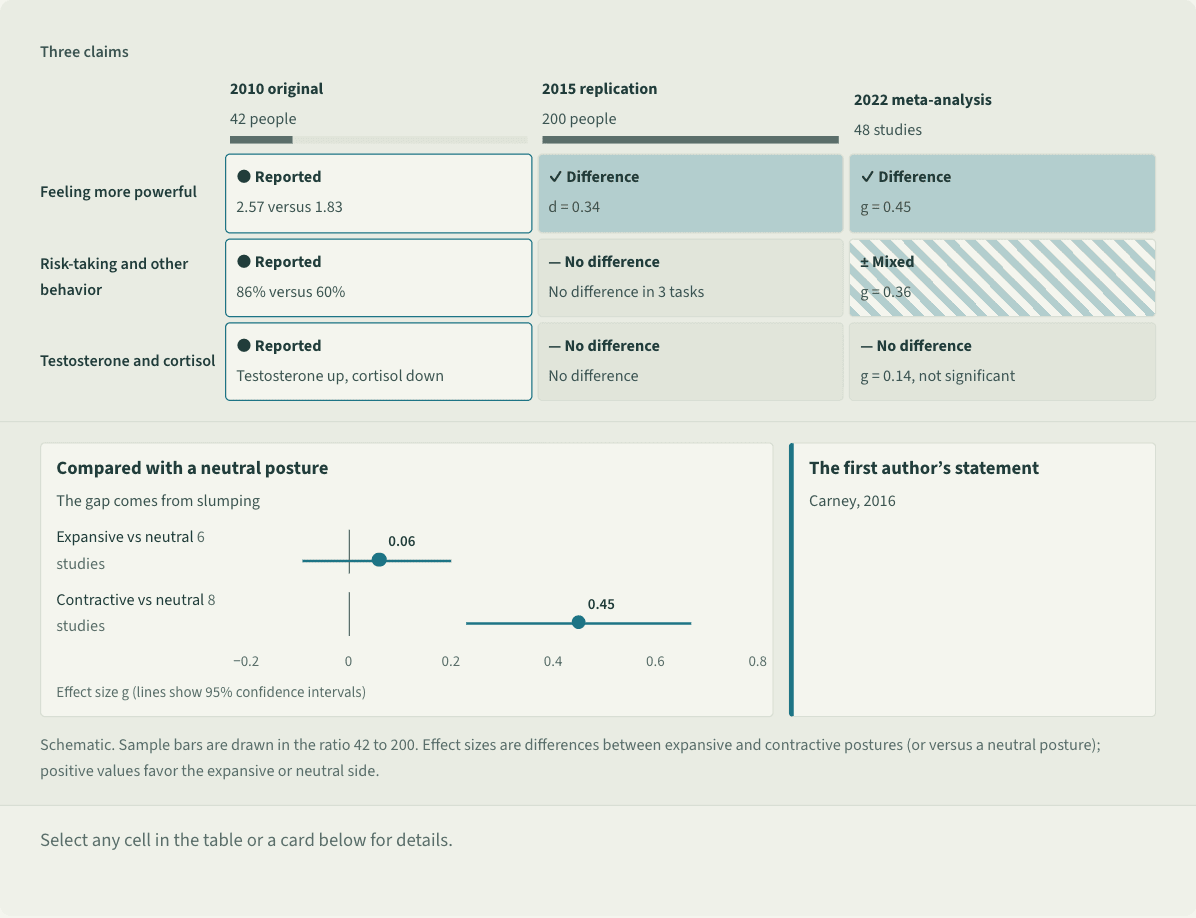
Schematic. Sample bars are drawn in the ratio 42 to 200. Effect sizes are differences between expansive and contractive postures (or versus a neutral posture); positive values favor the expansive or neutral side.
Schematic. A table of three rows and three columns. Columns, left to right: the 2010 original study (42 people), the 2015 replication (200 people; its sample bar is about five times longer) and a 2022 meta-analysis (48 studies). Row one, feeling more powerful: reported in the original, still a difference in the replication (d = 0.34), and a difference in self-reported feelings in the meta-analysis (g = 0.45). Row two, risk-taking and other behavior: reported in the original (86% versus 60% took the gamble), no difference in the replication, and a difference in the meta-analysis (g = 0.36) that conflicts with preregistered studies, marked mixed. Row three, testosterone and cortisol: reported in the original, no difference in the replication, and no significant difference in the meta-analysis (g = 0.14, 4 studies). Below the table, two effect-size bars compare postures with a neutral posture: expansive versus neutral g = 0.06 (95% confidence interval −0.09 to 0.20, 6 studies); contractive versus neutral g = 0.45 (0.23 to 0.67, 8 studies). A card beside them describes the 2016 statement by the original first author.
 Save as image (PNG)
This figure image is licensed CC BY 4.0: reuse it with credit and a link back to this page. How to reuse
Key points
- A 2015 replication with 200 people, run by an experimenter blind to condition, found higher self-rated power (d = 0.34) but no difference in testosterone, cortisol or risk-taking.[2]
- In 2016 first author Carney said she no longer believes the effects are real: the sample was tiny, data were checked as they arrived, and tests and questions chosen because they “worked.”[3]
- A 2022 meta-analysis of 48 studies found expansive and contractive postures differed in self-reported feelings (g = 0.45) and behavior (g = 0.36), but not in hormones.[4]
- In the few studies with a neutral-posture control, the gap came mainly from the negative effect of contractive postures (g = 0.45); expansive and neutral barely differed (g = 0.06).[4]
An example
Before a job interview, Lin stands in a restroom with her hands on her hips for two minutes and feels a little steadier. Feeling more powerful is the result that held up in a large replication; the testosterone and cortisol changes did not reappear.[2]
Misreadings and limits
The common misreading is that two minutes in a pose changes your hormones and makes you take more risks. The large replication found neither,[2] and the meta-analysis found no hormone difference.[4] Feeling more powerful is a small-to-moderate effect that self-reports may inflate through guesses about the study’s aims; with few neutral-control studies, the slumping finding is preliminary.[4]
Sources
- 1 Carney, D. R., Cuddy, A. J. C., & Yap, A. J. (2010). Power posing: Brief nonverbal displays affect neuroendocrine levels and risk tolerance. Psychological Science, 21(10), 1363–1368. doi:10.1177/0956797610383437
- 2 Ranehill, E., Dreber, A., Johannesson, M., Leiberg, S., Sul, S., & Weber, R. A. (2015). Assessing the robustness of power posing: No effect on hormones and risk tolerance in a large sample of men and women. Psychological Science, 26(5), 653–656. doi:10.1177/0956797614553946
- 3 Carney, D. R. (2016). My position on “Power Poses”. University of California, Berkeley, Haas School of Business faculty pages. View source
- 4 Elkjær, E., Mikkelsen, M. B., Michalak, J., Mennin, D. S., & O’Toole, M. S. (2022). Expansive and contractive postures and movement: A systematic review and meta-analysis of the effect of motor displays on affective and behavioral responses. Perspectives on Psychological Science, 17(1), 276–304. doi:10.1177/1745691620919358
Last checked against sources: October 28, 2026