Stages of attachment
依恋发展阶段
What are the stages of attachment?
Stages of attachment describe how infants come to focus their attachment on particular people. Schaffer and Emerson (1964) followed 60 Glasgow infants and, from mothers' reports of protest at separation, outlined a sequence of stages; Bowlby proposed four similar phases.[1][2]
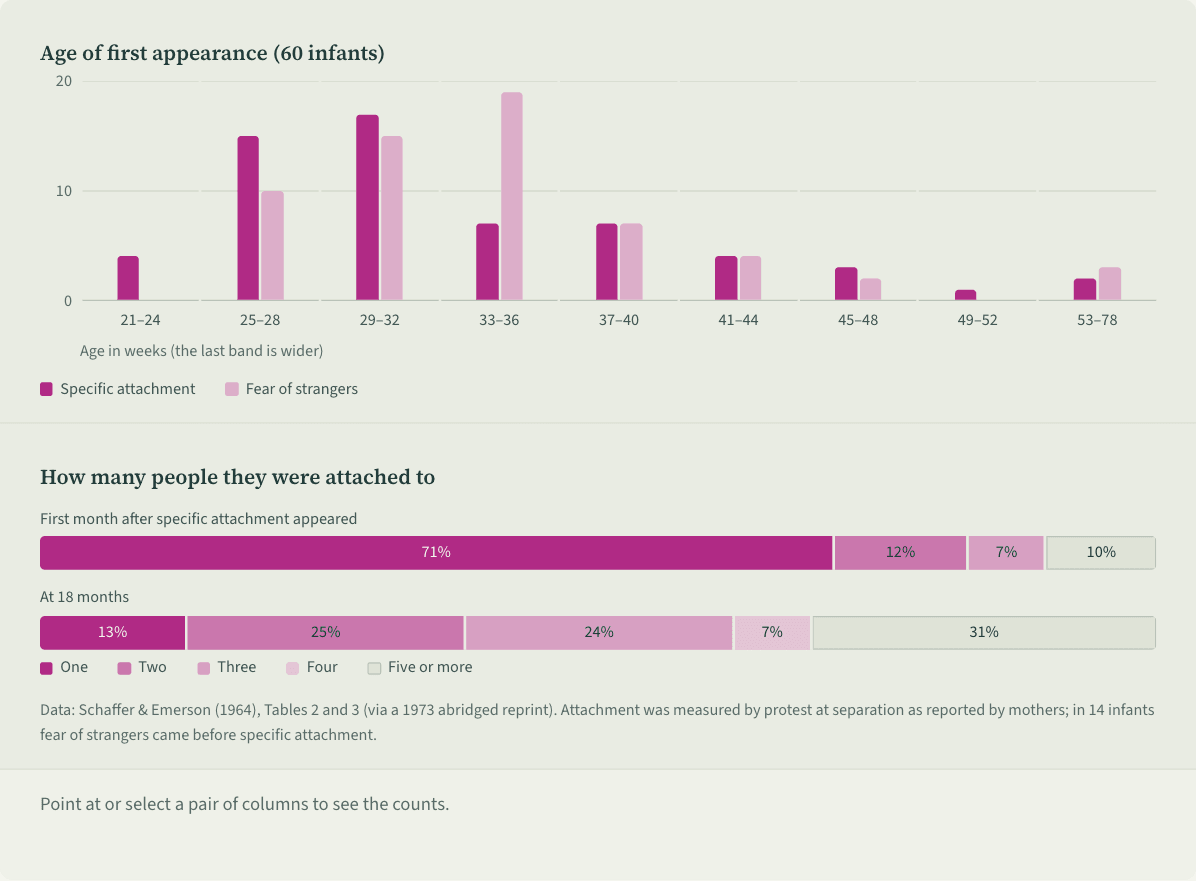
Age of first appearance (60 infants)
Age in weeks (the last band is wider)
How many people they were attached to
First month after specific attachment appeared
At 18 months
Data: Schaffer & Emerson (1964), Tables 2 and 3 (via a 1973 abridged reprint). Attachment was measured by protest at separation as reported by mothers; in 14 infants fear of strangers came before specific attachment.
Above, a column chart in four-week bands with two columns each: infants first showing a specific attachment, and infants first showing fear of strangers. 21–24 weeks, 4 and 0; 25–28, 15 and 10; 29–32, 17 and 15; 33–36, 7 and 19; 37–40, 7 and 7; 41–44, 4 and 4; 45–48, 3 and 2; 49–52, 1 and 0; 53–78, 2 and 3. Most specific attachments appeared at 25–32 weeks, with fear of strangers a little later. Below, two stacked bars for the number of attachment figures: in the first month after specific attachment, one 71%, two 12%, three 7%, five or more 10%; at 18 months, one 13%, two 25%, three 24%, four 7%, five or more 31%.
 Save as image (PNG)
This figure image is licensed CC BY 4.0: reuse it with credit and a link back to this page. How to reuse
Key points
- The sequence: an asocial stage, when any stimulation will do; indiscriminate attachment, protesting when anyone puts the baby down; specific attachment to particular people; then, soon after, multiple attachments.[1]
- Age at first specific attachment varied widely: the earliest at 22 weeks, most in the third quarter of the first year, and two only after their first birthday.[1][2]
- Multiple attachments came early: a month after onset, 29% already protested at more than one person leaving. By 18 months only 13% had a single figure; 75% were attached to their father.[1][2]
- Attachment figures were not simply those who fed the baby: about a fifth of principal figures took no part in physical care. Intensity tracked the mother’s responsiveness and how much she interacted.[1][2]
An example
At three months, Lin’s daughter smiles at anyone who holds her. At eight months she cries when Lin leaves, and when a visiting aunt reaches for her she buries her face in her father’s shoulder. At 18 months she also calls after her grandmother. This fits multiple attachments forming soon after the first specific one.
Misreadings and limits
The study rested on one measure: mothers' reports of protest in seven everyday separations, with little direct observation and no scoring of greetings or secure-base exploring. Bowlby suspected the earliest signs went unreported.[2] Ainsworth’s home observations found the average baby did not protest every time the mother left.[3]
Sources
- 1 Schaffer, H. R., & Emerson, P. E. (1964). The development of social attachments in infancy. Monographs of the Society for Research in Child Development, 29(3, Serial No. 94). doi:10.2307/1165727
- 2 Bowlby, J. (1969). Attachment and loss: Vol. 1. Attachment. Hogarth Press (Pelican Books edition, 1971; page numbers in the research notes follow it). View source
- 3 Ainsworth, M. D. S., Blehar, M. C., Waters, E., & Wall, S. (1978). Patterns of attachment: A psychological study of the strange situation. Lawrence Erlbaum (reissued 2015, Psychology Press Classic Editions). View source
Last checked against sources: October 27, 2026