Strange Situation
陌生情境测验
What is the Strange Situation?
The Strange Situation is a roughly 20-minute laboratory procedure designed by Mary Ainsworth and colleagues. A one-year-old is twice separated from and reunited with a caregiver in an unfamiliar room, with a stranger present at times. The relationship is classified mainly from the baby’s behavior at reunion.[1]
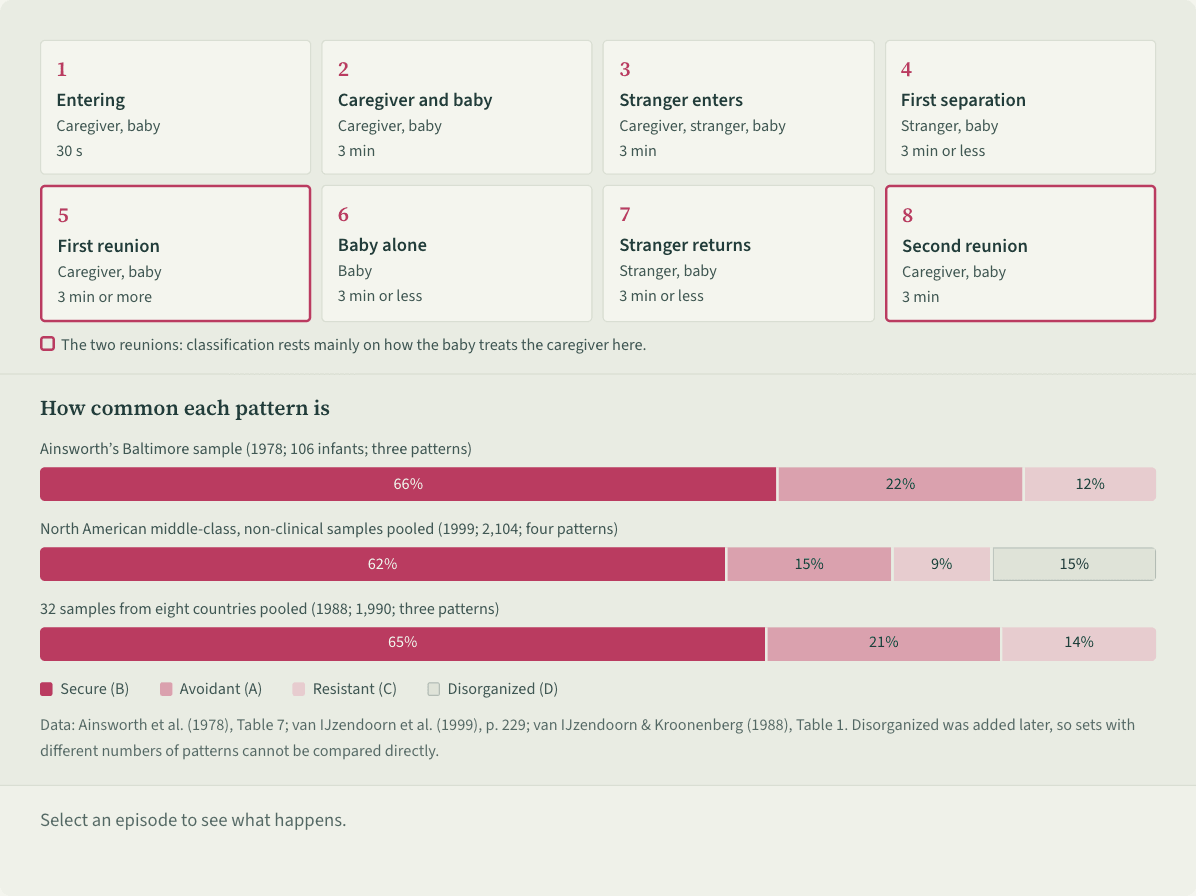
The two reunions: classification rests mainly on how the baby treats the caregiver here.
How common each pattern is
Ainsworth’s Baltimore sample (1978; 106 infants; three patterns)
North American middle-class, non-clinical samples pooled (1999; 2,104; four patterns)
32 samples from eight countries pooled (1988; 1,990; three patterns)
Data: Ainsworth et al. (1978), Table 7; van IJzendoorn et al. (1999), p. 229; van IJzendoorn & Kroonenberg (1988), Table 1. Disorganized was added later, so sets with different numbers of patterns cannot be compared directly.
Top, eight episodes: 1 entering the room (caregiver and baby, 30 seconds); 2 caregiver and baby (3 minutes); 3 stranger enters (3 minutes, then the caregiver leaves); 4 first separation (stranger and baby, 3 minutes or less); 5 first reunion (caregiver and baby, 3 minutes or more); 6 baby alone (3 minutes or less); 7 stranger returns (3 minutes or less); 8 second reunion (caregiver and baby, 3 minutes). Episodes 5 and 8 are outlined: classification looks mainly at them. Bottom, three stacked bars: Ainsworth’s 1978 Baltimore sample of 106 infants, secure 66%, avoidant 22%, resistant 12%; North American middle-class samples pooled in 1999, 2,104 infants, secure 62%, avoidant 15%, resistant 9%, disorganized 15%; 32 samples from eight countries pooled in 1988, 1,990 infants, secure 65%, avoidant 21%, resistant 14%.
 Save as image (PNG)
This figure image is licensed CC BY 4.0: reuse it with credit and a link back to this page. How to reuse
Key points
- Over eight episodes the caregiver leaves and returns twice, a stranger comes and goes twice, and the baby is alone once. Most last three minutes; separations end early for a distressed baby.[1]
- Secure (B) infants seek the caregiver at reunion and settle quickly; avoidant (A) infants avoid or ignore them; resistant or ambivalent (C) infants seek yet resist contact and are hard to soothe.[1]
- Main and Solomon added disorganized (D). North American middle-class samples pool to about 62% B, 15% A, 9% C, 15% D; D at least doubles in high-risk groups like maltreated infants.[2]
- In 32 samples from eight countries, secure was commonest everywhere; avoidance was more frequent in Western Europe, resistance in Israel and Japan, yet variation within countries was 1.5 times that between them.[3]
An example
Jay picks up his one-year-old son from daycare each evening. Some days the boy crawls over to be held, then goes back to his blocks; other days he glances up and keeps playing. The Strange Situation looks at moments like these, but across a standardized series of episodes, not a single pickup.
Misreadings and limits
A classification describes a child’s relationship with one caregiver, and the same child may differ with each parent.[4] Avoidant and resistant patterns are common, organized strategies, not diagnoses.[2][4] Early papers called both “anxious attachment,” which is not the anxiety scored in adult attachment questionnaires.[1]
Sources
- 1 Ainsworth, M. D. S., Blehar, M. C., Waters, E., & Wall, S. (1978). Patterns of attachment: A psychological study of the strange situation. Lawrence Erlbaum (reissued 2015, Psychology Press Classic Editions). View source
- 2 van IJzendoorn, M. H., Schuengel, C., & Bakermans-Kranenburg, M. J. (1999). Disorganized attachment in early childhood: Meta-analysis of precursors, concomitants, and sequelae. Development and Psychopathology, 11(2), 225–249. doi:10.1017/S0954579499002035
- 3 van IJzendoorn, M. H., & Kroonenberg, P. M. (1988). Cross-cultural patterns of attachment: A meta-analysis of the Strange Situation. Child Development, 59(1), 147–156. doi:10.2307/1130396
- 4 Granqvist, P., Sroufe, L. A., Dozier, M., Hesse, E., Steele, M., van IJzendoorn, M., Solomon, J., et al. (2017). Disorganized attachment in infancy: A review of the phenomenon and its implications for clinicians and policy-makers. Attachment & Human Development, 19(6), 534–558. doi:10.1080/14616734.2017.1354040
Last checked against sources: October 27, 2026