Harlow’s monkey experiments
哈洛恒河猴实验
What were Harlow’s monkey experiments?
In the 1950s, Harry Harlow at the University of Wisconsin raised rhesus monkeys, separated from their mothers at birth, with two artificial “mothers”: one covered in terry cloth, one of bare wire mesh. He concluded that contact comfort far outweighs nursing in forming the infant’s bond.[1]
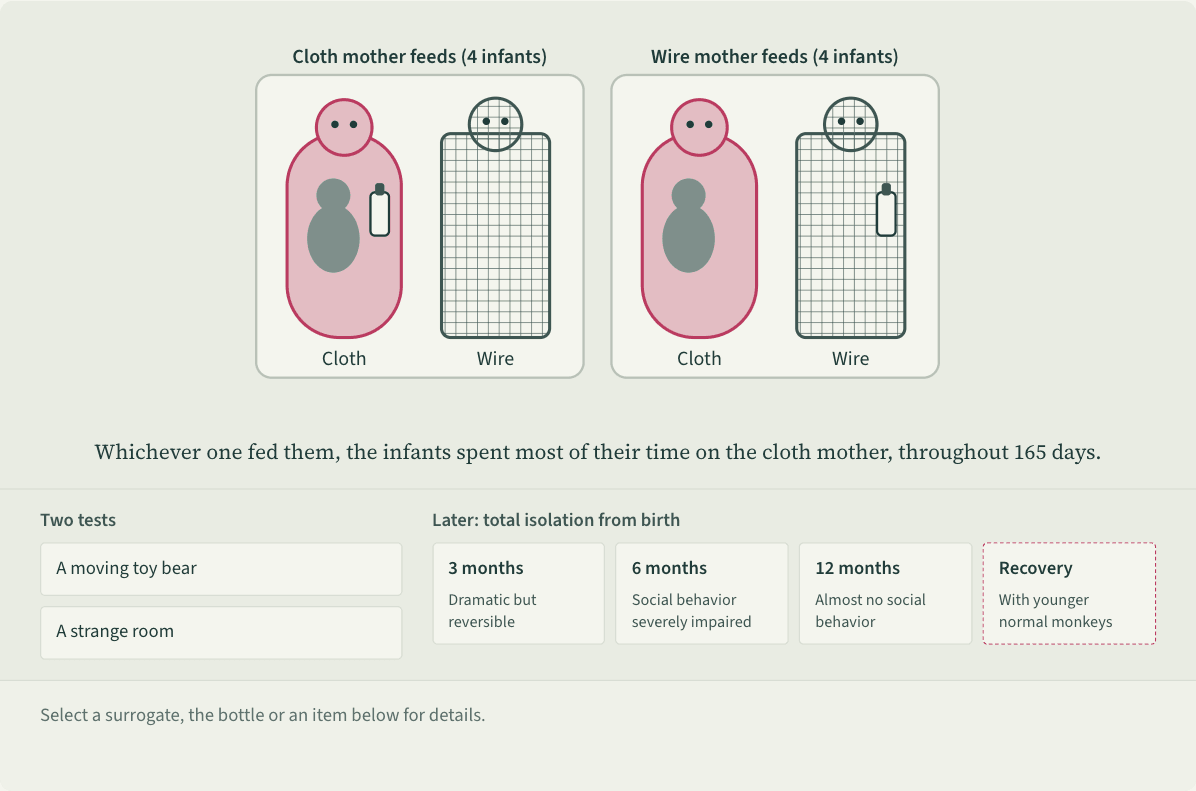
Whichever one fed them, the infants spent most of their time on the cloth mother, throughout 165 days.
Two tests
Later: total isolation from birth
Two cages side by side, each with a cloth-covered surrogate mother on the left and a wire-mesh one on the right. In the left cage the bottle is on the cloth mother, in the right cage on the wire mother; in both, the infant clings to the cloth mother. A note says that whichever surrogate fed them, the infants spent most of their time on the cloth mother across 165 days. Below are two tests (a moving toy bear, a strange room) and a timeline of the isolation studies: three months, dramatic but reversible effects; six months, severely impaired social behavior; twelve months, almost no social behavior; six-month isolates who spent time with three-month-old normal monkeys were close to normal by one year.
 Save as image (PNG)
This figure image is licensed CC BY 4.0: reuse it with credit and a link back to this page. How to reuse
Key points
- Of eight infants, four were fed by the cloth mother and four by the wire one. Either way, they spent most of their time on the cloth mother across 165 days.[1]
- Frightened by a moving toy bear or the like, they ran to the cloth mother. In a strange room they explored from her as a base; her presence halved their emotionality score.[1]
- Later studies isolated infants from birth. Three months of total isolation had reversible effects; six months severely impaired social behavior, and twelve months left monkeys with almost no normal social responses.[2]
- A 1971 report found that six-month isolates who regularly spent time with three-month-old normal monkeys were, by one year of age, scarcely distinguishable from them in exploration and play.[3]
An example
After his vaccinations, Lin’s one-year-old son screams and pushes his bottle away. Only when Lin holds him close does he slowly calm down. Being held, not food, settles him, much like Harlow’s contact comfort, though human attachment also depends on how promptly caregivers respond.
Misreadings and limits
A common misreading is that a soft substitute is enough. Isolates given only cloth surrogates calmed down but developed only crude social behavior.[3] The experiments predate modern ethics guidelines and are now widely considered unethical, even cruel.[4]
Sources
- 1 Harlow, H. F. (1958). The nature of love. American Psychologist, 13(12), 673–685. doi:10.1037/h0047884
- 2 Harlow, H. F., Dodsworth, R. O., & Harlow, M. K. (1965). Total social isolation in monkeys. Proceedings of the National Academy of Sciences, 54(1), 90–97. doi:10.1073/pnas.54.1.90
- 3 Harlow, H. F., & Suomi, S. J. (1971). Social recovery by isolation-reared monkeys. Proceedings of the National Academy of Sciences, 68(7), 1534–1538. doi:10.1073/pnas.68.7.1534
- 4 Spielman, R. M., Jenkins, W. J., & Lovett, M. D. (2020). 9.3 Stages of development. Psychology 2e. OpenStax. View source
Last checked against sources: October 27, 2026