Adolescent risk-taking
青少年冒险行为
What is adolescent risk-taking?
Adolescent risk-taking is behavior whose outcome, good or bad, is uncertain. Adolescents take more risks than children or adults, and the tendency can run toward negative risks, which are illegal or dangerous, or positive ones that are legal, socially acceptable and constructive.[1]
Two lines that sort risks
The dual systems model (schematic)
Critique and evidence
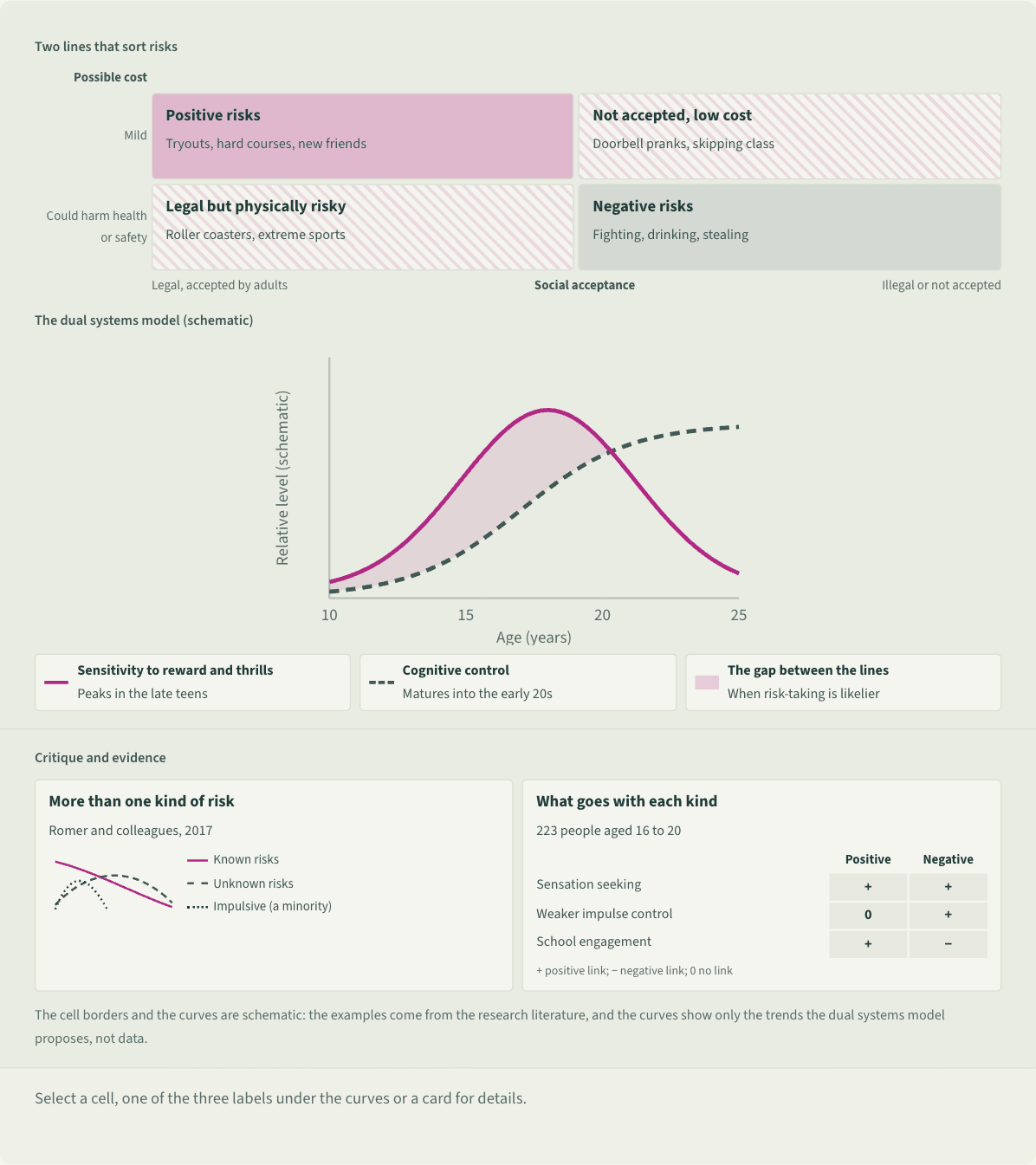
The cell borders and the curves are schematic: the examples come from the research literature, and the curves show only the trends the dual systems model proposes, not data.
Top, a two-by-two grid. The horizontal axis runs from legal and accepted by adults to illegal or not accepted; the vertical axis from mild costs to possible harm to health or safety. Top left, positive risks: team tryouts, hard courses, making new friends, auditioning for a play. Top right, not accepted but low cost: ringing a doorbell and running, skipping class, still counted as negative risks in studies. Bottom left, legal but physically risky: roller coasters, extreme sports, rugby, counted as positive risks on early scales, which Duell and Steinberg see as mainly thrill seeking. Bottom right, negative risks: fighting, drinking, stealing, drunk driving. Below, a schematic chart for ages 10 to 25: sensitivity to reward and thrills forms an inverted U peaking in the late teens; cognitive control rises gradually and levels off in the early 20s; the years where the lines diverge are marked as more prone to risk. Two cards: a 2017 critique by Romer and colleagues dividing risk-taking into known risks, unknown risks and impulsive disregard of risk, of which only the last two rise in adolescence and impulsive risk-taking is found in a minority; and a 2020 study by Duell and Steinberg of 223 people aged 16 to 20, in which positive and negative risk-taking were correlated (r = .31), both linked to sensation seeking, only negative risks to impulsivity, and positive risks to school engagement.
 Save as image (PNG)
This figure image is licensed CC BY 4.0: reuse it with credit and a link back to this page. How to reuse
Key points
- Positive risks benefit development, carry mild costs that do not threaten health or safety, and are legal and acceptable to adults, such as team tryouts, hard courses or new friendships.[1]
- The dual systems model holds that sensitivity to reward and novelty peaks in the late teens while self-control matures gradually into the early 20s; the mismatch makes these years prone to risk.[2]
- The gap shows mainly under emotional arousal, unclear odds or with friends present. When they can weigh choices calmly, adolescents of about 15 reason about risk much as adults do.[2]
- In a study of 223 people aged 16 to 20, the two kinds went together and both tracked sensation seeking; only negative risks tracked impulsivity, and positive ones went with school engagement.[4]
An example
Jay, 16, signs up for basketball tryouts he may not make and starts talking to a new classmate. The same month, he skips a class with friends. By Duell and Steinberg’s definitions, the tryouts and the new friendship are positive risks; skipping class is a negative one.
Misreadings and limits
A popular claim is that teenagers are reckless because their brains are unfinished. Romer and colleagues argue that the teenage rise in sensation seeking is mostly exploration, not a lack of control, and that heedless, impulsive risk-taking clusters in a minority whose weak self-control shows from childhood.[3] The model’s own authors call it an oversimplification.[2]
Sources
- 1 Duell, N., & Steinberg, L. (2019). Positive risk taking in adolescence. Child Development Perspectives, 13(1), 48–52. doi:10.1111/cdep.12310
- 2 Shulman, E. P., Smith, A. R., Silva, K., Icenogle, G., Duell, N., Chein, J., & Steinberg, L. (2016). The dual systems model: Review, reappraisal, and reaffirmation. Developmental Cognitive Neuroscience, 17, 103–117. doi:10.1016/j.dcn.2015.12.010
- 3 Romer, D., Reyna, V. F., & Satterthwaite, T. D. (2017). Beyond stereotypes of adolescent risk taking: Placing the adolescent brain in developmental context. Developmental Cognitive Neuroscience, 27, 19–34. doi:10.1016/j.dcn.2017.07.007
- 4 Duell, N., & Steinberg, L. (2020). Differential correlates of positive and negative risk taking in adolescence. Journal of Youth and Adolescence, 49(6), 1162–1178. doi:10.1007/s10964-020-01237-7
Last checked against sources: October 28, 2026