Transitional object
过渡客体
What is a transitional object?
A transitional object, in D. W. Winnicott’s 1953 term, is an infant’s “first not-me possession,” such as a blanket corner or soft toy used at bedtime or when anxious. He placed it in an intermediate area between inner and outer reality that helps the infant come to accept external reality.[1]
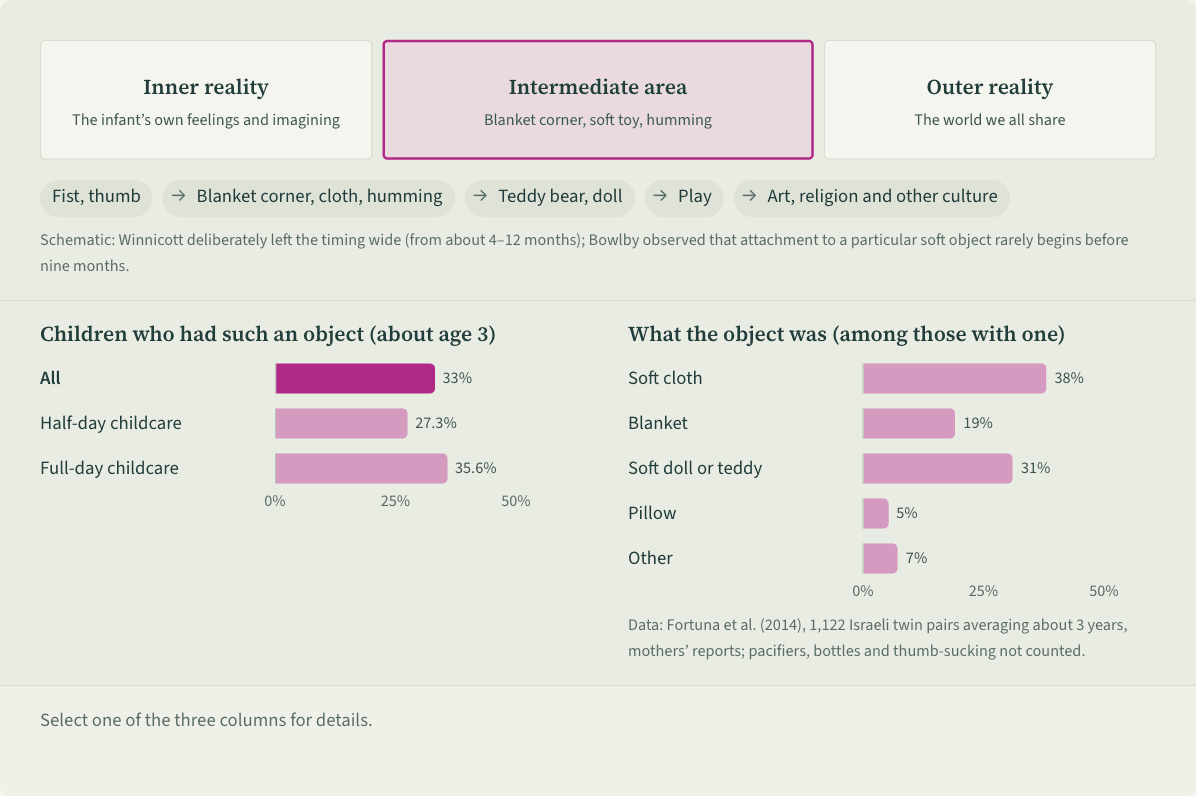
- Fist, thumb
- Blanket corner, cloth, humming
- Teddy bear, doll
- Play
- Art, religion and other culture
Schematic: Winnicott deliberately left the timing wide (from about 4–12 months); Bowlby observed that attachment to a particular soft object rarely begins before nine months.
Top, three columns: inner reality on the left, the intermediate area in the middle (where the transitional object sits), outer reality on the right. A row of arrows below runs: fist and thumb; blanket corner, soft cloth and humming; teddy bears and dolls; play; art, religion and other cultural experience. Bottom, two sets of bars: 33% of children had such an object, 27.3% with half-day childcare and 35.6% with full-day; among those with one, soft cloth 38%, blanket 19%, soft doll or teddy 31%, pillow 5%, other 7%.
 Save as image (PNG)
This figure image is licensed CC BY 4.0: reuse it with credit and a link back to this page. How to reuse
Key points
- Winnicott noted that the child claims rights over it, cuddles and mauls it, and lets no one else change it. Parents often leave it unwashed, since washing breaks the continuity of experience.[1]
- It is not mourned when outgrown; it gradually loses meaning as, in Winnicott’s view, the intermediate experience spreads into play, art and religion.[1]
- Not every child has one. About 33% of three-year-olds in 1,122 Israeli twin pairs did; Western samples reach 60%, while rates are lower where infants stay near their mothers day and night.[3]
- Bowlby observed that attachment to a particular soft object rarely begins before nine months. In one longitudinal study, most children attached to a soft object were securely attached to their mothers.[2][4]
An example
Jay’s two-year-old daughter has a faded little blanket. She strokes its corner at bedtime and stuffs it into her bag for daycare. After it was washed once, she cried that it “smelled wrong.” By Winnicott’s description, this is a typical transitional object.
Misreadings and limits
Winnicott considered transitional phenomena healthy and universal, but surveys show many children never have such an object, so it is not a required stage.[3] Bowlby questioned the “transitional” theory, preferring to call them substitute objects that attachment behavior turns to when the natural figure is unavailable.[2]
Sources
- 1 Winnicott, D. W. (1953). Transitional objects and transitional phenomena: A study of the first not-me possession. International Journal of Psycho-Analysis, 34, 89–97. View source
- 2 Bowlby, J. (1969). Attachment and loss: Vol. 1. Attachment. Hogarth Press (Pelican Books edition, 1971; page numbers in the research notes follow it). View source
- 3 Fortuna, K., Baor, L., Israel, S., Abadi, A., & Knafo, A. (2014). Attachment to inanimate objects and early childcare: A twin study. Frontiers in Psychology, 5, Article 486. doi:10.3389/fpsyg.2014.00486
- 4 Lehman, E. B., Denham, S. A., Moser, M. H., & Reeves, S. L. (1992). Soft object and pacifier attachments in young children: The role of security of attachment to the mother. Journal of Child Psychology and Psychiatry, 33(7), 1205–1215. doi:10.1111/j.1469-7610.1992.tb00939.x
Last checked against sources: October 27, 2026