Grief rituals
哀伤仪式
What are grief rituals?
Grief rituals are the funeral and the symbolic acts that follow a death, such as lighting a candle, visiting the grave or holding a memorial gathering.[1][2] In a set of experiments, people who performed rituals after a loss reported less grief, partly because they regained a sense of control.[1]
How rituals might help
What studies found
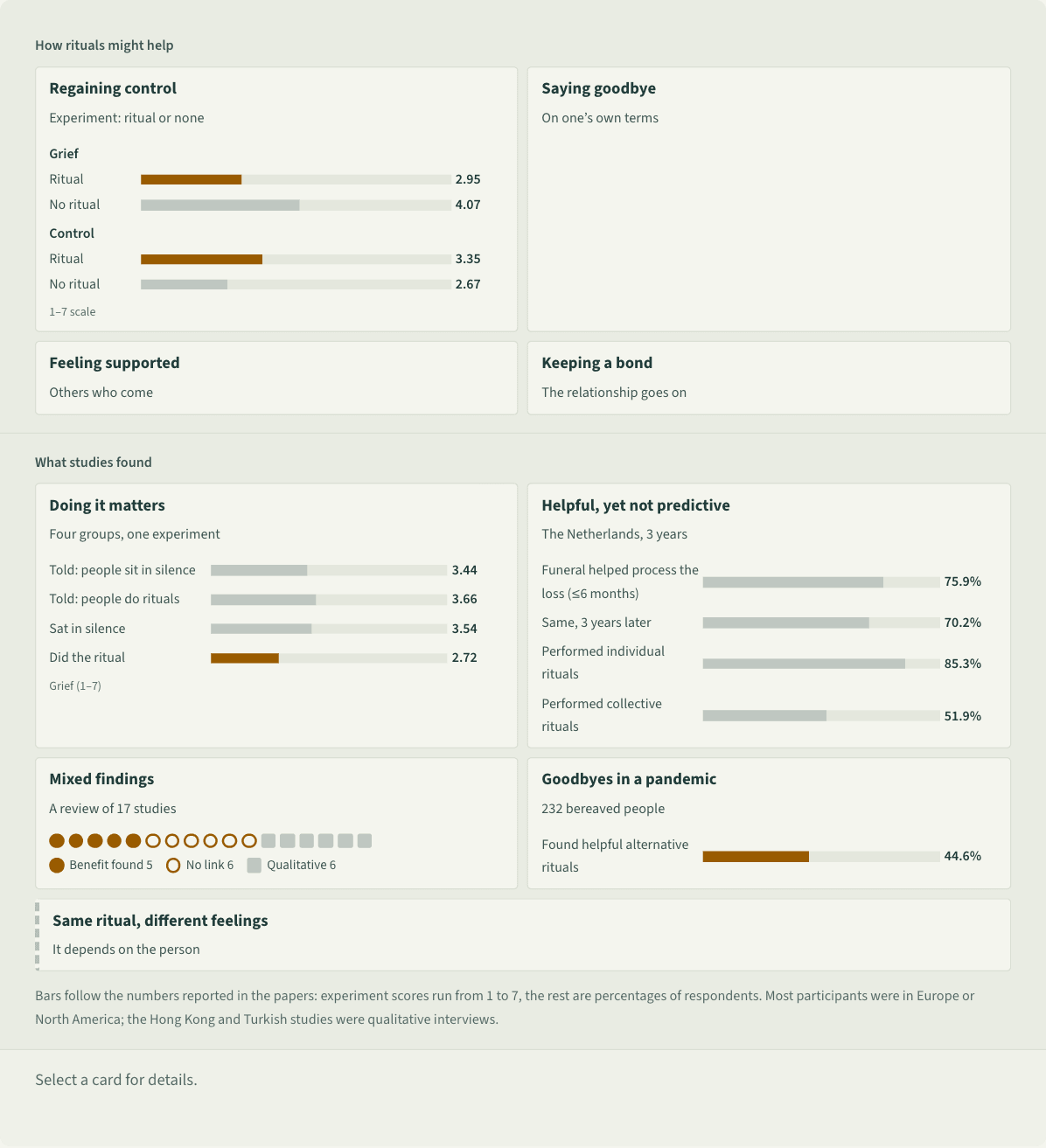
Bars follow the numbers reported in the papers: experiment scores run from 1 to 7, the rest are percentages of respondents. Most participants were in Europe or North America; the Hong Kong and Turkish studies were qualitative interviews.
Under the heading “How rituals might help” are four cards: regaining control, saying goodbye, feeling supported, and keeping a bond with the person who died. The first card holds two pairs of bars on a 1-to-7 scale: after losing a lottery, people who did a ritual rated their grief 2.95 and those who did not 4.07; their sense of control was 3.35 and 2.67. Under the heading “What studies found” are four cards. The first shows grief in the four groups of one experiment: only the group that carried out a ritual was lower, at 2.72, while the other three ranged from 3.44 to 3.66. The second is a Dutch follow-up study, with bars showing that 75.9% within six months of the loss and 70.2% three years later said the funeral arrangements helped them process the loss, 85.3% performed individual rituals and 51.9% collective ones, yet none of this predicted later grief. The third is a review drawn as 17 dots: 5 observational studies that found benefits, 6 that found no link, and 6 qualitative studies. The fourth is a pandemic study in which 44.6% of 232 people found helpful alternative rituals. A last card explains that the same ritual can feel supportive to some people and burdensome to others.
 Save as image (PNG)
This figure image is licensed CC BY 4.0: reuse it with credit and a link back to this page. How to reuse
Key points
- In experiments, recalling a past ritual or doing an assigned one (draw your feelings, add salt, tear up the page) brought less grief and more control, even for people who doubted rituals.[1]
- In a 3-year Dutch study, over 70% said the funeral period helped them process the loss and 85% performed rituals such as lighting candles, yet neither predicted how their grief changed.[2]
- In one review, 5 of 11 observational studies linked funeral participation to benefits and 6 did not; qualitative work suggests the benefit depends on shaping the rituals, saying goodbye and feeling supported.[3]
- People bereaved during COVID-19 felt restrictions worsened funerals and rituals, yet attended and rated funerals much as people bereaved earlier did; about 45% of the 232 found helpful alternative rituals.[4]
An example
When Jay’s grandmother died, he was working abroad and could not get home for the funeral. On the seventh night after her death, a date his family marks, he lit a candle beside her photo, wrote her a letter he would never send and talked with his mother by video about the dishes his grandmother used to cook.
Misreadings and limits
A common belief is that missing the funeral or a proper goodbye makes grief hard to resolve. Findings are mixed: 6 of 11 observational studies found no link,[3] and in a pandemic study, post-funeral rituals and their helpfulness were unrelated to prolonged grief symptoms.[4] Grief that stays intense and disrupts life may call for professional help; see Prolonged grief disorder.
Sources
- 1 Norton, M. I., & Gino, F. (2014). Rituals alleviate grieving for loved ones, lovers, and lotteries. Journal of Experimental Psychology: General, 143(1), 266–272. doi:10.1037/a0031772 Several other papers by the second author have been retracted since 2023 over data problems; as of October 2026 this paper has no correction or retraction.
- 2 Mitima-Verloop, H. B., Mooren, T. T. M., & Boelen, P. A. (2021). Facilitating grief: An exploration of the function of funerals and rituals in relation to grief reactions. Death Studies, 45(9), 735–745. doi:10.1080/07481187.2019.1686090
- 3 Burrell, A., & Selman, L. E. (2022). How do funeral practices impact bereaved relatives’ mental health, grief and bereavement? A mixed methods review with implications for COVID-19. OMEGA – Journal of Death and Dying, 85(2), 345–383. doi:10.1177/0030222820941296
- 4 Mitima-Verloop, H. B., Mooren, T. T. M., Kritikou, M. E., & Boelen, P. A. (2022). Restricted mourning: Impact of the COVID-19 pandemic on funeral services, grief rituals, and prolonged grief symptoms. Frontiers in Psychiatry, 13, 878818. doi:10.3389/fpsyt.2022.878818
Last checked against sources: October 28, 2026