Prolonged grief disorder
延长哀伤障碍
What is prolonged grief disorder?
Prolonged grief disorder can follow the death of someone close: intense longing for, or preoccupation with, the person persists far beyond what the bereaved person’s culture expects, with intense emotional pain and clear impairment.[1][2] ICD-11 and DSM-5-TR, published in 2022, both include it.[1][2]
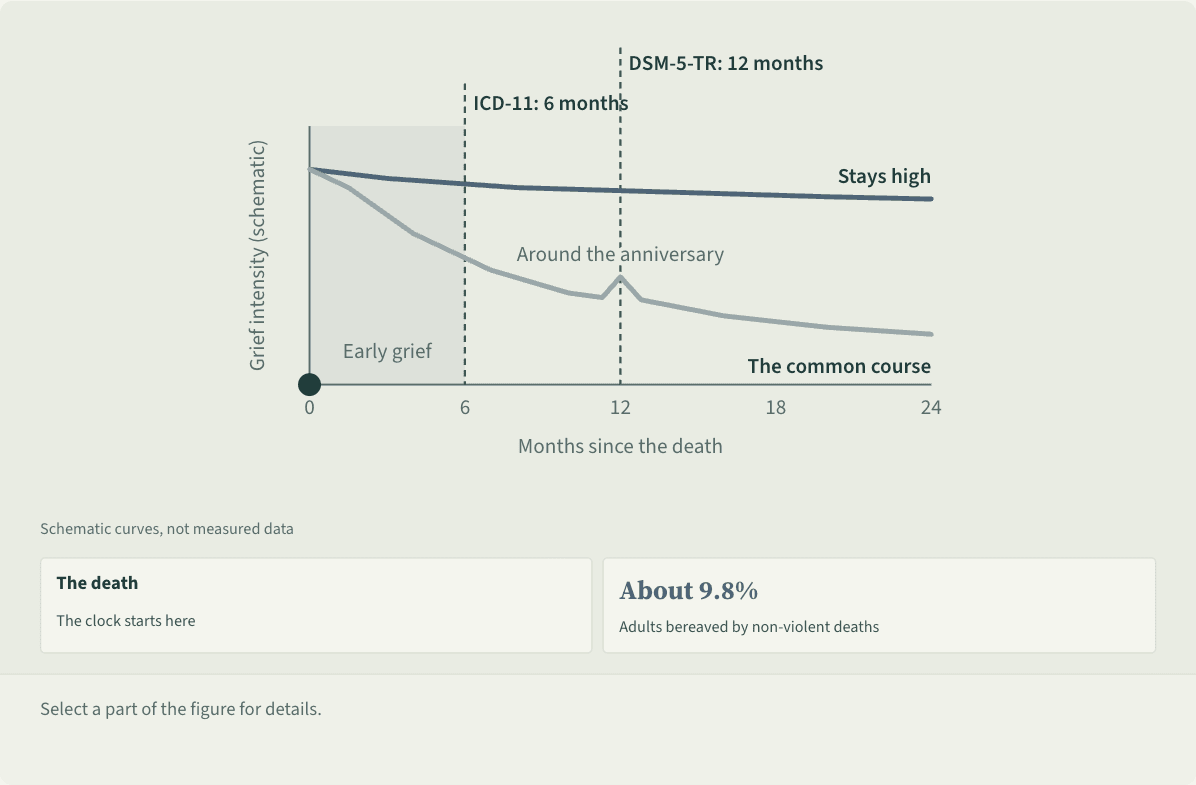
Schematic curves, not measured data
Schematic. The horizontal axis shows months since the death, marked 0, 6, 12, 18 and 24; the vertical axis is grief intensity, without a scale. A lightly shaded area from 0 to 6 months is labeled early bereavement. A vertical line at 6 months marks the ICD-11 threshold and one at 12 months the DSM-5-TR threshold for adults (6 months for children and adolescents). One curve, labeled the common course, starts high, declines gradually and settles low between about 6 and 12 months, with a small bump at 12 months labeled around the anniversary. The other, labeled stays high, starts equally high and remains high past 12 months. A note says the curves are schematic, not measured data. A box at right reads about 9.8%: a meta-analysis of 14 studies of adults bereaved by non-violent deaths, 95% confidence interval 6.8% to 14.0%.
 Save as image (PNG)
This figure image is licensed CC BY 4.0: reuse it with credit and a link back to this page. How to reuse
Key points
- DSM-5-TR: at least 12 months after the death (6 for children and adolescents), intense yearning or preoccupation nearly every day for the past month, plus 3 of 8 further symptoms.[1]
- ICD-11 (code 6B42) sets a minimum of 6 months, and grief that stays within the normal span for the person’s culture and religion is not diagnosed.[2]
- It overlaps with depression and PTSD, but its symptoms center on the person who died, with yearning and sadness, rather than fear, in the foreground.[2][3]
- A meta-analysis put it at about 9.8% of adults bereaved by non-violent deaths.[4] Risk is higher after sudden or unnatural deaths and with little social support.[1]
An example
Ms. Wang’s father died in hospital during the pandemic, and she could not say goodbye. For months she sleeps badly and cries whenever she thinks of him. This is common early in bereavement and is not prolonged grief disorder: DSM-5-TR requires at least 12 months and grief that clearly disrupts daily life.[1]
Misreadings and limits
Normal grief is not a disorder. For most people intense grief eases with time, and strong emotions early in bereavement should not be treated as pathology.[3] Telling prolonged grief disorder from normal grief takes a professional weighing duration, severity and cultural norms, not a symptom checklist.[1][2]
If you need help now
If you’re struggling to cope or having thoughts of harming yourself:
- US and Canada: call or text 988 (24/7)
- UK and Ireland: Samaritans, 116 123 (free, 24/7)
- Australia: Lifeline, 13 11 14 (24/7)
- Elsewhere: findahelpline.com
If you’re in immediate danger, call your local emergency number.
Psyfield is not a crisis service. Numbers checked October 2026.
Sources
- 1 American Psychiatric Association (2025). Prolonged grief disorder. Psychiatry.org (physician review August 2025). View source
- 2 World Health Organization (2025). 6B42 Prolonged grief disorder. ICD-11 for mortality and morbidity statistics (2025-01 release). View source
- 3 Szuhany, K. L., Malgaroli, M., Miron, C. D., & Simon, N. M. (2021). Prolonged grief disorder: Course, diagnosis, assessment, and treatment. Focus, 19(2), 161–172. doi:10.1176/appi.focus.20200052
- 4 Lundorff, M., Holmgren, H., Zachariae, R., Farver-Vestergaard, I., & O’Connor, M. (2017). Prevalence of prolonged grief disorder in adult bereavement: A systematic review and meta-analysis. Journal of Affective Disorders, 212, 138–149. doi:10.1016/j.jad.2017.01.030
Last checked against sources: October 27, 2026