Worden’s tasks of mourning
哀悼的四项任务
What are Worden’s four tasks of mourning?
Worden’s tasks of mourning are a framework for grief counseling: accept the reality of the loss, process the pain of grief, adjust to a world without the deceased, and find a way to remember the deceased while embarking on the rest of life.[1] It is widely used to guide counseling.[2]
Worden’s four tasks (fifth edition)
Tasks can be revisited or worked on together
Stages and tasks
Three wordings of task IV
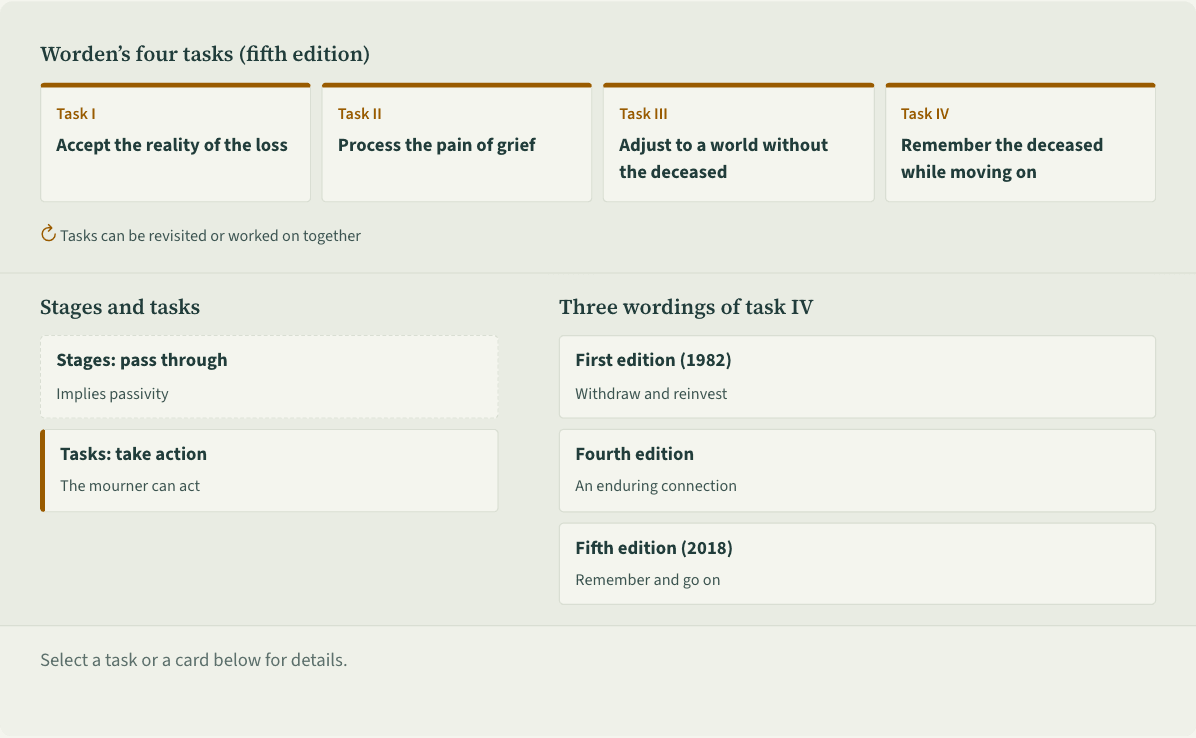
Schematic. Four cards across the top read: task I, accept the reality of the loss; task II, process the pain of grief; task III, adjust to a world without the deceased (external, internal and spiritual); task IV, find a way to remember the deceased while embarking on the rest of life. A dashed loop around the cards notes that tasks can be revisited or worked on together. At bottom left, two small cards contrast stages, which imply passing through, with tasks, which imply the mourner can act. At bottom right, a short timeline gives three wordings of task IV: first edition (1982), withdraw emotional energy from the deceased and reinvest it in another relationship; fourth edition, find an enduring connection with the deceased while embarking on a new life; fifth edition (2018), find a way to remember the deceased while embarking on the rest of life’s journey.
 Save as image (PNG)
This figure image is licensed CC BY 4.0: reuse it with credit and a link back to this page. How to reuse
Key points
- Worden argues that stages and phases imply passivity, something the mourner simply passes through, whereas tasks imply that the mourner needs to, and can, take action.[1]
- There is no fixed order, though some is implied: the emotional impact of a death is hard to face before accepting that it happened. Tasks can be revisited or worked on together.[1]
- Task IV has been rewritten. The first edition spoke of withdrawing emotional energy and reinvesting it; later editions stress staying connected while moving on.[1][2]
- A review ranks it with the dual process model among the most influential frameworks for guiding counseling; research finds no single set of stages or tasks that everyone follows.[2][3]
An example
Six months after her mother died, Lin cancels her mother’s phone line, lets herself cry when memories come, learns the household chores her mother used to handle, and cooks her mother’s favorite dish on her birthday. Some days she feels back at the start; for Worden, tasks are often revisited.[1]
Misreadings and limits
The tasks are not a checklist to tick off in order. Worden stresses that mourning is a fluid process shaped by many factors, and that no single end date can be set for it.[1] Most bereaved people adapt with their own resources and support from family and friends; only a minority need professional help.[3]
Sources
- 1 Worden, J. W. (2018). Grief counseling and grief therapy: A handbook for the mental health practitioner (5th ed.). Springer Publishing Company. View source
- 2 Hall, C. (2011). Beyond Kübler-Ross: Recent developments in our understanding of grief and bereavement. InPsych, 33(6). Australian Psychological Society. View source
- 3 Stroebe, M., Schut, H., & Boerner, K. (2017). Cautioning health-care professionals: Bereaved persons are misguided through the stages of grief. OMEGA – Journal of Death and Dying, 74(4), 455–473. doi:10.1177/0030222817691870
Last checked against sources: October 27, 2026