Empty chair technique
空椅子技术
What is the empty chair technique?
In the empty chair technique, a client imagines an important person, or a part of themselves, in an empty chair and speaks to them, then moves to that chair to answer in their role.[1] It comes from Gestalt therapy and has earlier roots in Moreno’s psychodrama.[1][2]
In a session
Origins
Research
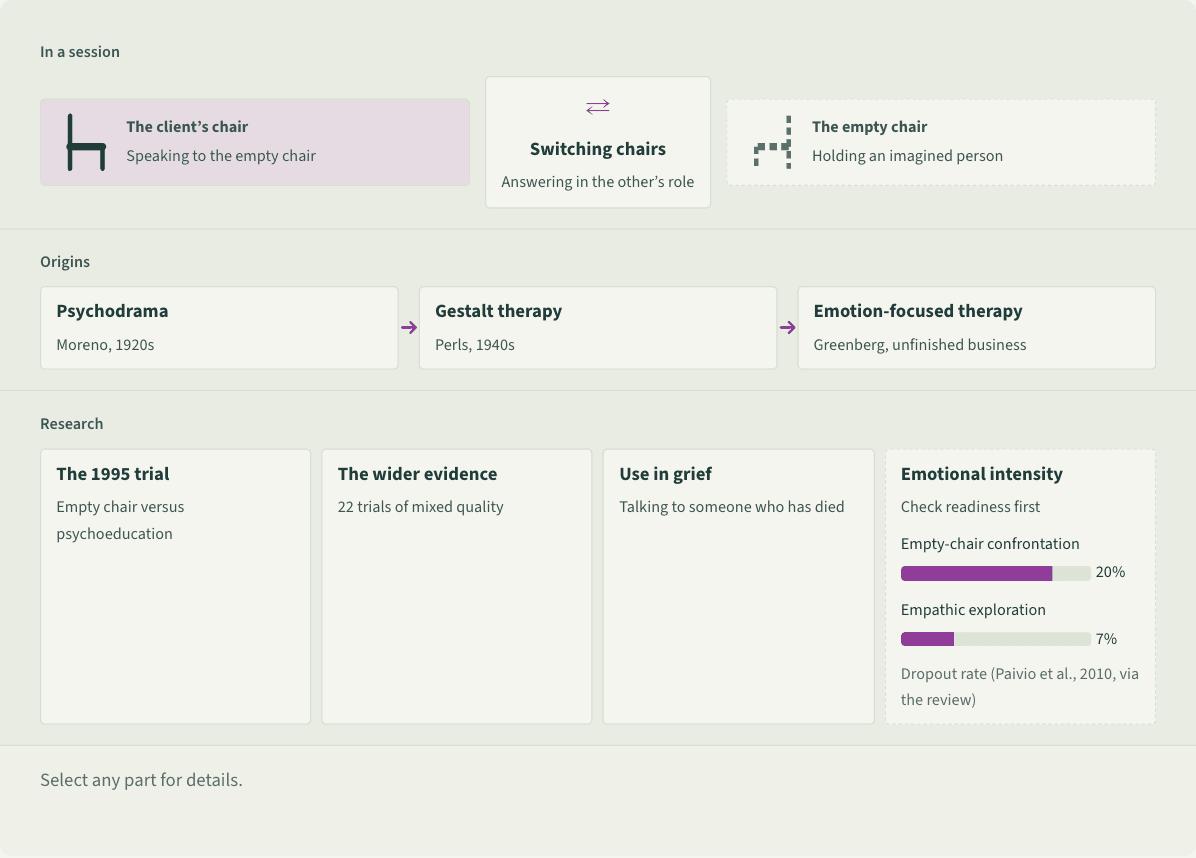
Schematic in three rows. In a session: the client’s chair on the left and an empty chair on the right, standing for an imagined significant other or a part of the self, with a two-way arrow between them labeled switching chairs. Origins: three cards joined by arrows, left to right, Moreno’s psychodrama (1920s), Perls’s Gestalt therapy (1940s) and Greenberg’s emotion-focused therapy. Research: four cards, the 1995 randomized trial, the systematic review, use in grief, and emotional intensity. The emotional intensity card has two bars: in childhood-trauma therapy, 20% dropped out of empty-chair confrontation and 7% of empathic exploration.
 Save as image (PNG)
This figure image is licensed CC BY 4.0: reuse it with credit and a link back to this page. How to reuse
Key points
- Emotion-focused therapy distinguishes two uses: dialogue with a part of the self, such as an inner critic, is two-chair work; with a significant other, it is empty-chair work for “unfinished business.”[2]
- Unfinished business is lasting hurt and resentment toward a significant other, such as a parent. Process studies link better outcomes to expressing primary emotions and unmet needs and seeing the other differently.[2]
- In a 1995 randomized trial on unfinished business (34 clients), the empty-chair group improved more than a psychoeducation group on every outcome, and gains held at one year.[3]
- A review of 22 randomized trials calls the results promising, but most embedded the technique in wider therapy and only 2 had low risk of bias.[2] Used once, it matches other interventions.[4]
An example
As a child, Jay was often scolded by his father in front of others, and the memory still angers and saddens him. His counselor asks him to picture his father in the empty chair and say what he never said; then Jay sits there and answers as his father. He falls silent, and they talk once he settles.
Misreadings and limits
The technique deliberately stirs strong feelings such as anger and sadness, and not everyone can tolerate it. In one childhood-trauma trial, 20% dropped out of the group confronting the abuser in an empty chair, against 7% in the other group, and the reviewers advise checking a client’s readiness first.[2] In the research it is done in therapy sessions, guided by a therapist.[1][2]
Sources
- 1 American Psychological Association (2018–2023). Empty-chair technique; Gestalt therapy; Psychodrama; Unfinished business; Emotion-focused therapy. APA Dictionary of Psychology (empty-chair technique and psychodrama updated November 15, 2023; other entries April 19, 2018). View source
- 2 Ottingerová, L., Halamová, J., & Szitás, D. (2026). Experiential therapies including Chairwork: A systematic review of randomized controlled trials. Frontiers in Psychology, 16, 1692630. doi:10.3389/fpsyg.2025.1692630
- 3 Paivio, S. C., & Greenberg, L. S. (1995). Resolving “unfinished business”: Efficacy of experiential therapy using empty-chair dialogue. Journal of Consulting and Clinical Psychology, 63(3), 419–425. doi:10.1037/0022-006X.63.3.419
- 4 Pascual-Leone, A., & Baher, T. (2023). Chairwork in individual psychotherapy: Meta-analyses of intervention effects. Psychotherapy, 60(3), 370–382. doi:10.1037/pst0000490
Last checked against sources: October 28, 2026