Autism spectrum disorder
孤独症谱系障碍
What is autism spectrum disorder?
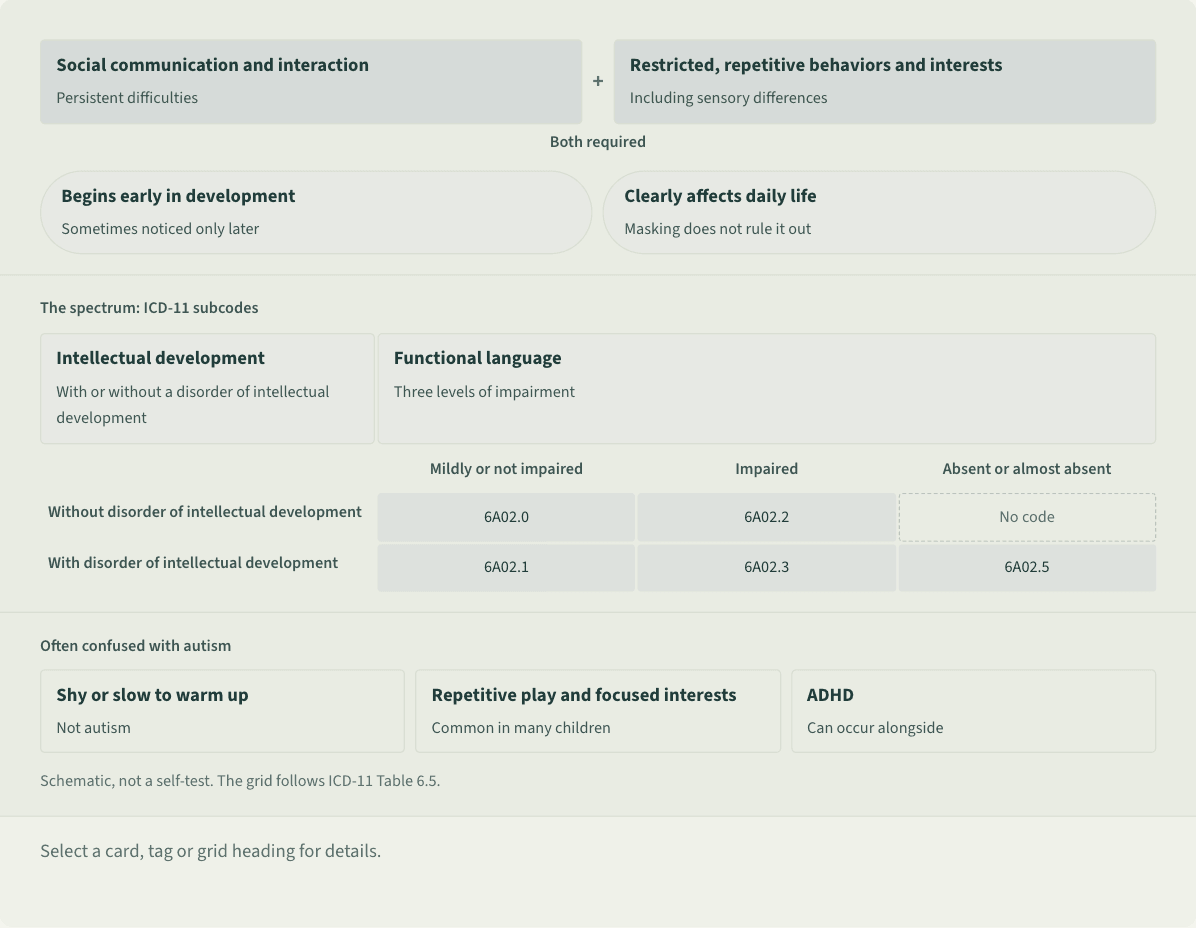
Autism spectrum disorder (autism) is a neurodevelopmental condition that begins early in development and has two core features: persistent difficulty starting and sustaining social communication and interaction, and restricted, repetitive, inflexible behavior, interests or activities, which can include over- or under-sensitivity to sound or light.[1][2]
Both required
The spectrum: ICD-11 subcodes
Often confused with autism
Schematic, not a self-test. The grid follows ICD-11 Table 6.5.
Schematic. At the top, two side-by-side cards joined by a plus sign and labeled as both required: “Social communication and interaction: persistent difficulties” and “Restricted, repetitive behaviors and interests: including sensory differences.” Below them, two tags: “Begins early in development” and “Clearly affects daily life.” In the middle, a grid of two rows and three columns: rows for without and with a disorder of intellectual development; columns for functional language mildly or not impaired, impaired, and completely or almost completely absent. The cells hold the codes 6A02.0, 6A02.2 and no code in the first row, and 6A02.1, 6A02.3 and 6A02.5 in the second. At the bottom, three cards: “Shy or slow to warm up” (not autism), “Repetitive play and focused interests” (common in many children) and “ADHD” (can occur alongside). A note says this is a schematic, not a self-test.
 Save as image (PNG)
This figure image is licensed CC BY 4.0: reuse it with credit and a link back to this page. How to reuse
Key points
- “Spectrum” means wide variation: intellectual ability ranges from profound impairment to superior.[3] ICD-11 subdivides by intellectual development and functional language; DSM-5 grades severity in the two core domains.[1][2]
- About 1 in 127 people worldwide were autistic in 2021 (WHO).[3] Among 6- to 12-year-olds in eight Chinese cities the estimate was 0.70%, three times higher in boys; 43% were newly diagnosed.[4]
- Autism often co-occurs with ADHD, anxiety, depression or epilepsy.[3] In the Chinese study, 43.1% of autistic children assessed for other conditions also had ADHD;[4] both can be diagnosed together.[1]
- Autism is lifelong.[1] Timely, evidence-based psychosocial interventions can improve autistic children’s communication and social interaction, and support should extend to education, employment and social care.[3]
An example
Ms. Wang’s son, two and a half, lines up his toy cars and cries when they take a new route home. An online quiz says “high risk,” and she is worried. Many children go through phases of repetitive play; autism comes into question only with lasting social communication difficulties.[1] A quiz cannot replace a developmental assessment, which she can seek.[2]
Misreadings and limits
This page is not for self-diagnosis, and online tests or questionnaires cannot diagnose autism: NICE calls for a multidisciplinary team using history, observation and examination.[2] Vaccines do not cause autism; the study claiming a link was fraudulent and retracted.[3] If a child loses language or social skills, seek prompt assessment; adults can be assessed too.[1][2]
If you need help now
If you’re struggling to cope or having thoughts of harming yourself:
- US and Canada: call or text 988 (24/7)
- UK and Ireland: Samaritans, 116 123 (free, 24/7)
- Australia: Lifeline, 13 11 14 (24/7)
- Elsewhere: findahelpline.com
If you’re in immediate danger, call your local emergency number.
Psyfield is not a crisis service. Numbers checked October 2026.
Sources
- 1 World Health Organization (2025). 6A02 Autism spectrum disorder. ICD-11 for mortality and morbidity statistics (2025-01 release). View source
- 2 National Institute for Health and Care Excellence (2011). Autism spectrum disorder in under 19s: Recognition, referral and diagnosis (CG128). NICE clinical guideline (last updated December 20, 2017). View source
- 3 World Health Organization (2025). Autism. WHO fact sheet (September 17, 2025). View source
- 4 Zhou, H., Xu, X., Yan, W., Zou, X., Wu, L., Luo, X., Li, T., Huang, Y., Guan, H., Chen, X., Mao, M., Xia, K., Zhang, L., Li, E., Ge, X., Zhang, L., Li, C., Zhang, X., Zhou, Y., … LATENT-NHC Study Team (2020). Prevalence of autism spectrum disorder in China: A nationwide multi-center population-based study among children aged 6 to 12 years. Neuroscience Bulletin, 36(9), 961–971. doi:10.1007/s12264-020-00530-6
Last checked against sources: October 28, 2026