Social anxiety disorder
社交焦虑障碍
What is social anxiety disorder?
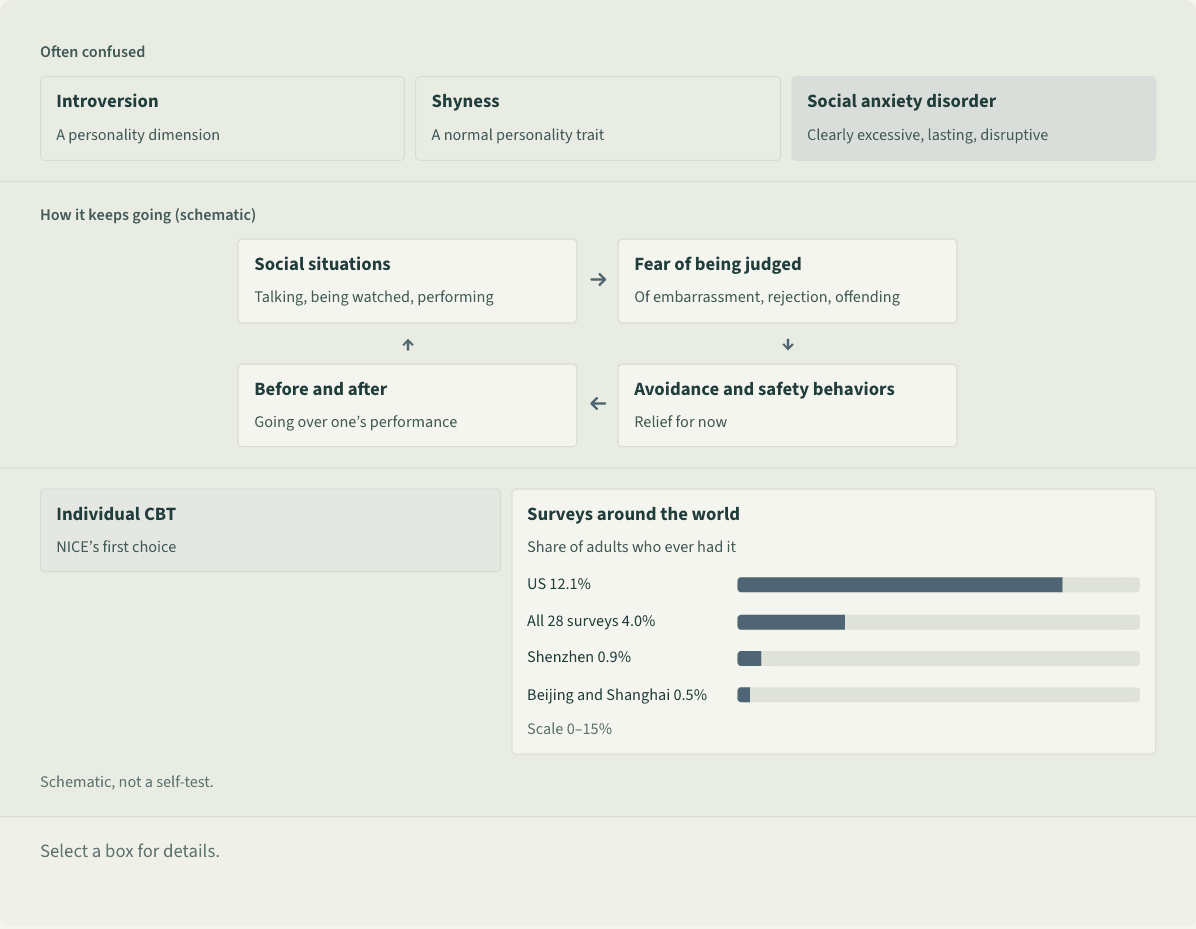
Social anxiety disorder is marked, excessive fear or anxiety in social situations, such as conversation, being watched or performing, about being judged negatively for one’s actions or visible nerves. The situations are avoided or endured with intense fear.[1] It lasts at least several months and brings clear distress or impairment.[1]
Often confused
How it keeps going (schematic)
Schematic, not a self-test.
 Save as image (PNG)
This figure image is licensed CC BY 4.0: reuse it with credit and a link back to this page. How to reuse
Key points
- Nerves about public speaking are common, and shyness is a normal personality trait.[1] In one study, over four in five shy people did not have social phobia, the disorder’s older name.[2][3]
- People often cope through subtle avoidance, such as saying little or avoiding eye contact, and by rehearsing beforehand and replaying afterward; NICE treatment targets these safety behaviors.[1][4]
- Across 28 surveys of 142,405 adults, lifetime prevalence was about 4.0%: 12.1% in the US, 0.9% in Shenzhen, 0.5% in Beijing and Shanghai. Half of cases began by age 14.[3]
- For adults, NICE recommends individual CBT designed for social anxiety, up to 14 sessions over about four months, rather than group CBT.[4]
An example
Three months into a new job, Lin eats lunch at her desk, afraid her hands will shake at a shared table. Before meetings she scripts a full page, speaks without looking up, then replays whether she said something wrong. Whether she needs help depends on whether this lasts for months and disrupts work and life.[1]
Misreadings and limits
Online, calling yourself socially anxious often just means introverted or shy, which is not the disorder: introversion is a personality dimension only moderately linked to social phobia.[2] This page is not for self-diagnosis. If the fear lasts months and keeps you from school, work or friends, a professional can assess it, and it is treatable.[1][4]
If you need help now
If you’re struggling to cope or having thoughts of harming yourself:
- US and Canada: call or text 988 (24/7)
- UK and Ireland: Samaritans, 116 123 (free, 24/7)
- Australia: Lifeline, 13 11 14 (24/7)
- Elsewhere: findahelpline.com
If you’re in immediate danger, call your local emergency number.
Psyfield is not a crisis service. Numbers checked October 2026.
Sources
- 1 World Health Organization (2025). 6B04 Social anxiety disorder. ICD-11 for mortality and morbidity statistics (2025-01 release). View source
- 2 Heiser, N. A., Turner, S. M., & Beidel, D. C. (2003). Shyness: Relationship to social phobia and other psychiatric disorders. Behaviour Research and Therapy, 41(2), 209–221. doi:10.1016/S0005-7967(02)00003-7
- 3 Stein, D. J., Lim, C. C. W., Roest, A. M., de Jonge, P., Aguilar-Gaxiola, S., Al-Hamzawi, A., Alonso, J., Benjet, C., Bromet, E. J., Bruffaerts, R., de Girolamo, G., Florescu, S., Gureje, O., Haro, J. M., Harris, M. G., He, Y., Hinkov, H., Horiguchi, I., Hu, C., … Scott, K. M. (2017). The cross-national epidemiology of social anxiety disorder: Data from the World Mental Health Survey Initiative. BMC Medicine, 15, 143. doi:10.1186/s12916-017-0889-2
- 4 National Institute for Health and Care Excellence (2013). Social anxiety disorder: Recognition, assessment and treatment (CG159). NICE clinical guideline (published May 22, 2013). View source
Last checked against sources: October 28, 2026