Obsessive-compulsive disorder
强迫症
What is obsessive-compulsive disorder (OCD)?
OCD is marked by persistent obsessions (intrusive, unwanted thoughts, images or urges), compulsions (repetitive acts or mental rituals a person feels driven to perform in response), or both.[1] It is diagnosed only when these take up much time, such as over an hour a day, or cause marked distress or impairment.[1][2]
Compulsions usually answer obsessions
The cycle and its treatment: see exposure and response prevention
At least one must apply
Insight (two ICD-11 levels)
Schematic, not a self-test.
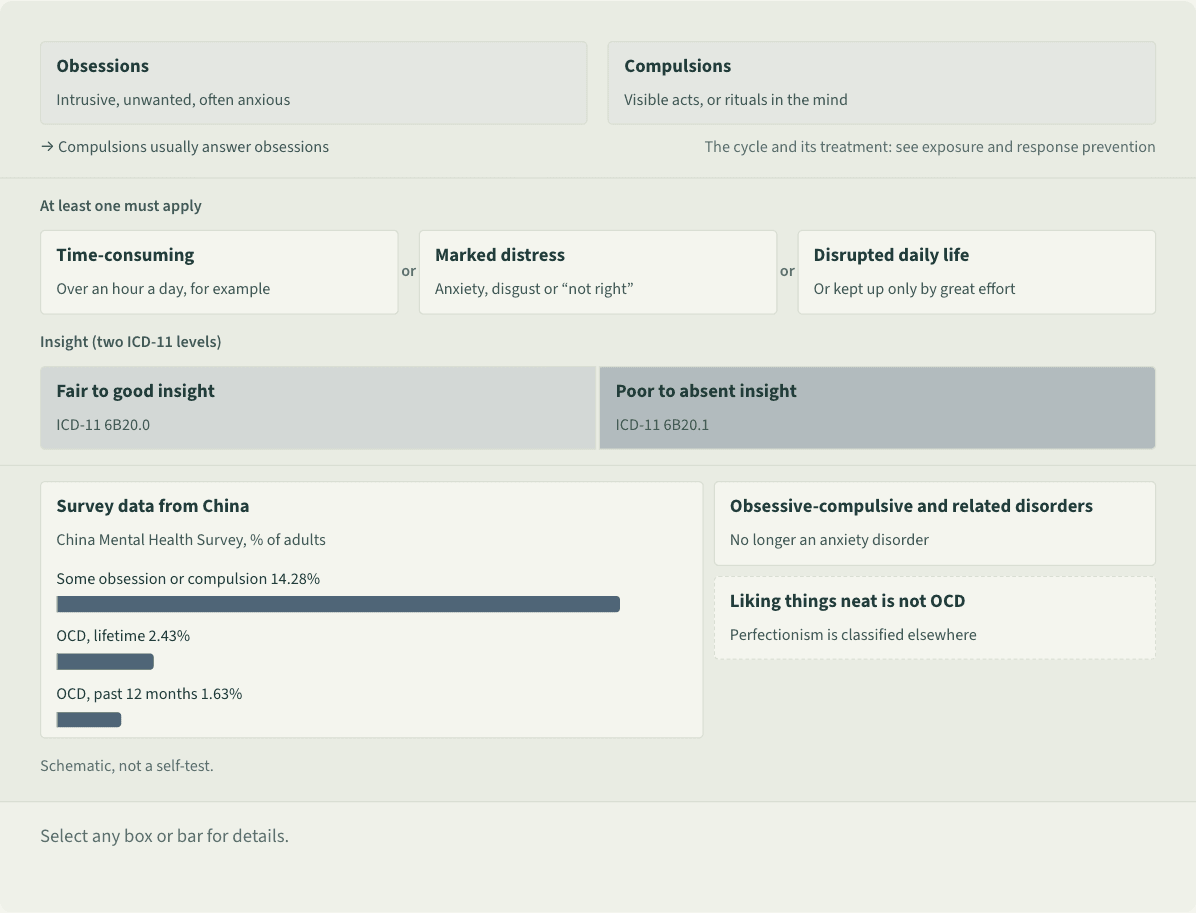
Schematic. At the top, two boxes side by side: obsessions (intrusive, unwanted thoughts, images or urges) and compulsions (repeated washing, checking or ordering, or mental rituals such as silent phrases and counting). An arrow between them notes that compulsions usually answer obsessions, and a note points to the exposure and response prevention page for the cycle and its treatment. In the middle, “At least one must apply” sits above three boxes: time-consuming (over an hour a day, for example), marked distress, and disrupted daily life. Next, a two-part bar shows the ICD-11 insight levels: fair to good, and poor to absent. Below, three bars on one scale show China Mental Health Survey data: some obsession or compulsion 14.28%, lifetime OCD 2.43%, OCD in the past 12 months 1.63%. At the bottom are two small boxes: the obsessive-compulsive and related disorders group, and why liking things neat is not OCD. A note says the figure is schematic and not a self-test.
 Save as image (PNG)
This figure image is licensed CC BY 4.0: reuse it with credit and a link back to this page. How to reuse
Key points
- Earlier DSM editions classed OCD as an anxiety disorder. DSM-5 and ICD-11 moved it into a new obsessive-compulsive and related disorders group, alongside body dysmorphic disorder and hoarding disorder.[2]
- Most people with OCD know their rituals are excessive, but insight varies. ICD-11 grades it fair-to-good or poor-to-absent; a few are sure harm will follow if they skip a ritual.[1][2]
- In the China Mental Health Survey, 2.43% of adults had had OCD in their lifetime, while 14.28% had had some obsession or compulsion. Only 6.74% of those with OCD received care.[3]
- NICE recommends CBT including exposure and response prevention for adults: up to 10 therapist hours when impairment is mild, more intensive CBT or medication when moderate, and both when severe.[4]
An example
Ms. Wang likes a spotless desk and jokes she is “a bit OCD,” but a mess doesn’t stop her working. Lin fears germs on her hands will make her family ill, washes several times after touching a door handle and loses over an hour a day, knowing it is excessive. What matters is time, distress and impact on daily life.[1]
Misreadings and limits
Saying “I’m so OCD” usually means liking things neat, which is not OCD: intrusive thoughts and double-checking are common, and they count as symptoms only when time-consuming or distressing.[1][2] This page cannot be used for self-diagnosis. If such thoughts or rituals cause distress or eat up time, a professional assessment can help; effective treatments exist.[2][4]
If you need help now
If you’re struggling to cope or having thoughts of harming yourself:
- US and Canada: call or text 988 (24/7)
- UK and Ireland: Samaritans, 116 123 (free, 24/7)
- Australia: Lifeline, 13 11 14 (24/7)
- Elsewhere: findahelpline.com
If you’re in immediate danger, call your local emergency number.
Psyfield is not a crisis service. Numbers checked October 2026.
Sources
- 1 World Health Organization (2025). 6B20 Obsessive-compulsive disorder. ICD-11 for mortality and morbidity statistics (2025-01 release). View source
- 2 Stein, D. J., Costa, D. L. C., Lochner, C., Miguel, E. C., Reddy, Y. C. J., Shavitt, R. G., van den Heuvel, O. A., & Simpson, H. B. (2019). Obsessive–compulsive disorder. Nature Reviews Disease Primers, 5, 52. doi:10.1038/s41572-019-0102-3
- 3 Liu, B., Cheng, J., Liu, Z., Huang, Y., Rehman, S., Shen, M., Liu, J., Ju, Y., Yu, Y., Xu, X., Wang, Z., Xu, Y., Li, T., Xu, G., Xu, X., Wang, L., Yan, Y., Xiao, S., Zhang, T., … Zhang, Y. (2025). Prevalence of obsessive-compulsive disorder and related healthcare utilisation in China: A cross-sectional epidemiological survey. General Psychiatry, 38(6), e102013. doi:10.1136/gpsych-2024-102013
- 4 National Institute for Health and Care Excellence (2005). Obsessive-compulsive disorder and body dysmorphic disorder: Treatment (CG31). NICE clinical guideline (presentational update May 2024). View source
Last checked against sources: October 28, 2026