Schizophrenia
精神分裂症
What is schizophrenia?
Schizophrenia is a mental disorder that disrupts thinking, perception, emotion, motivation and behavior. Persistent delusions, hallucinations and disorganized thinking are typical, along with negative symptoms such as flat emotion and lost drive, making it hard to tell what is real. ICD-11 requires symptoms for at least a month.[1][2]
Four groups of symptoms
Common misconceptions
Treatment and course
Schematic, not a self-test.
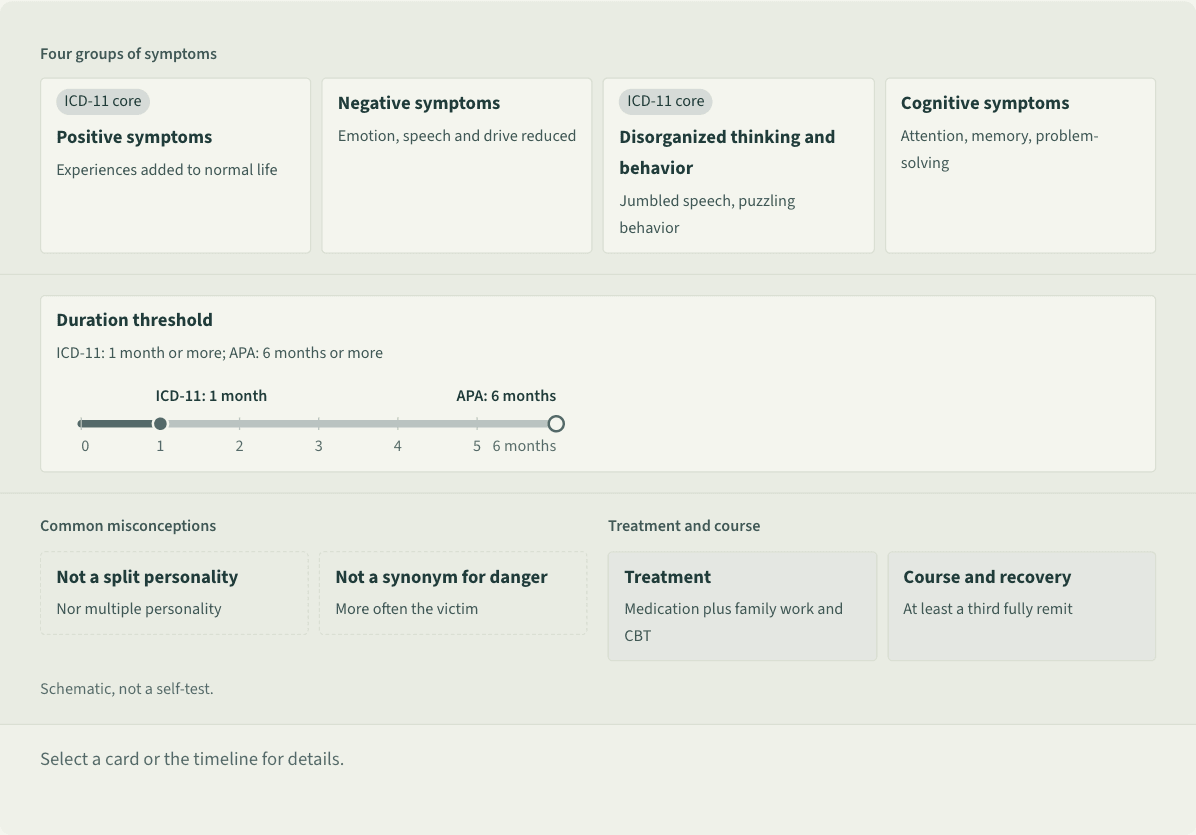
Schematic. Four cards at the top show symptom groups: positive symptoms (hallucinations, delusions, experiences of being controlled), marked as ICD-11 core symptoms; negative symptoms (flat emotion, little speech, lost drive, social withdrawal, little pleasure); disorganized thinking and behavior (jumbled speech, odd behavior or freezing), also marked as core; and cognitive symptoms (weaker attention, memory and problem-solving). In the middle, a timeline from 0 to 6 months marks ICD-11 at 1 month and the American Psychiatric Association at 6 months. At the bottom left, two dashed cards labeled “common misconceptions”: not a split or multiple personality; not a synonym for danger, as people with schizophrenia are more often victims. At the bottom right, two cards: treatment (for a first episode, antipsychotic medication with family intervention and CBT, early intervention services, supported employment) and course and recovery (varies between people; at least a third fully remit; life expectancy about nine years shorter). A note says the figure is a schematic, not a self-test.
 Save as image (PNG)
This figure image is licensed CC BY 4.0: reuse it with credit and a link back to this page. How to reuse
Key points
- Symptoms fall into three groups: positive (hallucinations, delusions), negative (flat emotion, little speech, lost drive) and disorganized thinking and speech. Attention and memory often suffer too.[2]
- ICD-11 requires two or more characteristic symptoms for most of a month or longer;[1] the American Psychiatric Association’s criteria require symptoms lasting at least six months.[2]
- WHO estimates that about 1 in 300 people worldwide have schizophrenia, 0.49% of adults over 20. On average they die nine years early, often of cardiovascular, metabolic or infectious disease.[3]
- For a first episode NICE recommends oral antipsychotic medication with family intervention and individual CBT, through early intervention services, plus supported employment for those who want work.[4]
An example
In his third year at university, Jay stops going to class and stays in his room. He says he hears people outside the door talking about him and wraps his phone in foil. His roommate Lin doesn’t laugh it off but helps him contact campus counseling, which refers him to a psychiatrist for assessment.
Misreadings and limits
It is not a “split” or multiple personality, and most people with schizophrenia are no more dangerous than anyone else; they are more likely to be victims of crime.[2] Symptom lists cannot diagnose it: medication, drugs and brain conditions can cause similar symptoms, so a full psychiatric assessment is needed.[1][2] Persistent voices, fears of persecution or marked changes in behavior call for prompt help.[4]
If you need help now
If you’re struggling to cope or having thoughts of harming yourself:
- US and Canada: call or text 988 (24/7)
- UK and Ireland: Samaritans, 116 123 (free, 24/7)
- Australia: Lifeline, 13 11 14 (24/7)
- Elsewhere: findahelpline.com
If you’re in immediate danger, call your local emergency number.
Psyfield is not a crisis service. Numbers checked October 2026.
Sources
- 1 World Health Organization (2025). 6A20 Schizophrenia. ICD-11 for mortality and morbidity statistics (2025-01 release). View source
- 2 American Psychiatric Association (2024). What is schizophrenia?. Psychiatry.org (physician review March 2024). View source
- 3 World Health Organization (2026). Schizophrenia. WHO fact sheet (September 11, 2026). View source
- 4 National Institute for Health and Care Excellence (2014). Psychosis and schizophrenia in adults: Prevention and management (CG178). NICE clinical guideline (published February 12, 2014; last updated September 4, 2026). View source
Last checked against sources: October 28, 2026