Specific phobia
特定恐惧症
How is a specific phobia different from ordinary fear?
Specific phobia is marked fear, out of proportion to the real danger, that reliably arises when facing or expecting a particular object or situation, such as certain animals, heights, enclosed spaces or blood; the person avoids it or endures it with intense fear.[1] Unlike ordinary fear, it lasts months and causes clear distress or impairment.[1]
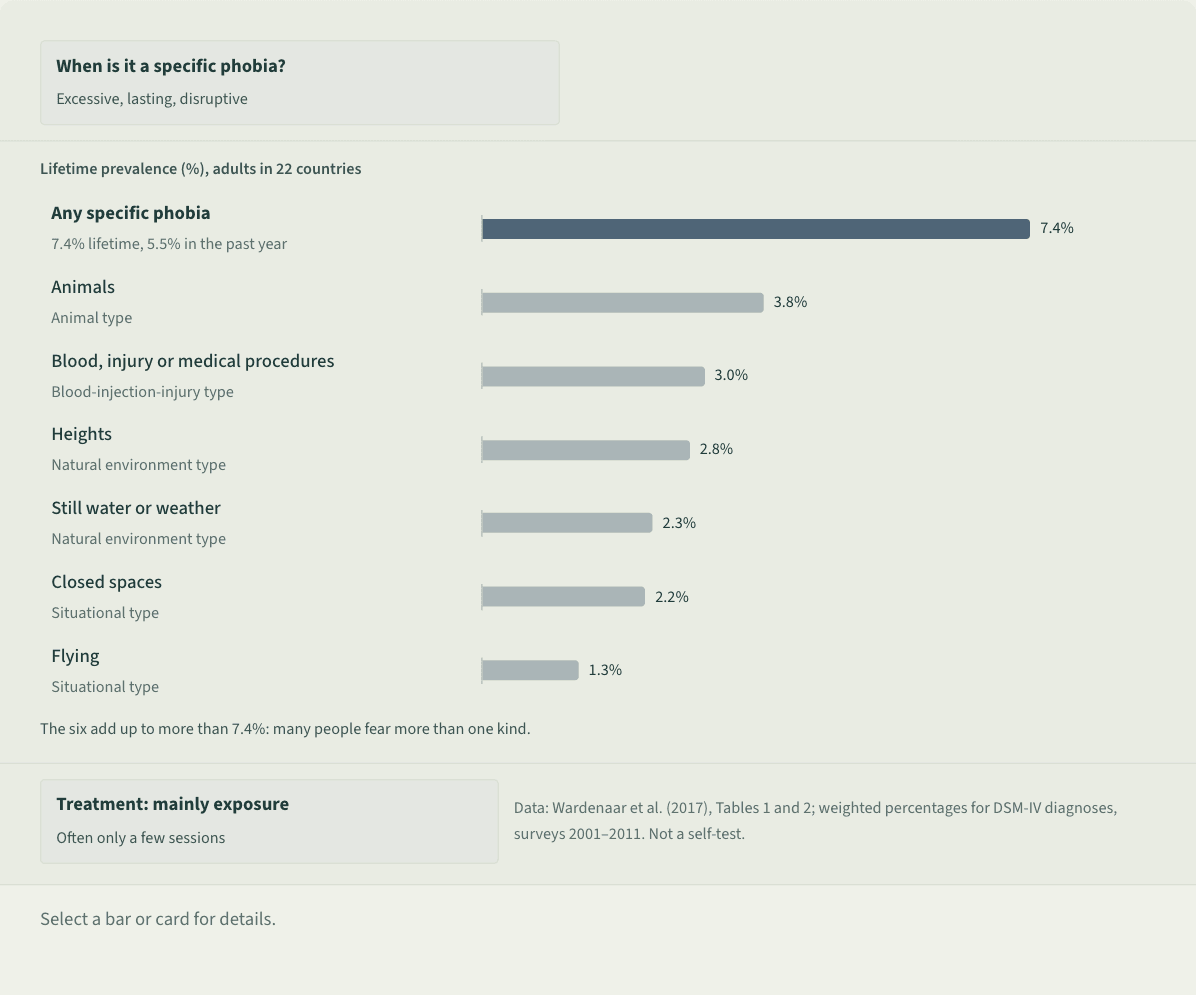
Lifetime prevalence (%), adults in 22 countries
The six add up to more than 7.4%: many people fear more than one kind.
Data: Wardenaar et al. (2017), Tables 1 and 2; weighted percentages for DSM-IV diagnoses, surveys 2001–2011. Not a self-test.
Data chart. At the top, a card: “When is it a specific phobia?” In the middle, seven horizontal bars on one scale: any specific phobia 7.4%, then six kinds of fear in descending order: animals 3.8%, blood, injury or medical procedures 3.0%, heights 2.8%, still water or weather 2.3%, closed spaces 2.2% and flying 1.3%, each tagged with its DSM type. A note under the bars says the six add up to more than the total because many people fear more than one kind. At the bottom, a card: “Treatment: mainly exposure.” A note gives the data source and says this is not a self-test.
 Save as image (PNG)
This figure image is licensed CC BY 4.0: reuse it with credit and a link back to this page. How to reuse
Key points
- DSM lists five types: animal, natural environment (heights, storms), blood-injection-injury, situational (flying, enclosed spaces) and other (such as vomiting).[2] Most people fear more than one thing.[1]
- Most triggers cause a racing heart and alarm, but people who fear blood, injections or injury may have a vasovagal response and faint.[1] Fear of animals or blood often brings disgust.[1]
- In surveys across 22 countries, lifetime prevalence was 7.4% and 12-month prevalence 5.5%, about twice as high in women; lifetime rates were 2.6% in Beijing and Shanghai and 4.0% in Shenzhen.[2]
- Germany’s S3 guideline recommends exposure-based CBT; most trials used a single 1- to 3-hour session, and it worked. Drug studies are scarce, so behavioral treatment comes first.[3]
An example
Lin has dodged the blood test at her work checkup for three years: last time she saw the needle, her vision went dark and she nearly fainted. She knows a blood draw is safe, yet the thought makes her heart race. Whether this amounts to a phobia depends on whether it persists and disrupts life; a professional can assess it.[1]
Misreadings and limits
This page is not for self-diagnosis. Wariness of real danger is normal, and young children’s fear of dogs or the dark is often part of development; only fear that is clearly excessive, lasts months and disrupts life may be a phobia.[1] If fear keeps you from medical care, travel or work, a doctor or therapist can help; exposure often works within a few sessions.[3]
If you need help now
If you’re struggling to cope or having thoughts of harming yourself:
- US and Canada: call or text 988 (24/7)
- UK and Ireland: Samaritans, 116 123 (free, 24/7)
- Australia: Lifeline, 13 11 14 (24/7)
- Elsewhere: findahelpline.com
If you’re in immediate danger, call your local emergency number.
Psyfield is not a crisis service. Numbers checked October 2026.
Sources
- 1 World Health Organization (2025). 6B03 Specific phobia. ICD-11 for mortality and morbidity statistics (2025-01 release). View source
- 2 Wardenaar, K. J., Lim, C. C. W., Al-Hamzawi, A. O., Alonso, J., Andrade, L. H., Benjet, C., Bunting, B., de Girolamo, G., Demyttenaere, K., Florescu, S. E., Gureje, O., Hisateru, T., Hu, C., Huang, Y., Karam, E., Kiejna, A., Lepine, J. P., Navarro-Mateu, F., Oakley Browne, M., … de Jonge, P. (2017). The cross-national epidemiology of specific phobia in the World Mental Health Surveys. Psychological Medicine, 47(10), 1744–1760. doi:10.1017/S0033291717000174
- 3 Bandelow, B., Werner, A. M., Kopp, I., Rudolf, S., Wiltink, J., & Beutel, M. E. (2022). The German Guidelines for the treatment of anxiety disorders: First revision. European Archives of Psychiatry and Clinical Neuroscience, 272(4), 571–582. doi:10.1007/s00406-021-01324-1
Last checked against sources: October 28, 2026