Gottman’s seven principles
幸福婚姻七法则
What are Gottman’s seven principles for making marriage work?
Gottman’s seven principles, from John Gottman and Nan Silver’s 1999 book, are: enhance love maps, nurture fondness and admiration, turn toward each other, let your partner influence you, solve solvable problems, overcome gridlock and create shared meaning.[3] The book pictures a strong relationship as a Sound Relationship House.[1]
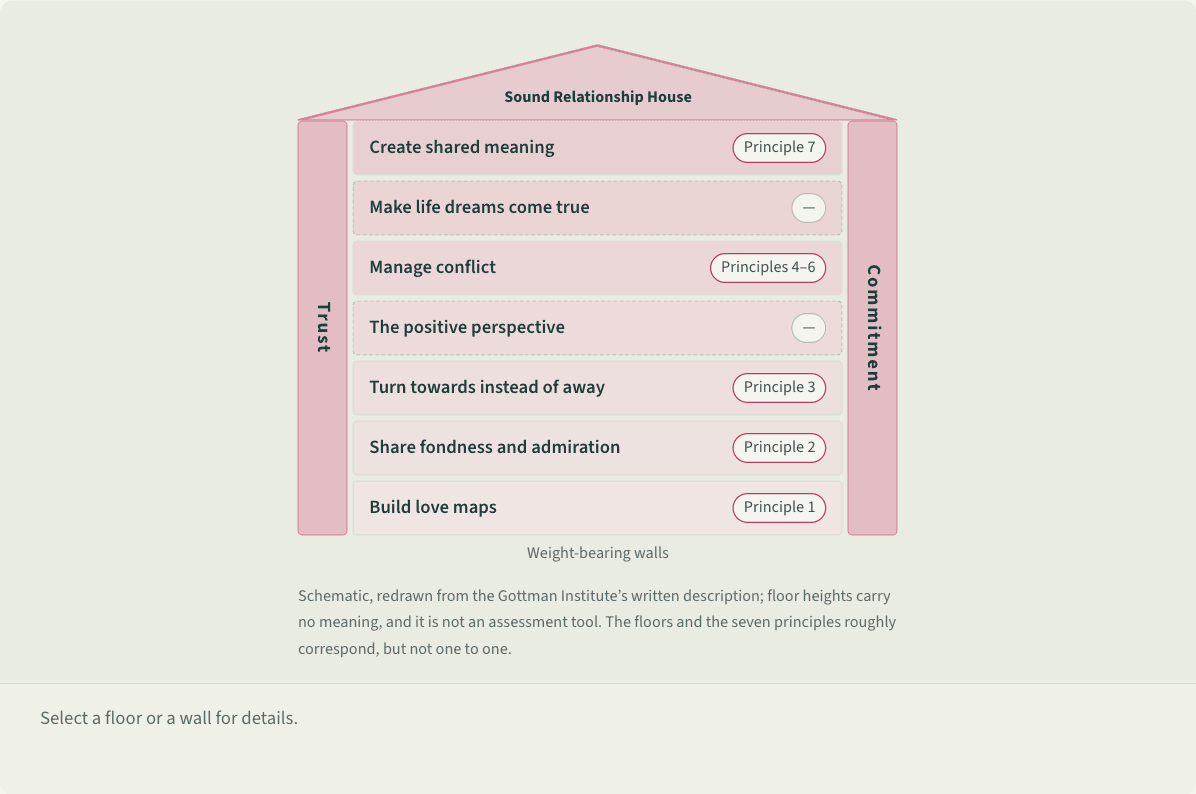
Weight-bearing walls
Schematic, redrawn from the Gottman Institute’s written description; floor heights carry no meaning, and it is not an assessment tool. The floors and the seven principles roughly correspond, but not one to one.
Schematic of a house with a triangular roof labeled Sound Relationship House. Inside are seven floors, from the bottom: 1, build love maps (tagged principle 1); 2, share fondness and admiration (principle 2); 3, turn towards instead of away (principle 3); 4, the positive perspective (no matching principle); 5, manage conflict (principles 4–6); 6, make life dreams come true (no matching principle); 7, create shared meaning (principle 7). An upright wall runs up each side, trust on the left and commitment on the right, labeled weight-bearing walls. A note says the figure is a schematic and the floors do not match the principles one to one.
 Save as image (PNG)
This figure image is licensed CC BY 4.0: reuse it with credit and a link back to this page. How to reuse
Key points
- The first three concern everyday closeness: know your partner’s history, tastes and worries, voice appreciation, and turn toward their bids for attention.[1]
- Principles 5 and 6 separate solvable problems from perpetual ones that recur in some form; Gottman puts the latter at about 69% of conflicts, to be managed rather than solved.[1]
- In a study of 130 newlywed couples, gentler start-ups by wives and husbands accepting influence went with stable marriages; active-listening paraphrases were rare in conflict and predicted nothing.[2]
- In a Norwegian evaluation, 490 people took a 12-hour seven-principles course; six months later relationship adjustment had improved modestly while controls had not, but groups were not randomized.[3]
An example
After dinner, Ms. Wang calls from the balcony, “Come and look at the sunset.” Jay is answering a message; he puts down his phone and joins her, and they watch for a while, then talk about the weekend. In Gottman’s terms, a bid has been met; small moments like this add up to principle 3, turning toward.
Misreadings and limits
A common misreading treats the principles as proven prescriptions. They rest largely on correlational studies of couples; critics argue that the samples were not randomly selected and that telling wives to start gently and husbands to accept influence goes beyond what the data can show.[4]
Sources
- 1 The Gottman Institute; Scott, J. (2015; 2020). The Gottman Method; What is the Sound Relationship House?. The Gottman Institute (both updated 2026). View source
- 2 Gottman, J. M., Coan, J., Carrere, S., & Swanson, C. (1998). Predicting marital happiness and stability from newlywed interactions. Journal of Marriage and the Family, 60(1), 5–22. doi:10.2307/353438
- 3 Zahl-Olsen, R., Thuen, F., & Bertelsen, T. B. (2024). The effectiveness of the in-person and online Gottman Seven Principles Couple Enhancement Program: A propensity score matching design. Journal of Marital and Family Therapy, 50(4), 882–898. doi:10.1111/jmft.12726
- 4 Stanley, S. M., Bradbury, T. N., & Markman, H. J. (2000). Structural flaws in the bridge from basic research on marriage to interventions for couples. Journal of Marriage and the Family, 62(1), 256–264. doi:10.1111/j.1741-3737.2000.00256.x
Last checked against sources: October 28, 2026