Emotionally focused therapy
情绪取向治疗
What is emotionally focused therapy?
Emotionally focused therapy (EFT) is a couple therapy developed by Susan Johnson and Leslie Greenberg in the 1980s and grounded in attachment theory.[1][2] It sees distress as thwarted emotional needs, above all for attachment; the therapist helps partners see their negative interaction cycle, reach the emotions beneath it, and build new, responsive interactions.[1][2]
When therapy begins
Nine steps in three stretches
Research and naming
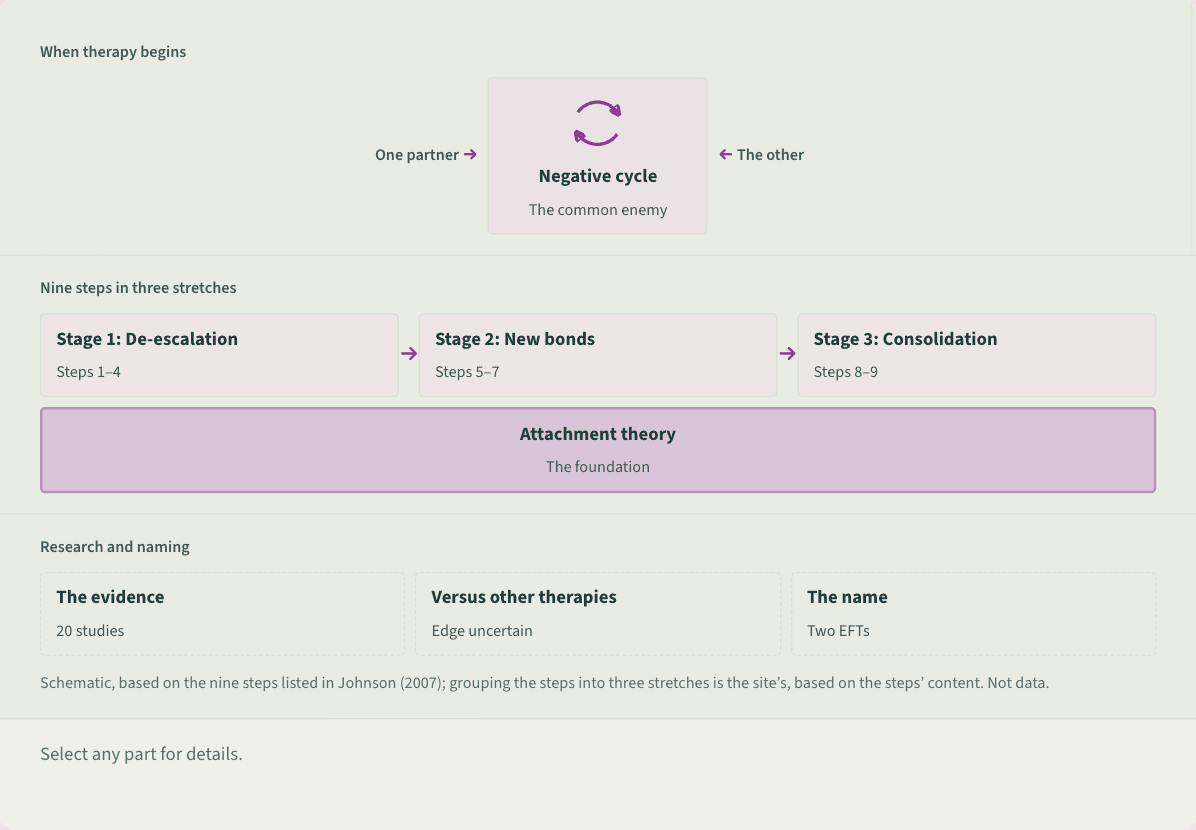
Schematic, based on the nine steps listed in Johnson (2007); grouping the steps into three stretches is the site’s, based on the steps’ content. Not data.
Schematic in three rows. The top row, labeled when therapy begins, shows one partner on the left and the other on the right, with a ring of arrows between them: a button labeled negative cycle, subtitled the common enemy. The middle row, labeled nine steps in three stretches, has three cards joined by arrows from left to right: stage 1, de-escalation (steps 1–4); stage 2, new bonds (steps 5–7); stage 3, consolidation (steps 8–9). A base button spanning all three is labeled attachment theory, subtitled the foundation. The bottom row, labeled research and naming, has three dashed cards: the evidence (20 studies), versus other therapies (edge uncertain), and the name (two EFTs). A note says the figure is a schematic and that grouping the steps into stages is the site’s, based on the steps’ content.
 Save as image (PNG)
This figure image is licensed CC BY 4.0: reuse it with credit and a link back to this page. How to reuse
Key points
- EFT is also the abbreviation for Greenberg’s emotion-focused therapy, an individual therapy;[2] the couple model he later built with Goldman is conceptually distinct.[3]
- Johnson holds that distressed partners do not lack communication skills; flooded with anxiety, they get trapped in self-reinforcing negative cycles such as demand–withdraw.[1]
- Anger can be framed as attachment protest and withdrawal as a defense against shame; the therapist helps partners reach primary emotions and casts the cycle as their common enemy.[1]
- Change is mapped in nine steps: de-escalating the negative cycle, then new bonding interactions in which partners voice deeper emotions in session, then consolidation.[1]
An example
Whenever Lin brings up weekend plans, Jay goes quiet and leaves, and she presses harder. The counselor sketches the back-and-forth as a loop: “It’s this loop that has you both stuck.” Lin then says she fears she doesn’t matter to him; Jay says he fears he can never do enough. This time, they don’t fight.
Misreadings and limits
EFT has a body of supporting evidence but has not been shown to beat other couple therapies. In one meta-analysis its edge over alternatives was small and uncertain (d = 0.44, 95% CI 0.03–0.85);[3] a meta-analysis of randomized trials found no significant difference from behavioral couple therapy and warned of possible publication bias.[4]
Sources
- 1 Johnson, S. M. (2007). The contribution of emotionally focused couples therapy. Journal of Contemporary Psychotherapy, 37(1), 47–52. doi:10.1007/s10879-006-9034-9
- 2 American Psychological Association (2018). Emotion-focused couples therapy; Emotion-focused therapy (EFT). APA dictionary of psychology (entries updated April 19, 2018). View source
- 3 Spengler, P. M., Lee, N. A., Wiebe, S. A., & Wittenborn, A. K. (2024). A comprehensive meta-analysis on the efficacy of emotionally focused couple therapy. Couple and Family Psychology: Research and Practice, 13(2), 81–99. doi:10.1037/cfp0000233
- 4 Rathgeber, M., Bürkner, P.-C., Schiller, E.-M., & Holling, H. (2019). The efficacy of emotionally focused couples therapy and behavioral couples therapy: A meta-analysis. Journal of Marital and Family Therapy, 45(3), 447–463. doi:10.1111/jmft.12336
Last checked against sources: October 28, 2026