Triangular theory of love
爱情三角理论
What is the triangular theory of love?
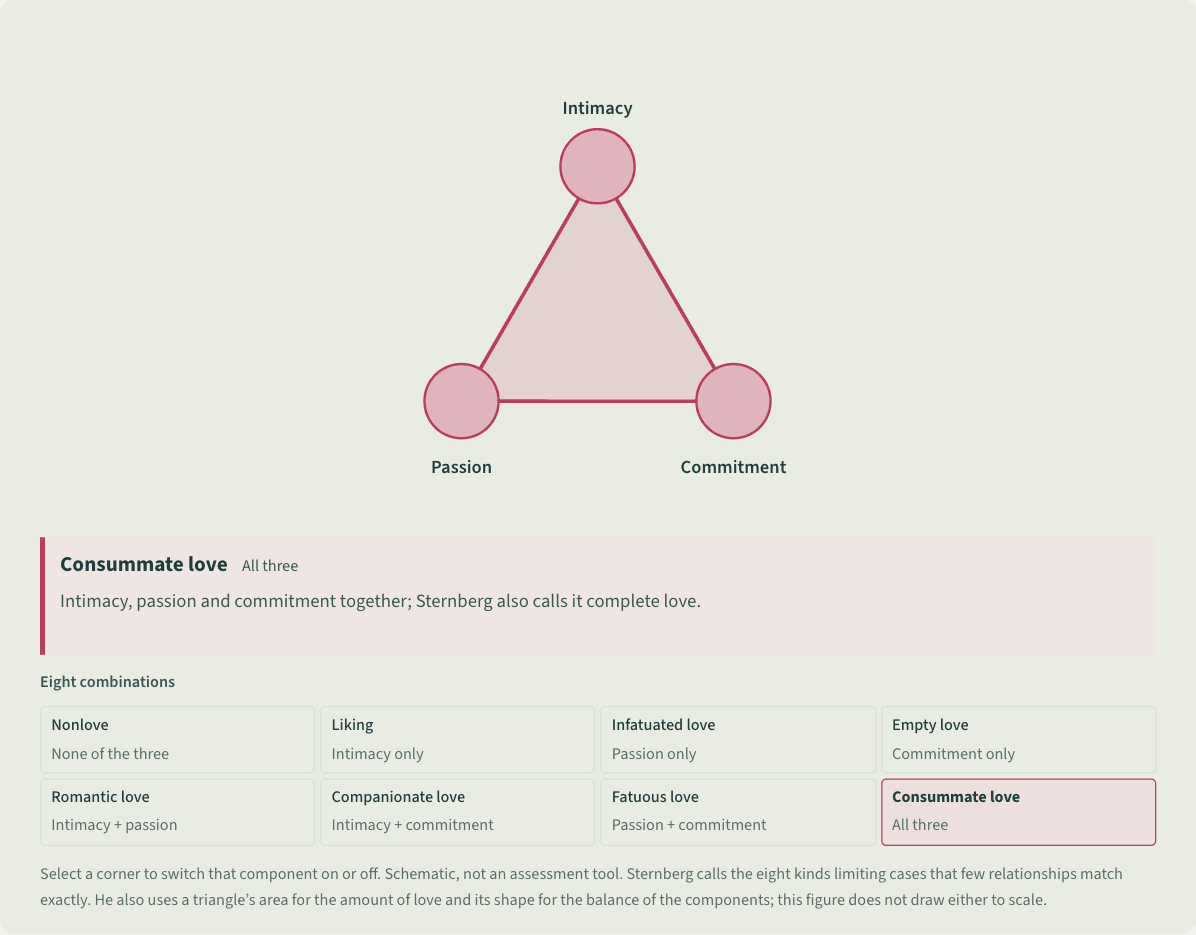
The triangular theory of love, proposed by Robert Sternberg in 1986, holds that love has three components, intimacy, passion and decision/commitment, pictured as the corners of a triangle.[1][2] Their strength sets how much love there is; their balance sets what kind it is.[1][2]
Schematic. The triangle has intimacy at the top corner, passion at lower left and commitment at lower right; each corner is a button that can be switched on or off. When two corners are on, a side joins them; when all three are on, the triangle is filled. The name of the current combination sits in the middle. Below, the eight combinations are listed, with the current one highlighted: nonlove (none), liking (intimacy only), infatuated love (passion only), empty love (commitment only), romantic love (intimacy and passion), companionate love (intimacy and commitment), fatuous love (passion and commitment) and consummate love (all three).
 Save as image (PNG)
This figure image is licensed CC BY 4.0: reuse it with credit and a link back to this page. How to reuse
Key points
- Intimacy is the warm sense of closeness and connection; passion, the drives toward romance, attraction and sex; commitment, the decision to love someone and, longer term, to keep that love.[2]
- The components combine into eight kinds of love, from nonlove (none) to consummate love (all three). Sternberg stresses these are limiting cases that few relationships match exactly.[2]
- It is usually measured with Sternberg’s Triangular Love Scale, 15 items per component rated 1–9. Of 232 studies reviewed, 64% used modified versions, mostly shortened.[4]
- Among 7,332 partnered adults in 25 countries, the three-factor structure held across countries. Longer relationships showed less passion and more commitment, but the gaps were small and cross-sectional.[3]
An example
Lin and Jay have been married ten years. They still talk about everything and both mean to stay together, though the racing heart of their early dating is rare now. In the theory’s terms this is close to companionate love, intimacy plus commitment; Sternberg notes that real relationships seldom fit one type exactly.
Misreadings and limits
The three components are less distinct than the theory implies. In the 25-country data they correlated at 0.75–0.81, which the researchers read as support for doubts about telling them apart;[4] earlier studies also found many scale items loading on more than one factor.[3]
Sources
- 1 Sternberg, R. J. (1986). A triangular theory of love. Psychological Review, 93(2), 119–135. doi:10.1037/0033-295X.93.2.119
- 2 Sternberg, R. J. (n.d.). Duplex theory of love: Triangular theory of love and theory of love as a story. Robert J. Sternberg’s website. View source
- 3 Sorokowski, P., Sorokowska, A., Karwowski, M., Groyecka, A., Aavik, T., et al. (2021). Universality of the triangular theory of love: Adaptation and psychometric properties of the Triangular Love Scale in 25 countries. The Journal of Sex Research, 58(1), 106–115. doi:10.1080/00224499.2020.1787318
- 4 Kowal, M., Sorokowski, P., Dinić, B. M., Pisanski, K., Gjoneska, B., et al. (2024). Validation of the short version (TLS-15) of the Triangular Love Scale (TLS-45) across 37 languages. Archives of Sexual Behavior, 53(2), 839–857. doi:10.1007/s10508-023-02702-7
Last checked against sources: October 28, 2026