Four Horsemen (Gottman)
末日四骑士
What are Gottman’s Four Horsemen?
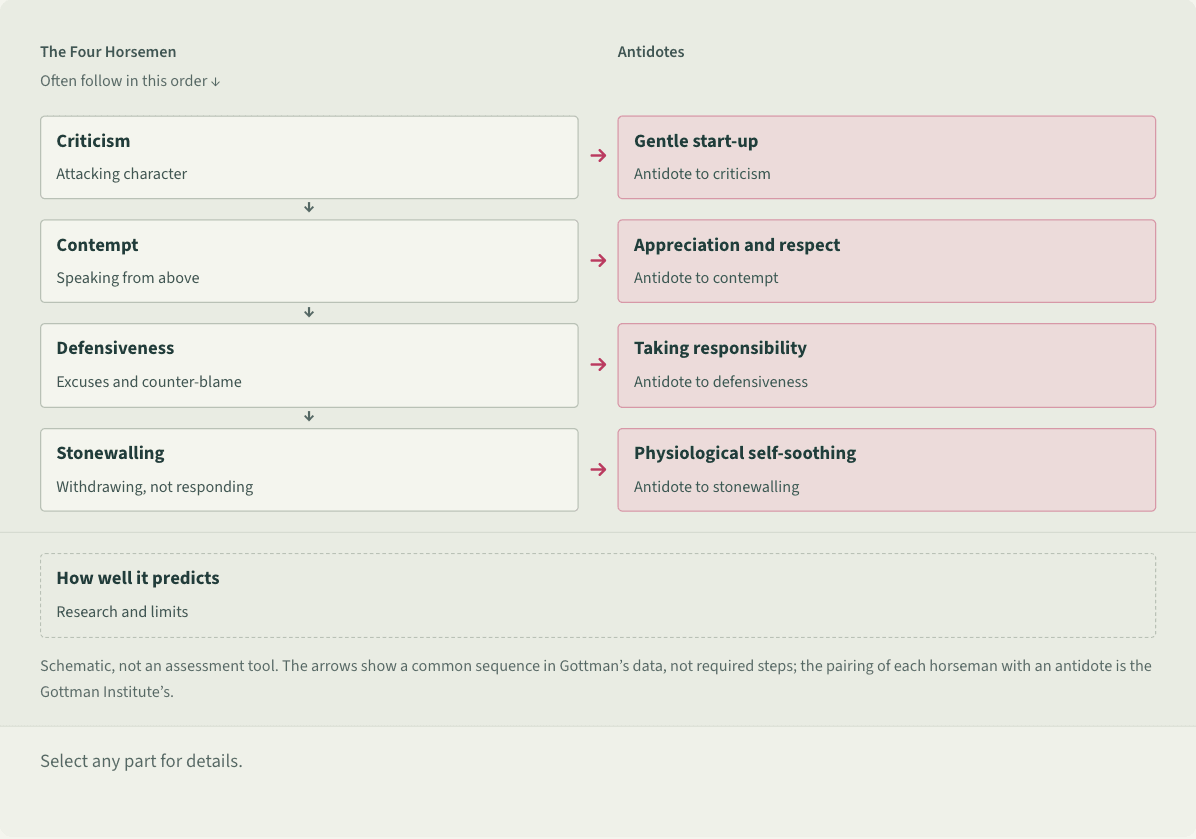
The Four Horsemen is John Gottman’s name for four destructive ways partners handle conflict: criticism (attacking character, not behavior), contempt (mockery from a position of superiority), defensiveness (excuses and counter-blame) and stonewalling (the listener withdrawing).[1][2] In his research, anger did not predict divorce, but these did.[1]
The Four Horsemen Often follow in this order ↓
Antidotes
→ → → →Schematic, not an assessment tool. The arrows show a common sequence in Gottman’s data, not required steps; the pairing of each horseman with an antidote is the Gottman Institute’s.
Schematic with two columns of four rows and a card below. The left column, labeled the Four Horsemen, lists from top to bottom criticism (attacking character), contempt (from above), defensiveness (excuses and counter-blame) and stonewalling (withdrawing, not responding), joined by downward arrows marked often follow in this order. The right column, labeled antidotes, matches them row by row: gentle start-up (say what you feel and need), appreciation and respect (thanks and affection, often), take responsibility (even for a part) and physiological self-soothing (pause for at least 20 minutes). An arrow points from each horseman to its antidote. A dashed card below, how well it predicts, is subtitled research and limits. A note says the figure is a schematic and the arrows show a common sequence, not required steps.
 Save as image (PNG)
This figure image is licensed CC BY 4.0: reuse it with credit and a link back to this page. How to reuse
Key points
- Gottman’s data suggest the four tend to build on one another: criticism draws contempt, then defensiveness, and finally stonewalling.[1]
- The Gottman Institute pairs each with an antidote: a gentle start-up that names feelings and needs, appreciation and respect, taking some responsibility, and a break of 20 minutes or more when flooded.[2]
- In a 14-year study of 79 couples, the Four Horsemen predicted earlier divorces, a lack of positive emotion predicted later ones, and the demand–withdraw pattern predicted both.[3]
- The idea concerns communication in conflict. An article from the institute says that when one partner uses violence to control or intimidate, couple therapy is inappropriate and specialist help is needed.[2]
An example
Lin works late and forgets to call. Jay greets her with, “You only ever think of yourself.” She snaps, “Because you nag all day?” He scoffs; she turns to her phone and stops answering. Next day he starts differently: “I was worried last night. Could you text if you’re late?” “You’re right, I forgot,” she says.
Misreadings and limits
The popular claim that Gottman predicts divorce with over 90% accuracy refers to models fitted to known outcomes in samples of a few dozen couples, such as the 93% in the 14-year study.[3] These were not cross-validated; when researchers tested the same approach on new data, accuracy fell sharply.[4]
Sources
- 1 Gottman, J. M. (1993). A theory of marital dissolution and stability. Journal of Family Psychology, 7(1), 57–75. doi:10.1037/0893-3200.7.1.57
- 2 The Gottman Institute; Brittle, Z. (2013; 2014). The Four Horsemen: The antidotes; V is for violence. The Gottman Institute blog (both updated 2026). View source
- 3 Gottman, J. M., & Levenson, R. W. (2000). The timing of divorce: Predicting when a couple will divorce over a 14-year period. Journal of Marriage and the Family, 62(3), 737–745. doi:10.1111/j.1741-3737.2000.00737.x
- 4 Heyman, R. E., & Slep, A. M. S. (2001). The hazards of predicting divorce without crossvalidation. Journal of Marriage and Family, 63(2), 473–479. doi:10.1111/j.1741-3737.2001.00473.x
Last checked against sources: October 28, 2026