Mentalization
心智化
What is mentalization?
Mentalization is the process of making sense of one’s own and others’ behavior in terms of mental states such as thoughts, feelings, wishes and intentions, either automatically or deliberately.[1] Also called reflective functioning, it is thought to develop within early attachment relationships.[2]
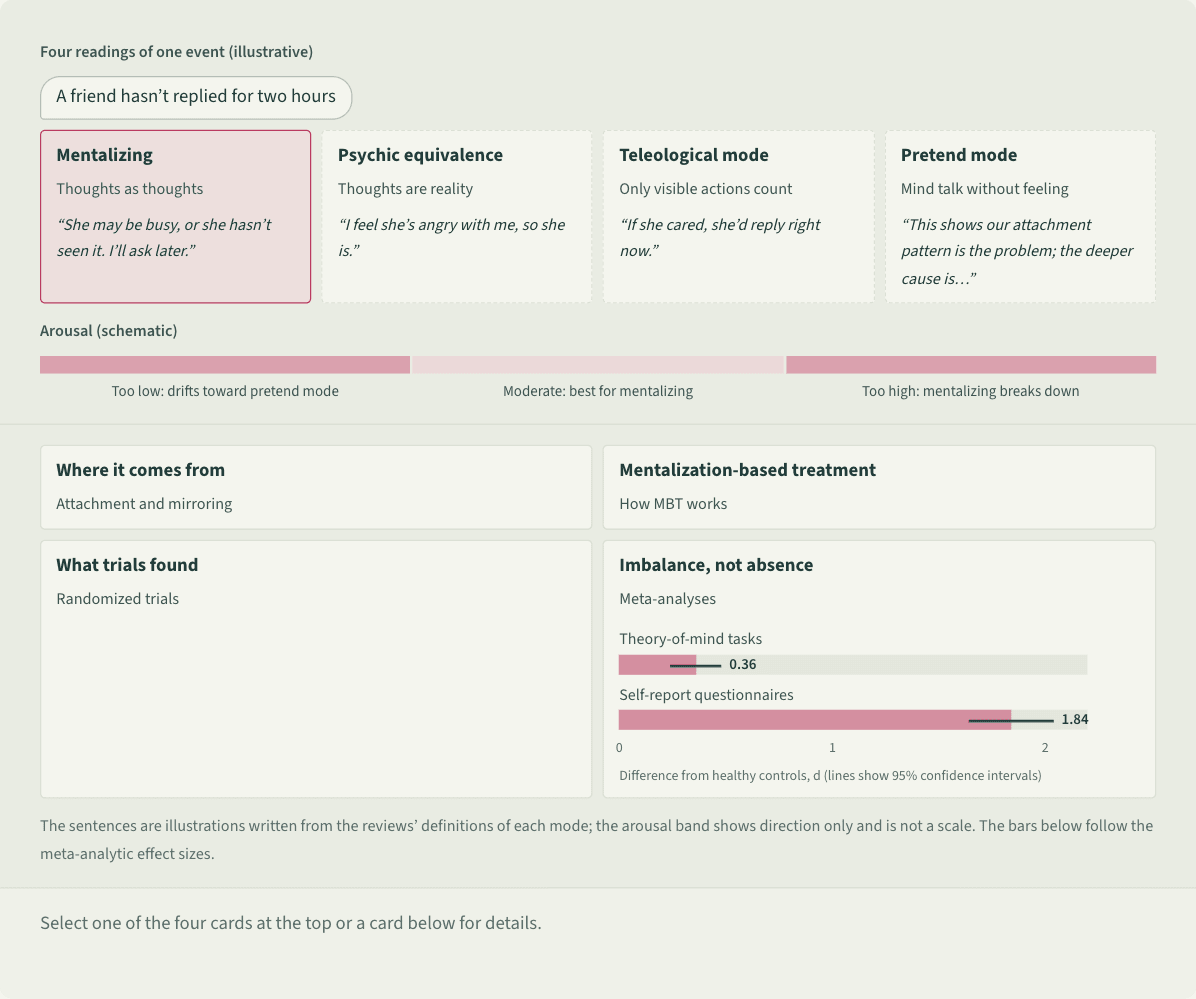
Four readings of one event (illustrative)
Arousal (schematic)
The sentences are illustrations written from the reviews’ definitions of each mode; the arousal band shows direction only and is not a scale. The bars below follow the meta-analytic effect sizes.
A line at the top sets the scene: a friend has not replied to a message for two hours. Below are four cards, each with an illustrative inner sentence. Mentalizing: she may be busy or may not have seen it; I’ll ask later. Psychic equivalence: I feel she’s angry with me, so she is. Teleological mode: if she cared, she would reply right now. Pretend mode: this shows our attachment pattern is the problem, and the deeper cause is…, fluent but cut off from what is felt. In the middle a horizontal band shows arousal, from too low through moderate to too high: too low tends toward pretend mode, moderate suits mentalizing best, and too high makes mentalizing break down. Four cards at the bottom: origins, how mentalization-based treatment works, results of randomized trials, and meta-analyses comparing people with borderline personality disorder with healthy controls, showing a difference of d = 0.36 on theory-of-mind tasks and 1.84 on self-report questionnaires, with two bars drawn to scale.
 Save as image (PNG)
This figure image is licensed CC BY 4.0: reuse it with credit and a link back to this page. How to reuse
Key points
- Fonagy and Bateman hold that the capacity grows when caregivers accurately understand and mirror a child’s feelings, and that early trauma and neglect can undermine it.[1]
- When mentalizing fails, people fall back on three modes: treating thoughts as facts (psychic equivalence), counting only visible actions (teleological mode), or talking about minds without feeling (pretend mode).[3][4]
- Mentalization-based treatment (MBT) was designed for borderline personality disorder and combines individual and group therapy. The therapist keeps a curious “not-knowing” stance, asking what happened rather than why.[3]
- MBT has five randomized trials, with symptom gains not significantly different from DBT or transference-focused psychotherapy.[4] Its developers ran the first two.[3]
An example
Lin’s message to a friend has gone unanswered for two hours. Her first thought is “She must be angry with me.” Then she reminds herself this is a guess: her friend may be in a meeting or may not have seen it. She puts the phone down and plans to ask this evening rather than decide what her friend thinks.
Misreadings and limits
Borderline personality disorder is often described as an inability to mentalize.[2] Newer research suggests an imbalance instead: mentalizing tends to fail under high arousal, and some people over-read others’ minds, though that is not specific to the disorder.[4] Evidence that MBT works by improving mentalizing is still scarce.[3]
Sources
- 1 Bateman, A., & Fonagy, P. (2010). Mentalization based treatment for borderline personality disorder. World Psychiatry, 9(1), 11–15. doi:10.1002/j.2051-5545.2010.tb00255.x
- 2 American Psychological Association (2018). Mentalization. APA Dictionary of Psychology (entry updated April 19, 2018). View source
- 3 Bateman, A., & Fonagy, P. (2013). Mentalization-based treatment. Psychoanalytic Inquiry, 33(6), 595–613. doi:10.1080/07351690.2013.835170
- 4 Leichsenring, F., Fonagy, P., Heim, N., Kernberg, O. F., Leweke, F., Luyten, P., Salzer, S., Spitzer, C., & Steinert, C. (2024). Borderline personality disorder: A comprehensive review of diagnosis and clinical presentation, etiology, treatment, and current controversies. World Psychiatry, 23(1), 4–25. doi:10.1002/wps.21156
Last checked against sources: October 28, 2026