Implicit bias
内隐偏见
What is implicit bias?
Implicit bias is an attitude toward a social group that a person is not consciously aware of. It is thought to arise from learned associations between qualities and social categories, and may shape perception and behavior unnoticed.[1] The Implicit Association Test (IAT), introduced in 1998, was designed to measure such attitudes.[2]
More
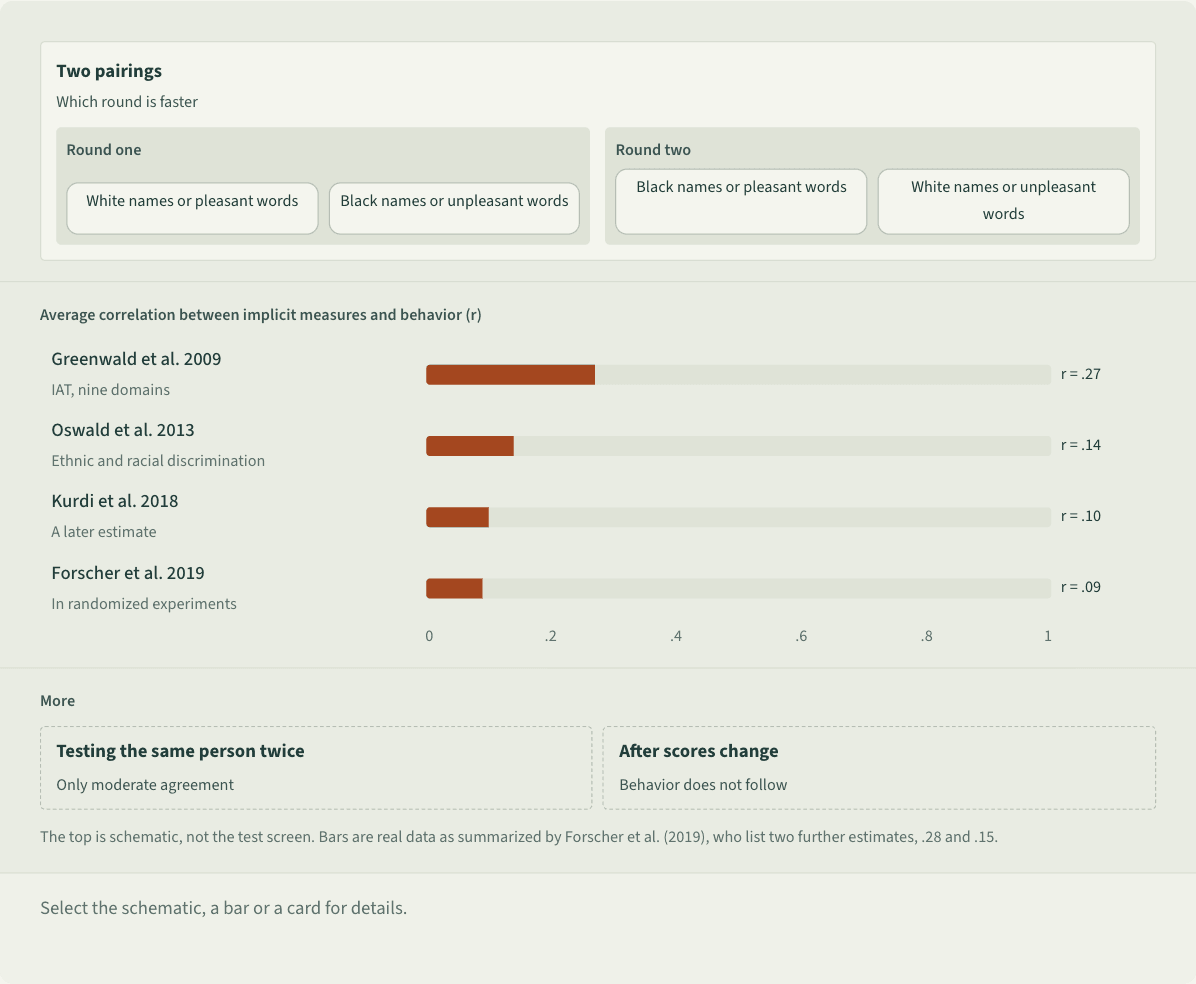
The top is schematic, not the test screen. Bars are real data as summarized by Forscher et al. (2019), who list two further estimates, .28 and .15.
Top, a schematic: two side-by-side panels stand for the IAT’s two rounds, each with a left and a right key. In round one the left key is “White names or pleasant words” and the right key “Black names or unpleasant words”; in round two the left key is “Black names or pleasant words” and the right key “White names or unpleasant words.” Below, four bars drawn to scale from 0 to 1, titled “Average correlation between implicit measures and behavior”: Greenwald et al. 2009, .27; Oswald et al. 2013, .14; Kurdi et al. 2018, .10; Forscher et al. 2019, .09. Under them, two cards: testing the same person twice (only moderate agreement) and after scores change (behavior does not follow). A note says the values follow Forscher et al.’s 2019 summary, which lists two further estimates, .28 and .15.
 Save as image (PNG)
This figure image is licensed CC BY 4.0: reuse it with credit and a link back to this page. How to reuse
Key points
- The IAT times how fast people sort names and words. In the original paper, 19 of 26 White students reported no preference or a pro-Black one; 25 scored as favoring White people.[2]
- Whether it predicts racial discrimination is disputed. Two meta-analyses found average correlations of about .24 and .15; the second team called IATs poor predictors, the first blamed different inclusion rules.[3]
- Scores from two sittings typically correlate only .5 to .6. The test’s developers concede that judging whether one person will discriminate with it would misclassify many; it suits large samples better.[3]
- A meta-analysis of 492 studies with about 87,000 participants found that implicit measures can be shifted, but mostly by small amounts, and the shifts did not bring matching changes in behavior.[4]
An example
Jay takes an online IAT on age, and the result says he automatically prefers young people. He is surprised; he has never thought of himself as biased against older people. When he retakes it a week later, the preference comes out much weaker.
Misreadings and limits
A common misreading treats a single IAT score as a verdict on whether someone is racist. Scores shift from one sitting to the next, and the test’s developers advise against judging individuals with it.[3] Unconscious bias training that aims to lower test scores cannot be expected to change behavior even if the scores fall.[4]
Sources
- 1 American Psychological Association (2023). Inclusive language guide (2nd ed.). American Psychological Association. View source
- 2 Greenwald, A. G., McGhee, D. E., & Schwartz, J. L. K. (1998). Measuring individual differences in implicit cognition: The implicit association test. Journal of Personality and Social Psychology, 74(6), 1464–1480. doi:10.1037/0022-3514.74.6.1464
- 3 Greenwald, A. G., Banaji, M. R., & Nosek, B. A. (2015). Statistically small effects of the Implicit Association Test can have societally large effects. Journal of Personality and Social Psychology, 108(4), 553–561. doi:10.1037/pspa0000016
- 4 Forscher, P. S., Lai, C. K., Axt, J. R., Ebersole, C. R., Herman, M., Devine, P. G., & Nosek, B. A. (2019). A meta-analysis of procedures to change implicit measures. Journal of Personality and Social Psychology, 117(3), 522–559. doi:10.1037/pspa0000160
Last checked against sources: October 28, 2026