Anhedonia
快感缺失
What is anhedonia?
Anhedonia is the inability to experience pleasure from normally pleasurable activities.[1] Diagnostic criteria describe it as markedly diminished interest or pleasure, one of the two core symptoms of a depressive episode; it also occurs in Schizophrenia and other conditions.[1][2]
Three stages of a reward
Snack study: lower in depression
Animal studies: less effort when dopamine is blocked
Snack study: no different from controls
In the clinic
Schematic, not a self-test.
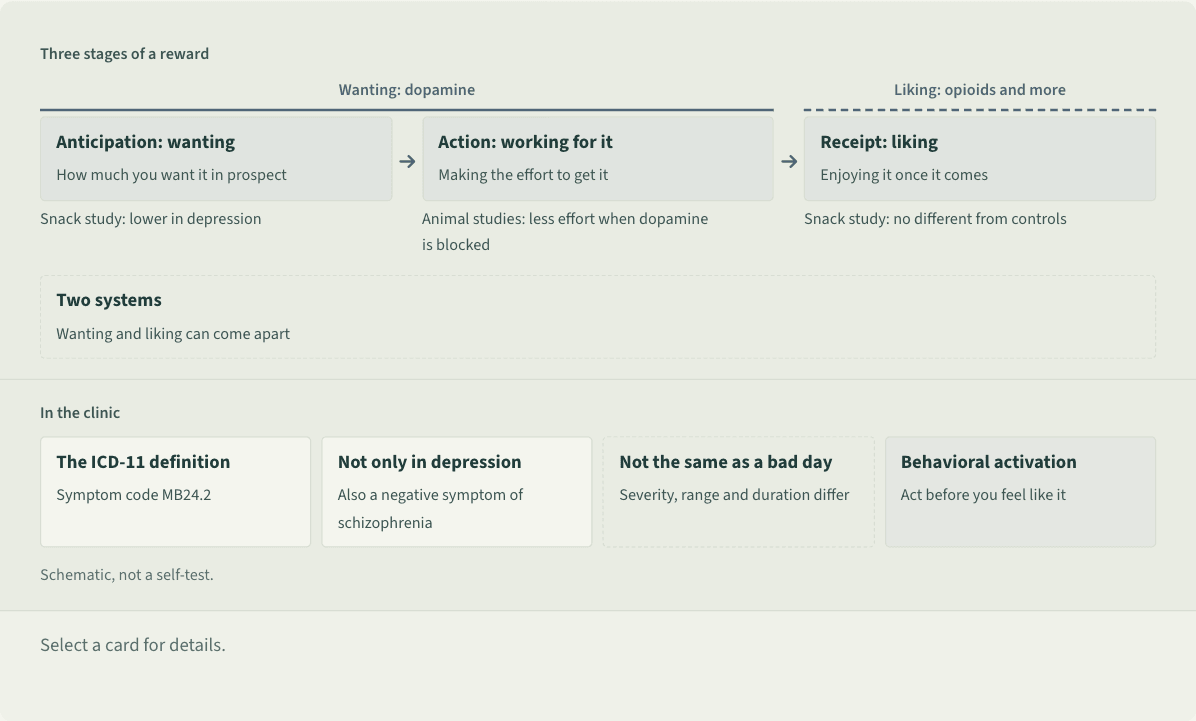
Schematic. Three cards at the top form a line titled “three stages of a reward”: anticipation (wanting), labeled as lower in people with depression in a snack study; action (willingness to work for it), labeled as reduced in animals when dopamine is blocked; and receipt (liking), labeled as no different from healthy people in the snack study. A bracket under the first two cards reads “wanting: dopamine” and one under the third reads “liking: opioids and more,” next to a card on the two systems. Below are three cards: the ICD-11 definition; not only in depression (one of the negative symptoms of schizophrenia); and a dashed card, “not the same as a bad day.” At the bottom is a card for behavioral activation. A note says the figure is a schematic, not a self-test.
 Save as image (PNG)
This figure image is licensed CC BY 4.0: reuse it with credit and a link back to this page. How to reuse
Key points
- DSM-IV-TR describes it as less interest in hobbies, “not caring anymore,” or no enjoyment in activities once found pleasurable, without separating lost motivation from lost pleasure.[2]
- Researchers therefore separate “wanting” (anticipating a reward and working for it) from “liking” (enjoying it once it arrives); animal studies tie dopamine mainly to wanting.[2]
- In one study, 52 people with depression wanted snacks less than 51 healthy controls on first sight, yet liked them just as much, both on sight and when tasting.[3]
- Behavioral activation, first developed within CBT, schedules activities to reconnect people with positive reinforcement; a meta-analysis of 26 randomized trials found it effective for depression.[2][4]
An example
Ms. Wang used to go to choir every week. This month, when friends ask, she feels it would be pointless and stays home; one time they drag her along, and she ends up enjoying it. That gap between not wanting to go and still enjoying it is what researchers mean when they separate “wanting” from “liking.”[2]
Misreadings and limits
Low days are common; ICD-11 says a depressive episode differs from ordinary low mood in the severity, range and duration of symptoms.[1] This page is not for self-diagnosis. If almost nothing has interested you nearly every day for two weeks or more and it disrupts life, see a doctor or mental health professional; if thoughts of self-harm appear, seek help right away.
If you need help now
If you’re struggling to cope or having thoughts of harming yourself:
- US and Canada: call or text 988 (24/7)
- UK and Ireland: Samaritans, 116 123 (free, 24/7)
- Australia: Lifeline, 13 11 14 (24/7)
- Elsewhere: findahelpline.com
If you’re in immediate danger, call your local emergency number.
Psyfield is not a crisis service. Numbers checked October 2026.
Sources
- 1 World Health Organization (2025). MB24.2 Anhedonia; Mood disorders: Depressive episode; 6A20 Schizophrenia. ICD-11 for mortality and morbidity statistics (2025-01 release). View source
- 2 Treadway, M. T., & Zald, D. H. (2011). Reconsidering anhedonia in depression: Lessons from translational neuroscience. Neuroscience & Biobehavioral Reviews, 35(3), 537–555. doi:10.1016/j.neubiorev.2010.06.006
- 3 Schulz, C., Klaus, J., Peglow, F., Ellinger, S., Kühnel, A., Walter, M., & Kroemer, N. B. (2026). Blunted anticipation, but not consummation, of food rewards in depression. Cell Reports Medicine, 7(6), 102796. doi:10.1016/j.xcrm.2026.102796
- 4 Ekers, D., Webster, L., Van Straten, A., Cuijpers, P., Richards, D., & Gilbody, S. (2014). Behavioural activation for depression; an update of meta-analysis of effectiveness and sub group analysis. PLoS ONE, 9(6), e100100. doi:10.1371/journal.pone.0100100
Last checked against sources: October 28, 2026