Activation–synthesis hypothesis
激活-整合假说
How does the activation–synthesis hypothesis explain dreaming?
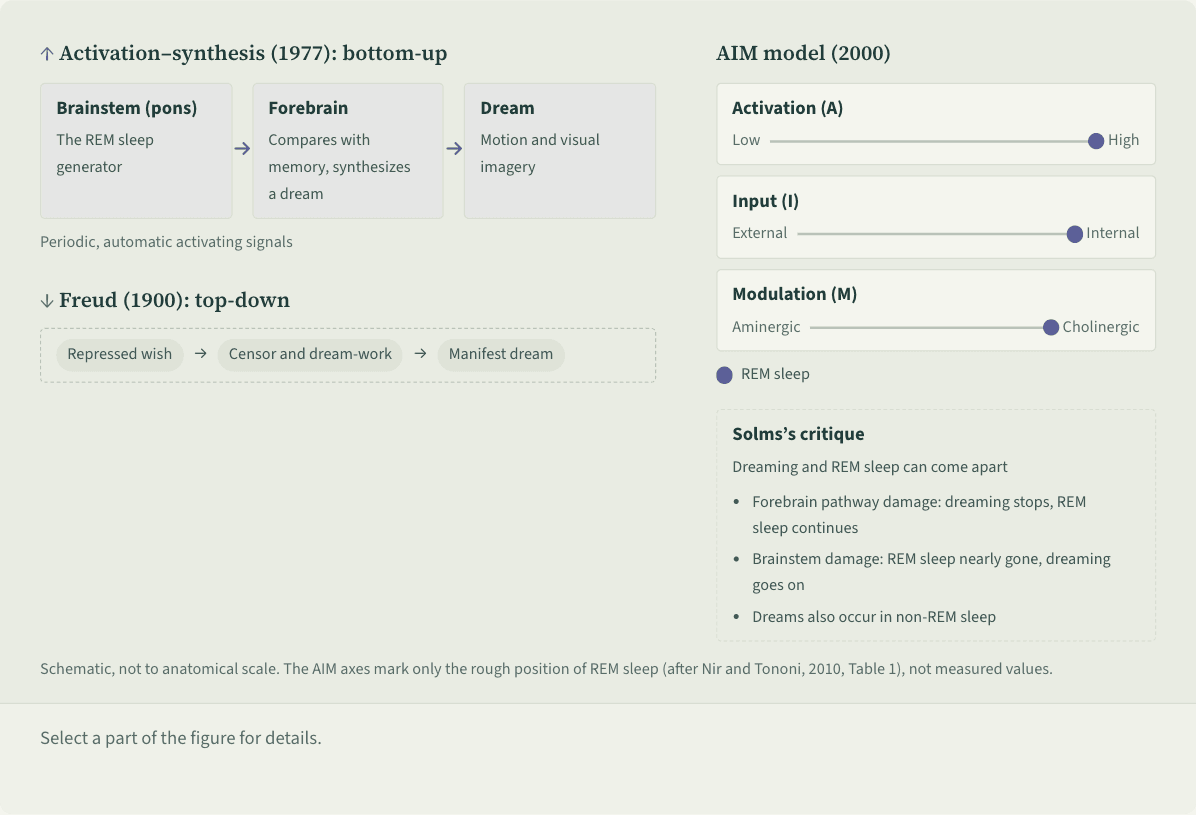
The activation–synthesis hypothesis, proposed by J. Allan Hobson and Robert McCarley in 1977, holds that during REM sleep a brainstem mechanism periodically and automatically activates the forebrain, which synthesizes a dream by comparing these signals with information stored in memory.[1]
Activation–synthesis (1977): bottom-up
Periodic, automatic activating signals
Freud (1900): top-down
AIM model (2000)
REM sleep
Schematic, not to anatomical scale. The AIM axes mark only the rough position of REM sleep (after Nir and Tononi, 2010, Table 1), not measured values.
Schematic in two parts. On the left, an upper lane runs bottom-up: the brainstem (pons) at the base sends an arrow labeled periodic, automatic activating signals to the forebrain at the top, marked compare with memory and synthesize, which points to the dream. A lower lane runs the other way and is labeled Freud’s contrast: a repressed wish passes the censor and the dream-work to become the manifest dream. On the right, the AIM model’s three axes are activation (low to high), input (external to internal) and modulation (aminergic to cholinergic), with REM sleep marked at high activation, internal input and the cholinergic end. Below, Solms’s critique: damage to a forebrain pathway ends dreaming while REM sleep continues; brainstem damage nearly abolishes REM sleep yet dreaming can go on; dreams also occur in non-REM sleep.
 Save as image (PNG)
This figure image is licensed CC BY 4.0: reuse it with credit and a link back to this page. How to reuse
Key points
- Intense, sporadic firing of brainstem reticular, oculomotor and vestibular neurons might shape the spatial and temporal features of dream imagery, and shifting transmitter ratios might explain why dreams are forgotten.[1]
- It reversed the psychoanalytic account: dreams start bottom-up from brainstem signals, not top-down from psychological motives, and are forgotten because the brain changes state, not because of repression.[4]
- In 2000 Hobson and colleagues expanded it into the AIM model, which places conscious states along three dimensions: activation, input source (internal or external) and the aminergic–cholinergic balance.[2][4]
- Critics led by Mark Solms noted that some forebrain lesions end dreaming while REM sleep carries on, and that dreams also occur in non-REM sleep; Solms argued that forebrain mechanisms control dreaming.[3][4]
An example
Jay dreams he is floating down a staircase while his surroundings keep switching from a classroom to a train station. On the activation–synthesis view, the floating motion and shifting imagery may come from brainstem activation of sensorimotor circuits in REM sleep, which the forebrain stitches into a story using places and people from memory.[1]
Misreadings and limits
It is often summed up as “dreams are meaningless,” but on Hobson’s side the way the brain interprets these signals may still carry psychological meaning.[4] Equating dreaming with REM sleep is also too simple: awakenings from non-REM sleep often yield reports too, and 10 to 30% of them cannot be told apart from REM reports.[4]
Sources
- 1 Hobson, J. A., & McCarley, R. W. (1977). The brain as a dream state generator: An activation-synthesis hypothesis of the dream process. American Journal of Psychiatry, 134(12), 1335–1348. doi:10.1176/ajp.134.12.1335
- 2 Hobson, J. A., Pace-Schott, E. F., & Stickgold, R. (2000). Dreaming and the brain: Toward a cognitive neuroscience of conscious states. Behavioral and Brain Sciences, 23(6), 793–842. doi:10.1017/S0140525X00003976
- 3 Solms, M. (2000). Dreaming and REM sleep are controlled by different brain mechanisms. Behavioral and Brain Sciences, 23(6), 843–850. doi:10.1017/S0140525X00003988
- 4 Nir, Y., & Tononi, G. (2010). Dreaming and the brain: From phenomenology to neurophysiology. Trends in Cognitive Sciences, 14(2), 88–100. doi:10.1016/j.tics.2009.12.001
Last checked against sources: October 27, 2026