Depression
抑郁症
What is depression?
Depression is a common mental disorder: for at least two weeks a person feels low, or loses interest in things they usually enjoy, most of the day, nearly every day. Other symptoms follow, such as poor concentration, low self-worth or changes in sleep, appetite and energy, and daily life is clearly disrupted.[1][2]
ICD-11: 10 symptoms in three clusters
Not the same as
Severity and treatment
Schematic, not a self-test.
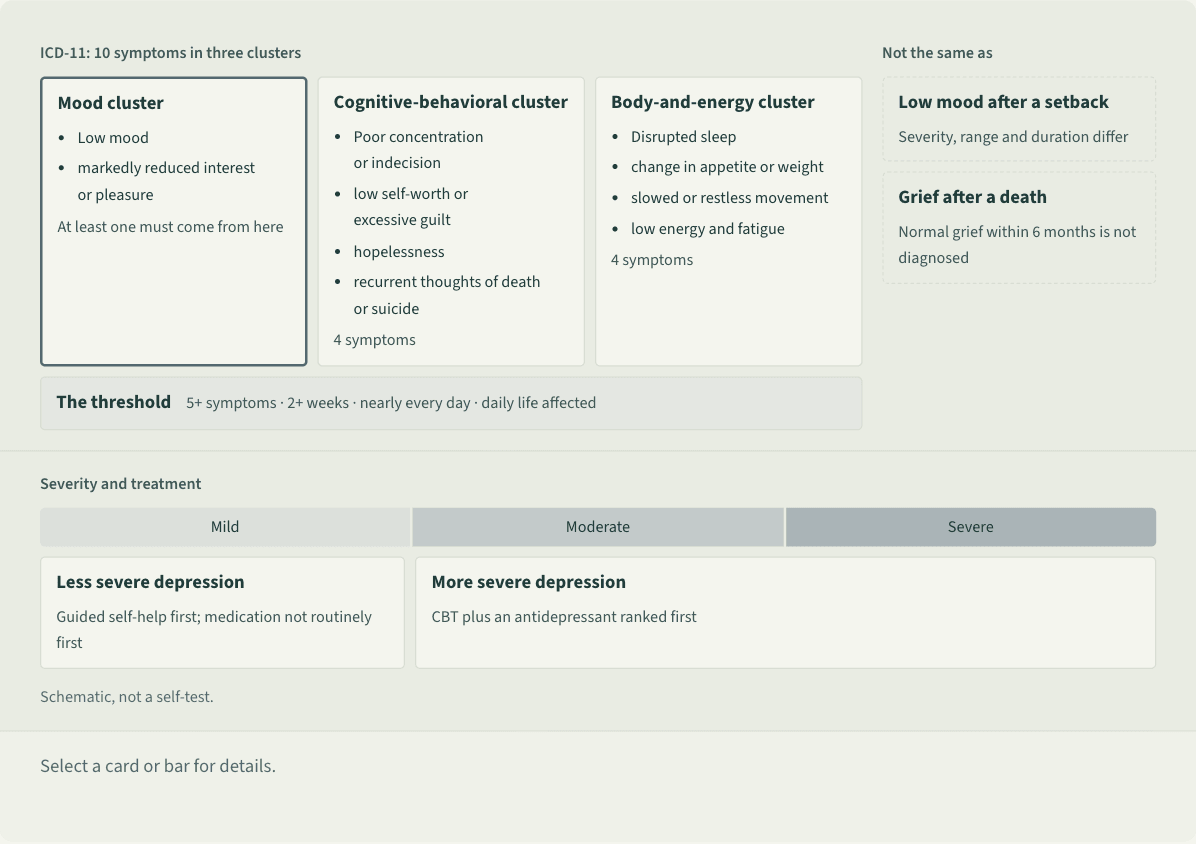
Schematic. Three cards at the top show ICD-11’s symptom clusters: a mood cluster of 2 (low mood; markedly reduced interest or pleasure), marked as the cluster at least one symptom must come from; a cognitive-behavioral cluster of 4 (poor concentration or indecision; low self-worth or excessive guilt; hopelessness about the future; recurrent thoughts of death or suicide); and a body-and-energy cluster of 4 (badly disrupted sleep; marked change in appetite or weight; visibly slowed or restless movement and speech; low energy and fatigue). Below them, a threshold bar: at least five symptoms, at least two weeks, most of the day nearly every day, clear effects on daily life. On the right, two dashed cards marked “not the same as”: low mood after a setback, and grief after a death. At the bottom, a bar split into mild, moderate and severe. The mild segment is labeled less severe depression: psychological therapy or guided self-help first, usually not medication. Moderate and severe are labeled more severe depression: several options, with CBT plus an antidepressant ranked first. A note says the figure is a schematic, not a self-test.
 Save as image (PNG)
This figure image is licensed CC BY 4.0: reuse it with credit and a link back to this page. How to reuse
Key points
- ICD-11 lists 10 symptoms in three clusters. A depressive episode needs at least five, lasting two weeks or more, including low mood or markedly reduced interest.[1]
- Grief after a death can also bring intense sadness, but the pain tends to come in waves mixed with good memories, and self-esteem usually holds. In depression, worthlessness is common.[2]
- WHO estimates that 5.2% of adults worldwide had depression in 2023, women about 1.5 times as often as men. Even in high-income countries only about a third of them get treatment.[3]
- Psychological treatments such as behavioral activation and CBT come first; antidepressants can be added in moderate or severe depression, not mild.[3] For more severe depression NICE ranks CBT plus medication first.[4]
An example
After his project is cancelled, Jay wakes before dawn for three weeks running and skips the weekly basketball game he used to love. He keeps saying he can’t do anything right and drifts off in meetings. Lin notices and goes with him to see a psychiatrist, who will assess what is going on and whether he needs treatment.
Misreadings and limits
Online depression quizzes cannot diagnose anyone. Diagnosis takes a full professional assessment that rules out medical causes such as an underactive thyroid, and the effects of drugs.[1][2] Low mood that lasts two weeks or more and affects daily life is a reason to see a doctor soon; thoughts of self-harm or suicide call for professional help right away.[3]
If you need help now
If you’re struggling to cope or having thoughts of harming yourself:
- US and Canada: call or text 988 (24/7)
- UK and Ireland: Samaritans, 116 123 (free, 24/7)
- Australia: Lifeline, 13 11 14 (24/7)
- Elsewhere: findahelpline.com
If you’re in immediate danger, call your local emergency number.
Psyfield is not a crisis service. Numbers checked October 2026.
Sources
- 1 World Health Organization (2025). Mood disorders: Depressive episode; 6A70 Single episode depressive disorder; 6A71 Recurrent depressive disorder. ICD-11 for mortality and morbidity statistics (2025-01 release). View source
- 2 American Psychiatric Association (2024). What is depression?. Psychiatry.org (physician review April 2024). View source
- 3 World Health Organization (2026). Depressive disorder (depression). WHO fact sheet (September 11, 2026). View source
- 4 National Institute for Health and Care Excellence (2022). Depression in adults: Treatment and management (NG222). NICE guideline (published June 29, 2022). View source
Last checked against sources: October 28, 2026