Effective apology
有效道歉
What is an effective apology?
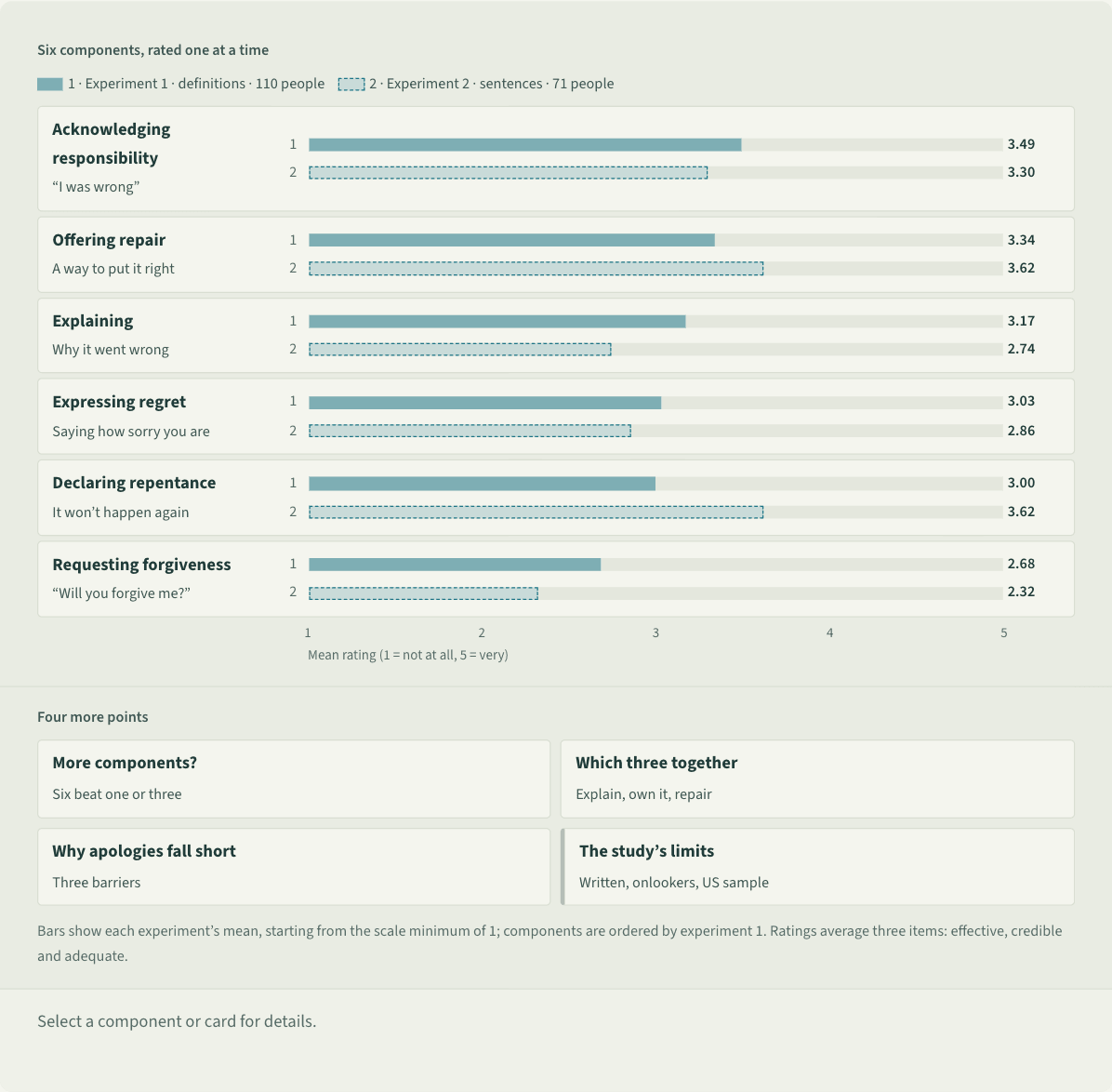
An effective apology is one that repairs trust and helps the other person forgive.[1][2] In 2016 Roy Lewicki and colleagues tested six components: expressing regret, explaining what went wrong, acknowledging responsibility, declaring repentance, offering repair and requesting forgiveness.[1]
Six components, rated one at a time
Four more points
Bars show each experiment’s mean, starting from the scale minimum of 1; components are ordered by experiment 1. Ratings average three items: effective, credible and adequate.
Schematic. Six rows of bars at the top, one per apology component, each with two bars: experiment 1 (definitions only, 110 people) and experiment 2 (actual sentences, 71 people), on an axis from 1 to 5. In order of experiment 1 scores: acknowledging responsibility 3.49 and 3.30; offering repair 3.34 and 3.62; explaining 3.17 and 2.74; expressing regret 3.03 and 2.86; declaring repentance 3.00 and 3.62; requesting forgiveness 2.68 and 2.32. Four cards below: more components? (six beat one or three); which three together (explanation, responsibility, repair); why apologies often fall short (three barriers); the study’s limits (written, onlookers, US sample).
 Save as image (PNG)
This figure image is licensed CC BY 4.0: reuse it with credit and a link back to this page. How to reuse
Key points
- In two experiments, 755 people read about a job candidate apologizing for a botched tax return; apologies with all six components were rated more effective than those with one or three.[1]
- Rated one at a time, acknowledging responsibility and offering repair ranked in the top three in both experiments, and requesting forgiveness came last in both.[1]
- A meta-analysis of 175 studies found that apology correlated with forgiveness at r = .42, one of the most notable effects it examined.[2]
- Karina Schumann names three barriers to apologizing well: low concern for the victim or relationship, a sense that it threatens self-image, and doubt that it will work.[3]
An example
Jay got a column wrong in Ms. Wang’s report, and she was caught out at the team meeting. Afterward he tells her, “I’m sorry, that column was my mistake, and it put you on the spot. I’ve sent you and the manager a corrected version, and from now on I’ll have a colleague check my tables.” He makes no excuses.
Misreadings and limits
A common misreading is that reciting a fixed script makes an apology work. The ratings come from US participants reading written apologies as a hiring manager, not from victims themselves; the authors note that tone and sincerity, the relationship and culture may change the results, and promised repair must actually happen.[1]
Sources
- 1 Lewicki, R. J., Polin, B., & Lount, R. B., Jr. (2016). An exploration of the structure of effective apologies. Negotiation and Conflict Management Research, 9(2), 177–196. doi:10.1111/ncmr.12073
- 2 Fehr, R., Gelfand, M. J., & Nag, M. (2010). The road to forgiveness: A meta-analytic synthesis of its situational and dispositional correlates. Psychological Bulletin, 136(5), 894–914. doi:10.1037/a0019993
- 3 Schumann, K. (2018). The psychology of offering an apology: Understanding the barriers to apologizing and how to overcome them. Current Directions in Psychological Science, 27(2), 74–78. doi:10.1177/0963721417741709
Last checked against sources: October 28, 2026