Prisoner’s dilemma
囚徒困境
What is the prisoner’s dilemma?
The prisoner’s dilemma is a game in which each player gains more by defecting whatever the other does, yet mutual defection leaves both worse off than mutual cooperation.[1] It is often taken to show a conflict between individual and group rationality.[1]
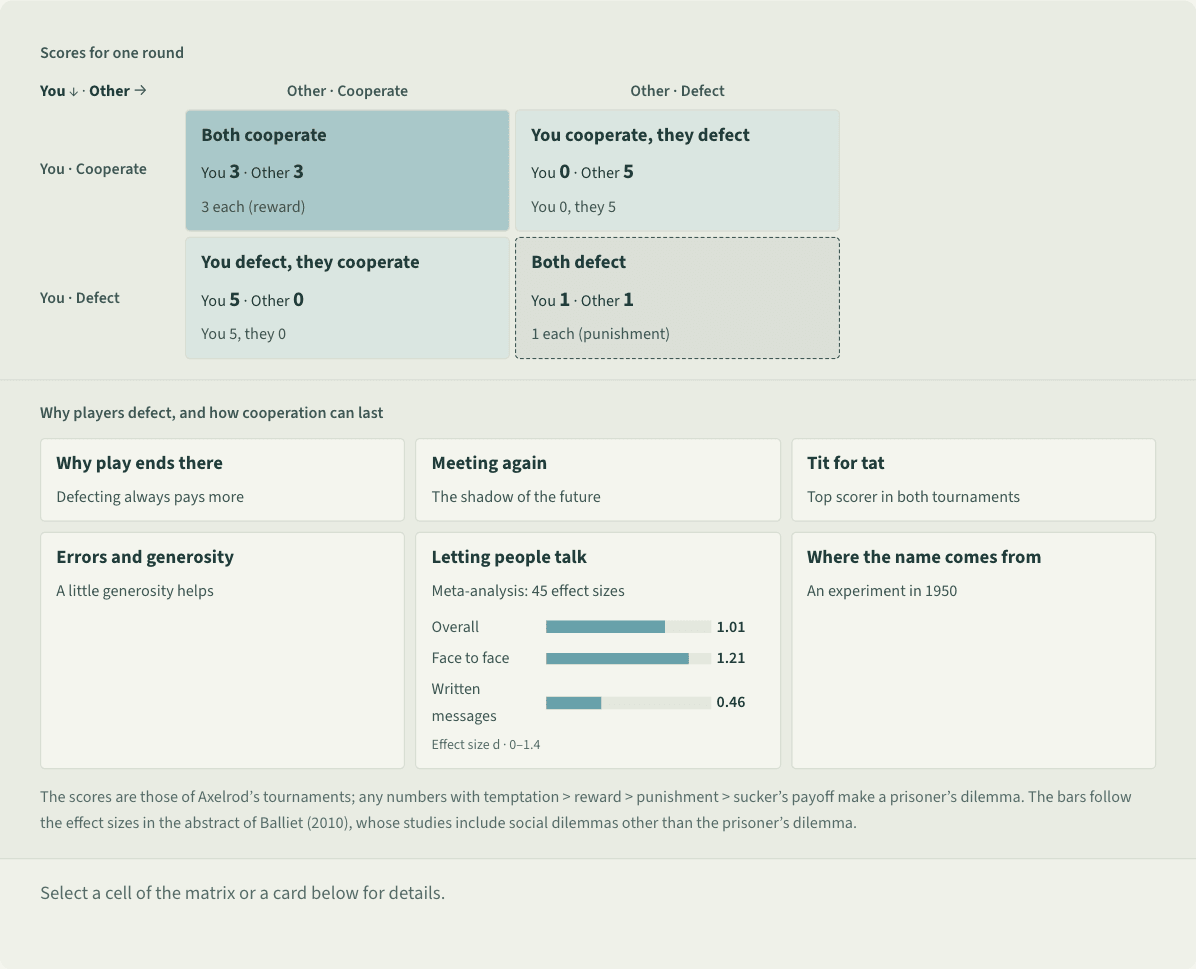
Scores for one round
Why players defect, and how cooperation can last
The scores are those of Axelrod’s tournaments; any numbers with temptation > reward > punishment > sucker’s payoff make a prisoner’s dilemma. The bars follow the effect sizes in the abstract of Balliet (2010), whose studies include social dilemmas other than the prisoner’s dilemma.
A two-by-two payoff matrix: rows are your choice, columns the other player’s. If both cooperate, each scores 3. If you cooperate and the other defects, you score 0 and the other 5. If you defect and the other cooperates, you score 5 and the other 0. If both defect, each scores 1. Whatever the other does, defecting earns you 1 or 2 points more, so both defect and score 1 each, less than the 3 each from mutual cooperation. Six cards below: why play ends in mutual defection; meeting again, where cooperation can hold if the chance of another round is high enough; tit for tat, the top scorer in both of Axelrod’s computer tournaments; errors, where slightly more generous strategies do better; communication, with three bars of effect sizes: 1.01 overall, 1.21 for face-to-face discussion and 0.46 for written messages; and where the name comes from.
 Save as image (PNG)
This figure image is licensed CC BY 4.0: reuse it with credit and a link back to this page. How to reuse
Key points
- It is not zero-sum: both sides could do better together.[1] Mutual defection is the only Nash equilibrium, and every other outcome is Pareto optimal.[1]
- In Robert Axelrod’s two computer tournaments, with 14 and then 62 entries, the top scorer both times was tit for tat: cooperate first, then copy the other player’s last move.[2]
- In a classic experiment, cooperators kept cooperating unless the partner always defected, individualists cooperated only with a tit-for-tat partner, and competitors rarely cooperated at all.[3]
- A meta-analysis of 45 effect sizes found that letting people communicate in social dilemma experiments strongly raised cooperation (d = 1.01), more so face to face than in writing.[4]
An example
Lin and Jay share an apartment and its kitchen. If the other cleans, slacking is easiest; if the other slacks, cleaning feels like being exploited. So neither cleans, and the mess bothers both more than if both had cleaned. They sit down together, draw up a cleaning schedule and agree that a missed turn means an extra one.
Misreadings and limits
A common misreading is that tit for tat is always best. A strategy’s rank in a tournament depends on which others it meets;[1] once mistakes or misunderstandings creep in, two tit-for-tat players can fall into alternating retaliation, while slightly more generous strategies sustain cooperation better.[1][3]
Sources
- 1 Kuhn, S. (2026). Prisoner’s dilemma. The Stanford Encyclopedia of Philosophy (Spring 2026 Edition, E. N. Zalta & U. Nodelman, Eds.; first published 4 September 1997, substantive revision 24 October 2025). View source
- 2 Axelrod, R., & Hamilton, W. D. (1981). The evolution of cooperation. Science, 211(4489), 1390–1396. doi:10.1126/science.7466396
- 3 Van Lange, P. A. M., Joireman, J., Parks, C. D., & Van Dijk, E. (2013). The psychology of social dilemmas: A review. Organizational Behavior and Human Decision Processes, 120(2), 125–141. doi:10.1016/j.obhdp.2012.11.003
- 4 Balliet, D. (2010). Communication and cooperation in social dilemmas: A meta-analytic review. Journal of Conflict Resolution, 54(1), 39–57. doi:10.1177/0022002709352443
Last checked against sources: October 28, 2026