Difficult conversations
高难度谈话
What is a difficult conversation?
A difficult conversation is any talk you would rather avoid, such as asking for a raise or complaining to a neighbor about a barking dog.[2] In their 1999 practical guide of that name, Douglas Stone, Bruce Patton and Sheila Heen argued that each one contains three conversations: what happened, feelings and identity.[1][2]
The three conversations
Intent and impact (schematic)
Other moves, and what research says
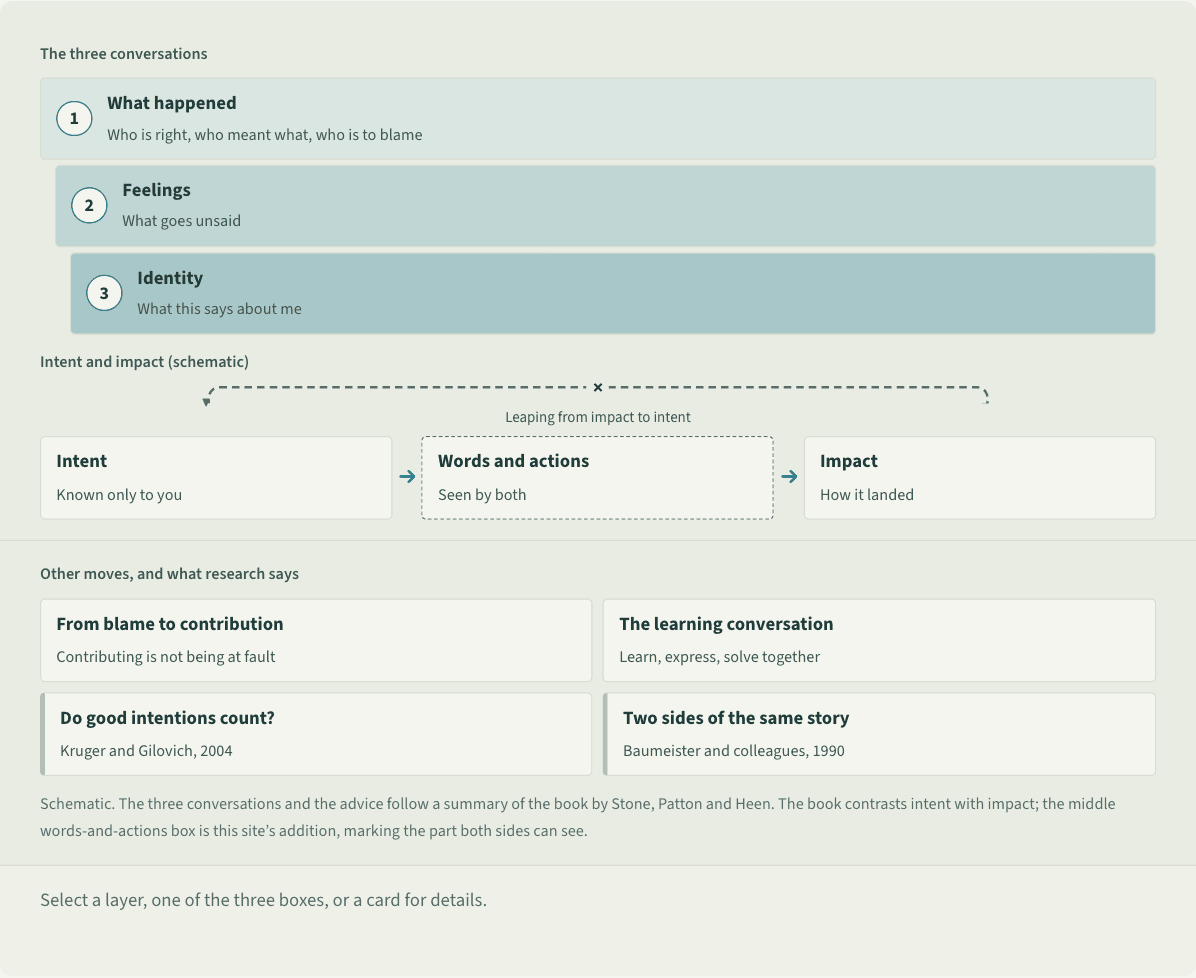
Schematic. The three conversations and the advice follow a summary of the book by Stone, Patton and Heen. The book contrasts intent with impact; the middle words-and-actions box is this site’s addition, marking the part both sides can see.
Three stacked bands at the top, shading from light to dark, stand for the three conversations beneath every difficult conversation: what happened, which argues over who is right, who meant what and who is to blame; feelings, the emotions both sides leave unsaid; and identity, what the situation says about who I am. A row of three boxes in the middle reads, left to right, intent, words and actions, and impact: only you know your intent, both sides can see the words and actions, and the impact is what the other person feels. A dashed arrow from impact back to intent is crossed out and labeled leaping from impact to intent. Four cards at the bottom: moving from blame to contribution, where contributing is not being at fault; the learning conversation, whose goals are to learn the other’s story, express yourself and solve the problem together; a 2004 study in which people gave themselves more credit for their intentions; and a 1990 study in which perpetrators and victims told conflicts differently.
 Save as image (PNG)
This figure image is licensed CC BY 4.0: reuse it with credit and a link back to this page. How to reuse
Key points
- What happened: who is right, who meant what, who is to blame. Feelings: emotions often left unsaid. Identity: what this says about me. Am I competent, good, worthy of love?[2]
- One error is leaping from impact to intent: I was hurt, so you meant it. Another is assuming good intentions cancel the hurt. Ask what was meant, and acknowledge feelings.[2]
- Swap blame for contribution: what did each side add? Contributing is not being at fault; an unlocked car contributes to a theft. Owning your share helps others stop blaming.[2]
- Research fits the gap: people credit their own good intentions more than others’,[3] and in conflict stories perpetrators call their acts understandable while victims call them gratuitous and lasting.[4]
An example
At a team meeting, Jay jumps in to answer a question the manager put to Lin. She feels angry and embarrassed, and wonders whether the manager now doubts her. Afterward she tells him, “You may have meant to help, but I felt cut off and a bit embarrassed. What were you thinking then?”
Misreadings and limits
A common misreading is “I meant well, so you shouldn’t be upset,” or the reverse, “only impact matters, intent is irrelevant.” The authors would discuss both: good intentions do not undo hurt, and being hurt does not prove intent, so ask.[2] The two studies above examined how people judge intentions and offenses, not the book’s method.[3][4]
Sources
- 1 Stone, D., Patton, B., & Heen, S. (1999). Difficult conversations: How to discuss what matters most. Viking Penguin (3rd ed., Penguin Books, 2023). View source The link is the book page of the Program on Negotiation at Harvard Law School. This site has not read the book itself; the page relies on that description, the Beyond Intractability summary and the tables of contents of two Chinese editions.
- 2 Conflict Research Consortium (n.d.). Summary of "Difficult conversations: How to discuss what matters most". Beyond Intractability, Conflict Information Consortium. View source
- 3 Kruger, J., & Gilovich, T. (2004). Actions, intentions, and self-assessment: The road to self-enhancement is paved with good intentions. Personality and Social Psychology Bulletin, 30(3), 328–339. doi:10.1177/0146167203259932
- 4 Baumeister, R. F., Stillwell, A., & Wotman, S. R. (1990). Victim and perpetrator accounts of interpersonal conflict: Autobiographical narratives about anger. Journal of Personality and Social Psychology, 59(5), 994–1005. doi:10.1037/0022-3514.59.5.994
Last checked against sources: October 28, 2026