Verbal de-escalation
降级技术
What is verbal de-escalation?
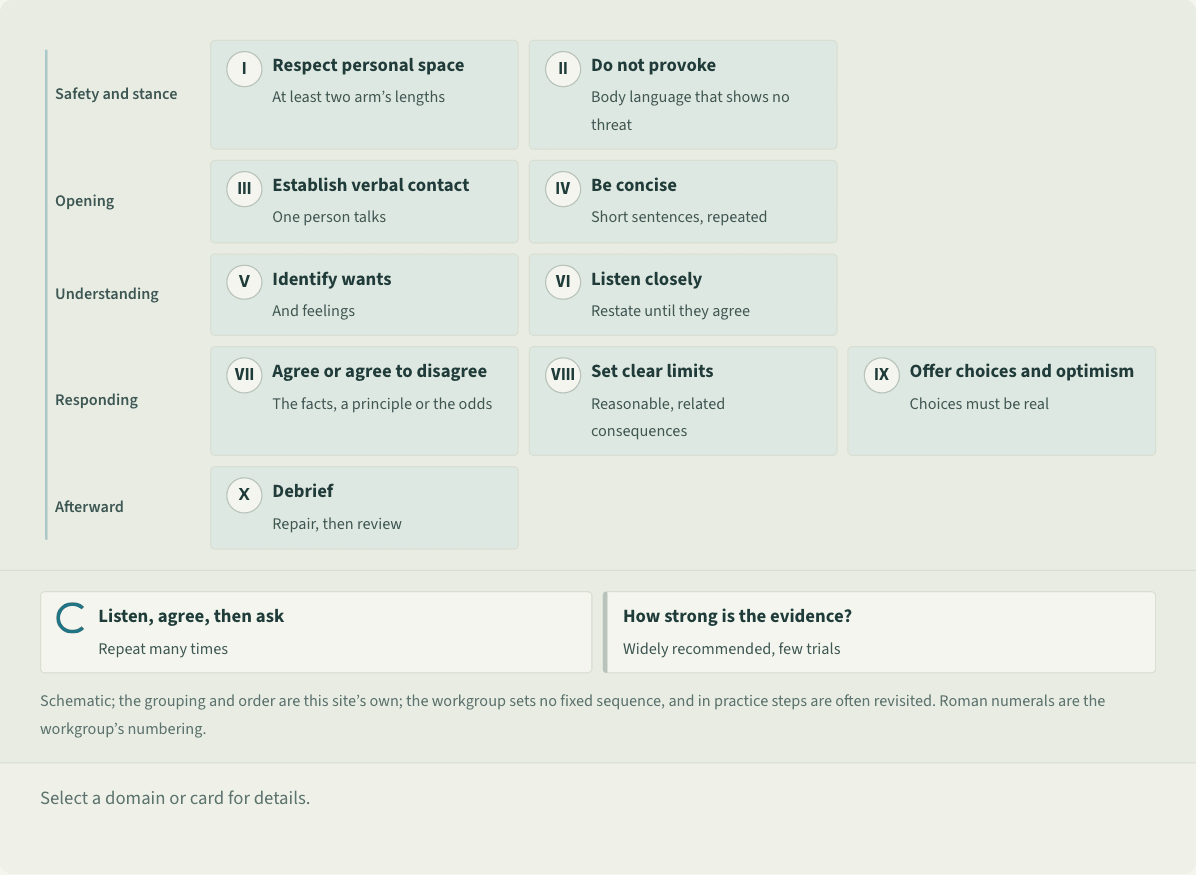
Verbal de-escalation is a set of techniques, using verbal and nonverbal communication, for defusing anger and averting aggression.[2] In 2012 the American Association for Emergency Psychiatry’s Project BETA workgroup set out 10 domains, aiming to help an agitated person regain control and to avoid restraint.[1]
Safety and stance
Opening
Understanding
Responding
Afterward
Schematic; the grouping and order are this site’s own; the workgroup sets no fixed sequence, and in practice steps are often revisited. Roman numerals are the workgroup’s numbering.
Schematic. Five groups of cards from top to bottom. Safety and stance: I respect personal space (at least two arm’s lengths), II do not provoke (body language that shows no threat). Opening: III establish verbal contact (one person talks), IV be concise (short sentences, repeated). Understanding: V identify wants (and feelings), VI listen closely (restate until they agree). Responding: VII agree or agree to disagree (with the facts, a principle or the odds), VIII set clear limits (reasonable, related consequences), IX offer choices and optimism (choices must be real). Afterward: X debrief (repair the relationship, review the response). Two cards at the bottom: listen, agree, then ask (repeat many times) and how strong the evidence is (widely recommended, few trials).
 Save as image (PNG)
This figure image is licensed CC BY 4.0: reuse it with credit and a link back to this page. How to reuse
Key points
- Safety comes first: keep at least two arm’s lengths away, leave each of you a way out, keep your hands visible, stand at an angle, and avoid staring, humiliation or other provocation.[1]
- One person talks, gives their name and asks how the person likes to be addressed; keep sentences short and repeat them; ask what the person wants and check with active listening.[1][2]
- Find something you can honestly agree with, such as the facts or a principle; calmly state which behavior is unacceptable and its consequences; and offer real, workable choices.[1]
- UK NICE guidance says psychiatric wards should restrain someone only when de-escalation and other preventive strategies have failed and harm is likely, and should keep trying to de-escalate throughout.[2]
An example
After an hour’s wait at the bank, Ms. Wang reaches the counter as the system fails and starts shouting. The clerk, Lin, signals a colleague to wait, gives her name and says, “You really have waited a long time.” He asks what she most needs, then offers two options: first in line tomorrow, or leave the papers with her.
Misreadings and limits
It is easily mistaken for making someone quiet and compliant; the workgroup aims to help the person regain control and notes that studies of specific techniques and their effects are few.[1] A Cochrane review found one usable trial, of very low quality;[3] in a Slovenian cluster-randomized study, trained hospitals had 73% fewer aggressive incidents than controls, but only six hospitals were randomized.[4]
Sources
- 1 Richmond, J. S., Berlin, J. S., Fishkind, A. B., Holloman, G. H., Jr., Zeller, S. L., Wilson, M. P., Rifai, M. A., & Ng, A. T. (2012). Verbal de-escalation of the agitated patient: Consensus statement of the American Association for Emergency Psychiatry Project BETA De-escalation Workgroup. Western Journal of Emergency Medicine, 13(1), 17–25. doi:10.5811/westjem.2011.9.6864
- 2 National Institute for Health and Care Excellence (2015). Violence and aggression: Short-term management in mental health, health and community settings (NG10). NICE guideline. View source
- 3 Spencer, S., Johnson, P., & Smith, I. C. (2018). De-escalation techniques for managing non-psychosis induced aggression in adults. Cochrane Database of Systematic Reviews, 2018(7), CD012034. doi:10.1002/14651858.CD012034.pub2
- 4 Celofiga, A., Kores Plesnicar, B., Koprivsek, J., Moskon, M., Benkovic, D., & Gregoric Kumperscak, H. (2022). Effectiveness of de-escalation in reducing aggression and coercion in acute psychiatric units. A cluster randomized study. Frontiers in Psychiatry, 13, 856153. doi:10.3389/fpsyt.2022.856153
Last checked against sources: October 28, 2026