Conflict escalation
冲突升级
What is conflict escalation?
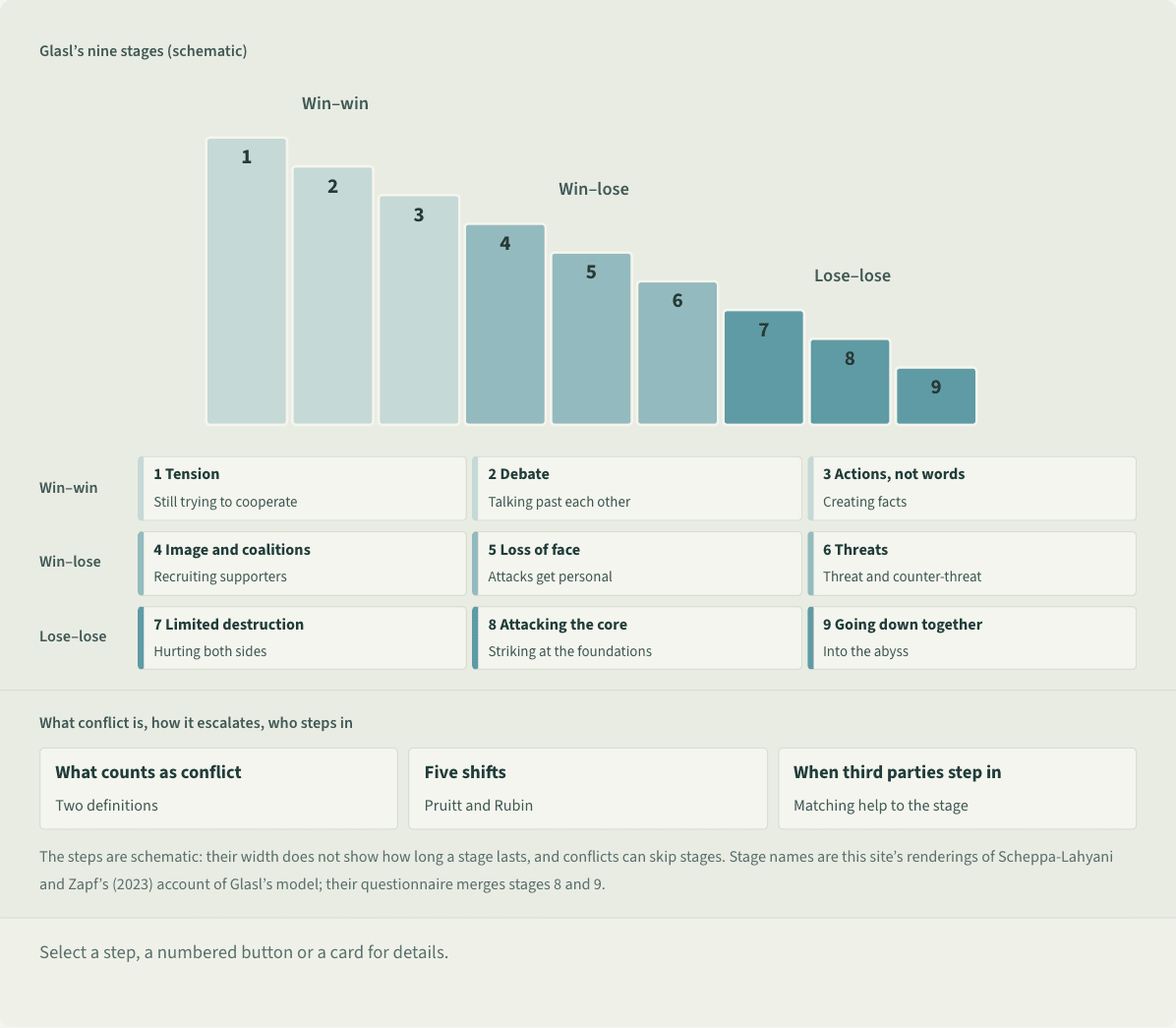
Conflict escalation is the stepwise increase in a conflict’s intensity and severity.[1] Friedrich Glasl’s model divides it into nine stages in three levels: both sides can still win, only one can win, and finally both lose.[1][2]
Glasl’s nine stages (schematic)
What conflict is, how it escalates, who steps in
The steps are schematic: their width does not show how long a stage lasts, and conflicts can skip stages. Stage names are this site’s renderings of Scheppa-Lahyani and Zapf’s (2023) account of Glasl’s model; their questionnaire merges stages 8 and 9.
Nine steps descend from upper left to lower right in three levels. The first level, win–win, holds stages 1 to 3: occasional tension, debate, and actions instead of words. The second, win–lose, holds stages 4 to 6: image and coalitions, loss of face, and threats. The third, lose–lose, holds stages 7 to 9: limited destruction, attacking the core, and going down together. Three cards below: two definitions of conflict; the five shifts Pruitt and Rubin describe; and when third parties step in, with moderation for stages 1 to 3, mediation for 5 to 7, arbitration for 6 to 8 and forced intervention by a party with power for 7 to 9.
 Save as image (PNG)
This figure image is licensed CC BY 4.0: reuse it with credit and a link back to this page. How to reuse
Key points
- Hocker and Wilmot define conflict as an expressed struggle between interdependent parties who see their goals as incompatible, resources as scarce and the other side as interfering.[3]
- Stages 1–3 stay on the issue, both sides still seeking a joint solution. From stage 4 it turns personal, with allies, loss of face and threats, and only one side can win.[1]
- In stages 7–9 each side will hurt the other even at its own cost; only a third party can end it.[1] Glasl held that each intervention suits only certain stages.[2]
- Pruitt and colleagues list five shifts: tactics from light to heavy, issues from few to many and from specific to general, goals from doing well to winning to hurting, and participants multiply.[4]
An example
Lin and her downstairs neighbor Ms. Wang disagree over a parking space. They talk it over, then just argue. Ms. Wang parks in Lin’s space anyway, and Lin posts about it in the residents’ group chat. Weeks later the chat has split into two camps, the two no longer greet each other, and nobody mentions the parking space.
Misreadings and limits
A common misreading is that every conflict passes through all nine stages in order. Glasl’s model allows stages to be skipped.[1] The questionnaire study built on it surveyed German employees once, each giving one party’s account of a workplace conflict, so it cannot show how conflicts unfold over time; stages 8 and 9 also proved hard to tell apart.[1]
Sources
- 1 Scheppa-Lahyani, M. N., & Zapf, D. (2023). Are you threatening me? Development and validation of the Conflict Escalation Questionnaire. Frontiers in Psychology, 14, Article 1164990. doi:10.3389/fpsyg.2023.1164990
- 2 Glasl, F. (1982). The process of conflict escalation and roles of third parties. In G. B. J. Bomers & R. B. Peterson (Eds.), Conflict management and industrial relations (pp. 119–140). Springer Netherlands. doi:10.1007/978-94-017-1132-6_6
- 3 Alvarez, I. M., González-Parera, M., & Manero, B. (2022). The role of emotions in classroom conflict management: Case studies geared towards improving teacher training. Frontiers in Psychology, 13, Article 818431. doi:10.3389/fpsyg.2022.818431
- 4 Conflict Research Consortium staff (n.d.). Summary of "Social conflict: Escalation, stalemate and settlement" (Pruitt, D. G., & Rubin, J. Z., 1986). Beyond Intractability, Conflict Information Consortium. View source
Last checked against sources: October 28, 2026