Lucid dreaming
清醒梦
What is lucid dreaming?
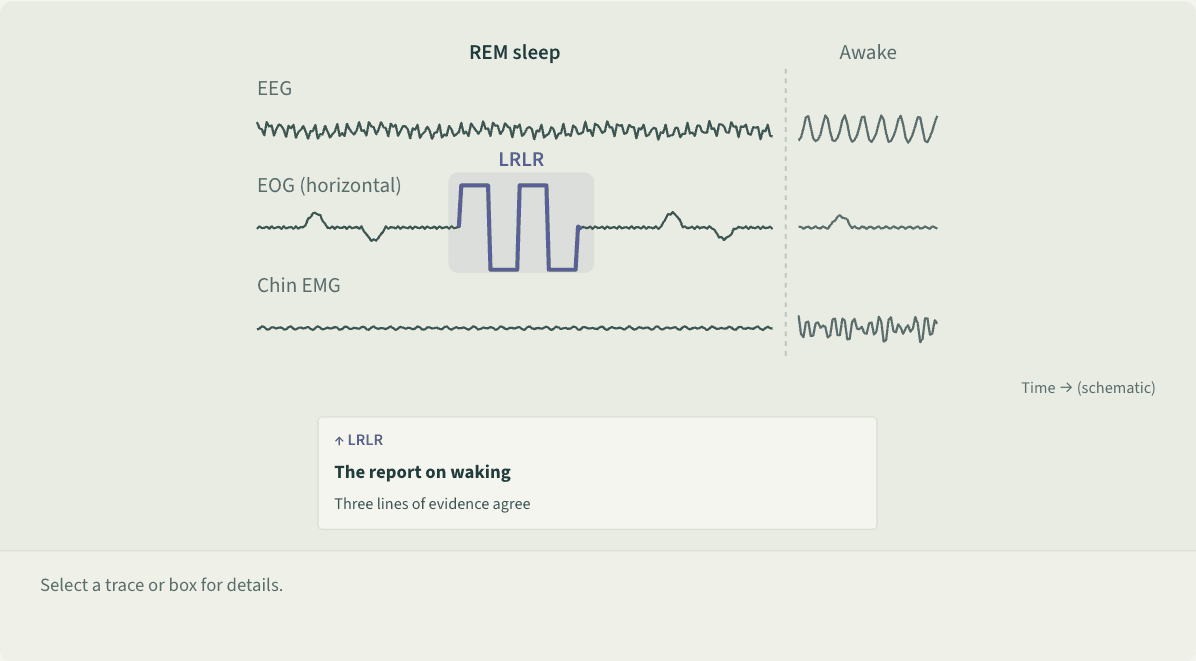
Lucid dreaming is becoming aware that you are dreaming while the dream goes on, sometimes with the ability to act deliberately.[1] In the lab, dreamers who realize they are dreaming move their eyes left and right in a prearranged pattern, and the signal appears in recordings of REM sleep.[1]
Time → (schematic)
Schematic with three horizontal traces, top to bottom: EEG, horizontal eye movements (EOG) and chin muscle activity (EMG), split into two segments. The left segment, labeled REM sleep, shows fast low-amplitude EEG without alpha waves, a few small ordinary rapid eye movements, a marked LRLR signal of four much larger left-right swings, and a nearly flat EMG. The right segment, labeled awake, shows alpha waves in the EEG and much higher EMG. A box below for the report given on waking points to the LRLR signal: a lucid dream counts as verified when the report, the signal and the sleep recording agree.
 Save as image (PNG)
This figure image is licensed CC BY 4.0: reuse it with credit and a link back to this page. How to reuse
Key points
- A meta-analysis of studies from 1966 to 2016 estimated that about 55% of people have had at least one lucid dream and about 23% have one at least monthly.[2]
- A 2012 systematic review of 35 induction studies found their methods generally weak; no technique had been shown to induce lucid dreams reliably and consistently.[3]
- Over a week of practicing a night-waking technique such as MILD, 355 online participants reported lucid dreams on 15.8% of mornings, up from 5.3% the week before. Daytime reality checks added nothing.[4]
- Its most researched use is treating recurring nightmares. Several small studies found it helped, but a larger online study found no added benefit.[1]
An example
Lin dreams she is looking for her seat in an exam hall. Something feels off, so she pushes a finger against her palm, a check she has learned, and it passes through. She realizes she is dreaming; the room stays, and she skips the exam for the sports field. Awake, she writes it in her dream diary.
Misreadings and limits
Lucid dreaming is often equated with steering dreams at will, a skill anyone can master from an online guide. Being aware is not being in control: deliberate control seems possible in only about a third of lucid dreams.[4] Most induction studies are also of low quality, and no technique has yet been shown to work reliably.[3]
Sources
- 1 Baird, B., Mota-Rolim, S. A., & Dresler, M. (2019). The cognitive neuroscience of lucid dreaming. Neuroscience & Biobehavioral Reviews, 100, 305–323. doi:10.1016/j.neubiorev.2019.03.008
- 2 Saunders, D. T., Roe, C. A., Smith, G., & Clegg, H. (2016). Lucid dreaming incidence: A quality effects meta-analysis of 50 years of research. Consciousness and Cognition, 43, 197–215. doi:10.1016/j.concog.2016.06.002
- 3 Stumbrys, T., Erlacher, D., Schädlich, M., & Schredl, M. (2012). Induction of lucid dreams: A systematic review of evidence. Consciousness and Cognition, 21(3), 1456–1475. doi:10.1016/j.concog.2012.07.003
- 4 Adventure-Heart, D. J. (2020). Findings from the International Lucid Dream Induction Study. Frontiers in Psychology, 11, 1746. doi:10.3389/fpsyg.2020.01746
Last checked against sources: October 27, 2026