Dissociation
解离
What is dissociation?
Dissociation is an involuntary disruption in the normal integration of identity, sensations, perceptions, emotions, thoughts, memories, movement or behavior.[1] Everyone dissociates mildly at times; only when it is severe enough to impair daily life can it amount to a dissociative disorder.[1][2]
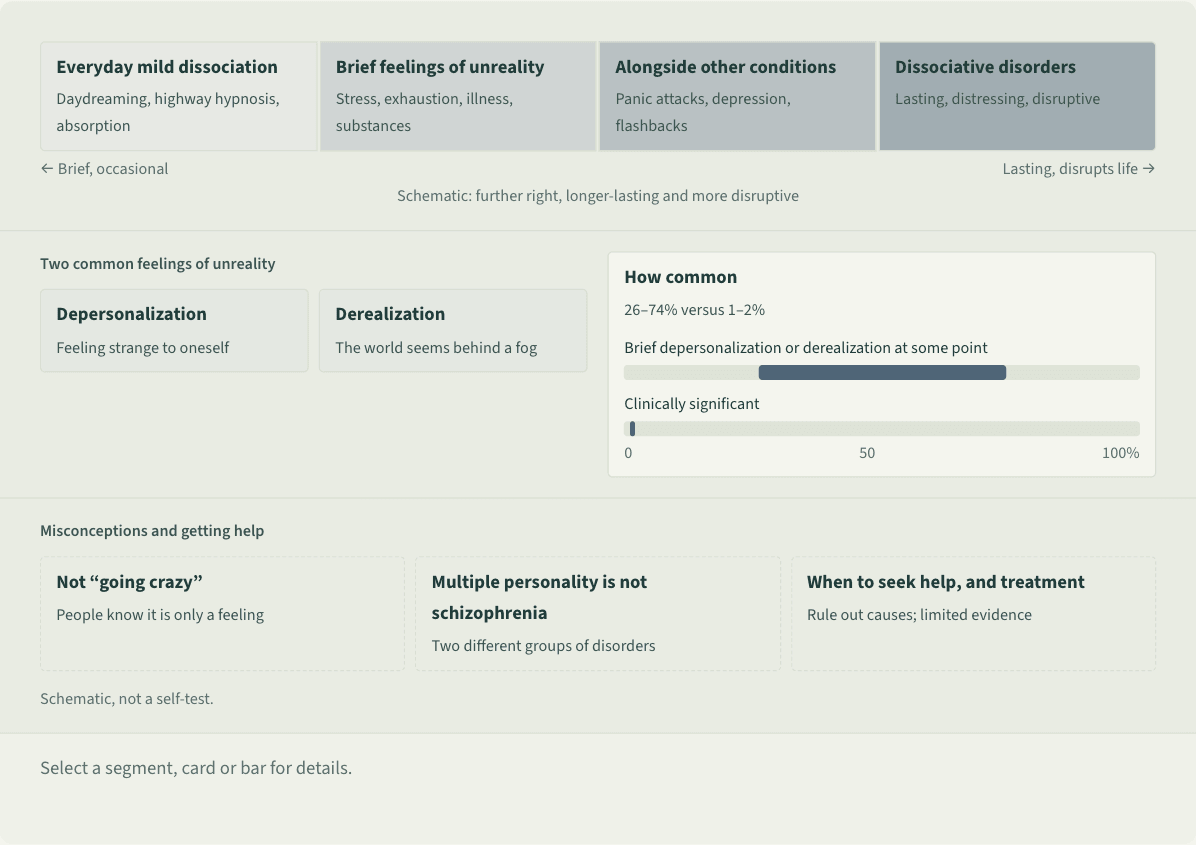
Schematic: further right, longer-lasting and more disruptive
Two common feelings of unreality
Misconceptions and getting help
Schematic, not a self-test.
Schematic. At the top, a band in four segments, from “brief, occasional” on the left to “lasting, disrupts life” on the right: everyday mild dissociation (daydreaming, highway hypnosis, getting lost in a book); brief feelings of unreality (under stress, exhaustion, illness or substances, fading once the state passes); alongside other conditions (panic attacks, depression, flashbacks after trauma); and dissociative disorders (lasting, distressing, disruptive; seven specific diagnoses in ICD-11). In the middle, two cards: depersonalization (feeling strange to oneself, as if watching oneself) and derealization (the world seems dreamlike, foggy, lifeless). Beside them, two range bars drawn to scale on 0–100%: brief depersonalization or derealization at some point in life, 26–74%; clinically significant, about 1–2%. At the bottom, three cards: not “going crazy” (people know it is only a feeling); multiple personality is not schizophrenia; and when to seek help and what treatment offers (other causes such as medication and epilepsy are ruled out first; no medication has proven effective). A note says the figure is a schematic, not a self-test.
 Save as image (PNG)
This figure image is licensed CC BY 4.0: reuse it with credit and a link back to this page. How to reuse
Key points
- The American Psychiatric Association notes that mild dissociation is common: daydreaming, “highway hypnosis” and getting lost in a book or film all involve losing touch with one’s surroundings.[2]
- Depersonalization is feeling strange or unreal to oneself, as if watching oneself from outside; derealization makes the world seem dreamlike, foggy or lifeless. Reality testing stays intact.[1]
- A systematic review estimated that 26–74% of people have had transient depersonalization or derealization, and 31–66% during a traumatic event; about 1–2% have clinically significant symptoms.[3]
- ICD-11’s dissociative disorders include dissociative identity disorder, popularly called multiple personality, classed apart from schizophrenia;[1] PTSD often involves dissociative symptoms too.[2]
An example
After two all-nighters to finish a project, Jay walks down a familiar street and suddenly feels as if a pane of glass separates him from everything. Sounds seem far away; it is like watching a film. He knows it is only a feeling. After a long sleep, it is gone.
Misreadings and limits
Feeling unreal does not mean “going crazy”: people with depersonalization know it is only a feeling, which sets it apart from psychosis.[1][4] Brief episodes are common; if they persist or recur and cause distress, see a doctor to rule out epilepsy, medication and other causes.[1] Psychotherapy helps some people; no medication has clearly proven effective.[4]
Sources
- 1 World Health Organization (2025). Dissociative disorders; 6B66 Depersonalization-derealization disorder. ICD-11 for mortality and morbidity statistics (2025-01 release). View source
- 2 American Psychiatric Association (2024). What are dissociative disorders?. Psychiatry.org (physician review October 2024). View source
- 3 Hunter, E. C. M., Sierra, M., & David, A. S. (2004). The epidemiology of depersonalisation and derealisation: A systematic review. Social Psychiatry and Psychiatric Epidemiology, 39(1), 9–18. doi:10.1007/s00127-004-0701-4
- 4 Spiegel, D. (2025). Depersonalization/derealization disorder. MSD Manual Professional Version (full review June 2025). View source
Last checked against sources: October 28, 2026