Diaphragmatic breathing
腹式呼吸
What is diaphragmatic breathing?
Diaphragmatic breathing relies mainly on the diaphragm, which contracts and moves down toward the abdomen to draw air in, then relaxes so air flows out passively.[1] As a relaxation exercise it is usually paired with slow breathing, under 10 breaths a minute.[2][3]
How the diaphragm moves
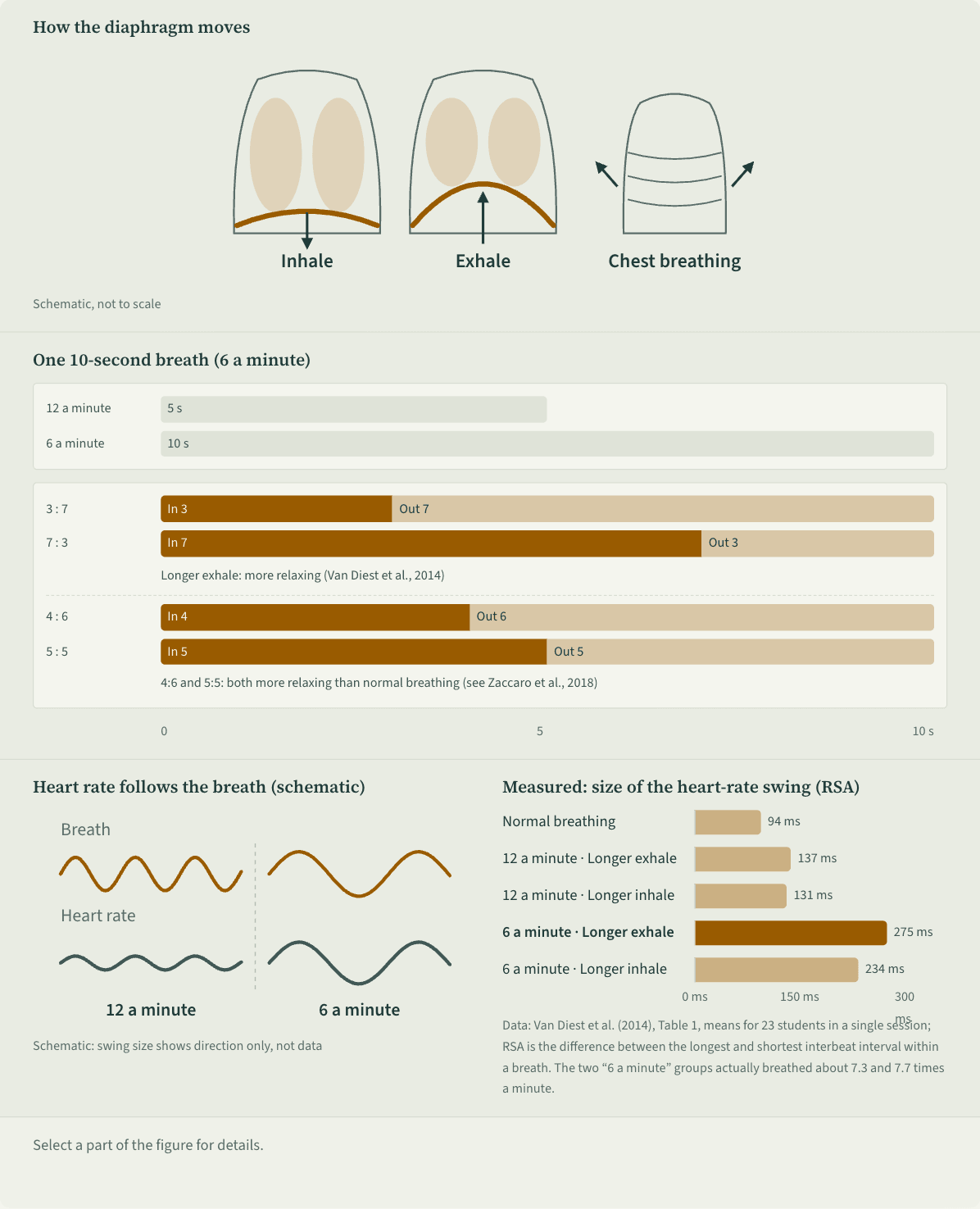
Schematic, not to scale
One 10-second breath (6 a minute)
Heart rate follows the breath (schematic)
Schematic: swing size shows direction only, not data
Three-row schematic. Top: two simplified torso outlines. On the inhale the diaphragm contracts and flattens downward, enlarging the chest cavity; on the exhale it relaxes and domes upward as air flows out passively. A small inset notes that chest breathing relies on the intercostal muscles pulling the ribs up and out. Middle: four 10-second bars, each split into an inhale and an exhale segment: 3 in and 7 out, 4 in and 6 out, 5 in and 5 out, 7 in and 3 out. Notes: in one study the longer-exhale pattern felt more relaxing than the reverse; in another, 4:6 and 5:5 were both more relaxing than normal breathing. A 5-second bar above marks 12 breaths a minute. Bottom left: two schematic wave segments in which a breathing curve and a heart-rate curve rise and fall together, heart rate rising on the inhale and falling on the exhale, with a larger swing at six breaths a minute than at twelve. Bottom right: a bar chart from one experiment showing mean heart-rate swing (RSA): normal breathing 94 ms; at 12 a minute, 137 with the longer exhale and 131 with the longer inhale; at 6 a minute, 275 and 234.
 Save as image (PNG)
This figure image is licensed CC BY 4.0: reuse it with credit and a link back to this page. How to reuse
Key points
- At rest, both the diaphragm and the intercostal muscles work. A deep breath relies mainly on the diaphragm, a shallow chest (costal) breath on the intercostals; both count as normal breathing.[1]
- Heart rate rises slightly with each inhale and falls with each exhale. Breathing under 10 times a minute enlarges this swing, raising heart rate variability, which researchers link to parasympathetic (vagal) activity.[2][3]
- People felt more relaxed when exhaling longer than inhaling (say 3 seconds in, 7 out) than the reverse.[3] In another study, 4:6 and 5:5 ratios were both more relaxing than usual breathing.[2]
- A meta-analysis of 12 randomized trials with 785 adults found lower self-reported stress after breathing exercises than in controls, a small-to-medium effect, with similar results for anxiety and depression.[4]
An example
Before a presentation, Ms. Wang’s heart is racing. She sits with one hand on her chest and one on her belly, breathes in slowly so the belly hand rises first, then breathes out even more slowly, for two minutes. Her heart seems to slow, and she can think through her opening.
Misreadings and limits
Calling chest breathing “wrong” overstates it; both patterns occur at rest.[1] Studies use such different rates and ratios that they are hard to pool.[2] Most trials are small with a moderate risk of bias, effects for people with health conditions are unclear, and breathing exercises do not replace treatment.[4]
Sources
- 1 Betts, J. G., Young, K. A., Wise, J. A., Johnson, E., Poe, B., Kruse, D. H., Korol, O., Johnson, J. E., Womble, M., & DeSaix, P. (2022). 22.3 The process of breathing. Anatomy and Physiology 2e. OpenStax. View source
- 2 Zaccaro, A., Piarulli, A., Laurino, M., Garbella, E., Menicucci, D., Neri, B., & Gemignani, A. (2018). How breath-control can change your life: A systematic review on psycho-physiological correlates of slow breathing. Frontiers in Human Neuroscience, 12, Article 353. doi:10.3389/fnhum.2018.00353
- 3 Van Diest, I., Verstappen, K., Aubert, A. E., Widjaja, D., Vansteenwegen, D., & Vlemincx, E. (2014). Inhalation/exhalation ratio modulates the effect of slow breathing on heart rate variability and relaxation. Applied Psychophysiology and Biofeedback, 39(3–4), 171–180. doi:10.1007/s10484-014-9253-x
- 4 Fincham, G. W., Strauss, C., Montero-Marin, J., & Cavanagh, K. (2023). Effect of breathwork on stress and mental health: A meta-analysis of randomised-controlled trials. Scientific Reports, 13, Article 432. doi:10.1038/s41598-022-27247-y
Last checked against sources: October 27, 2026