Circle of control
控制圈
What is the circle of control?
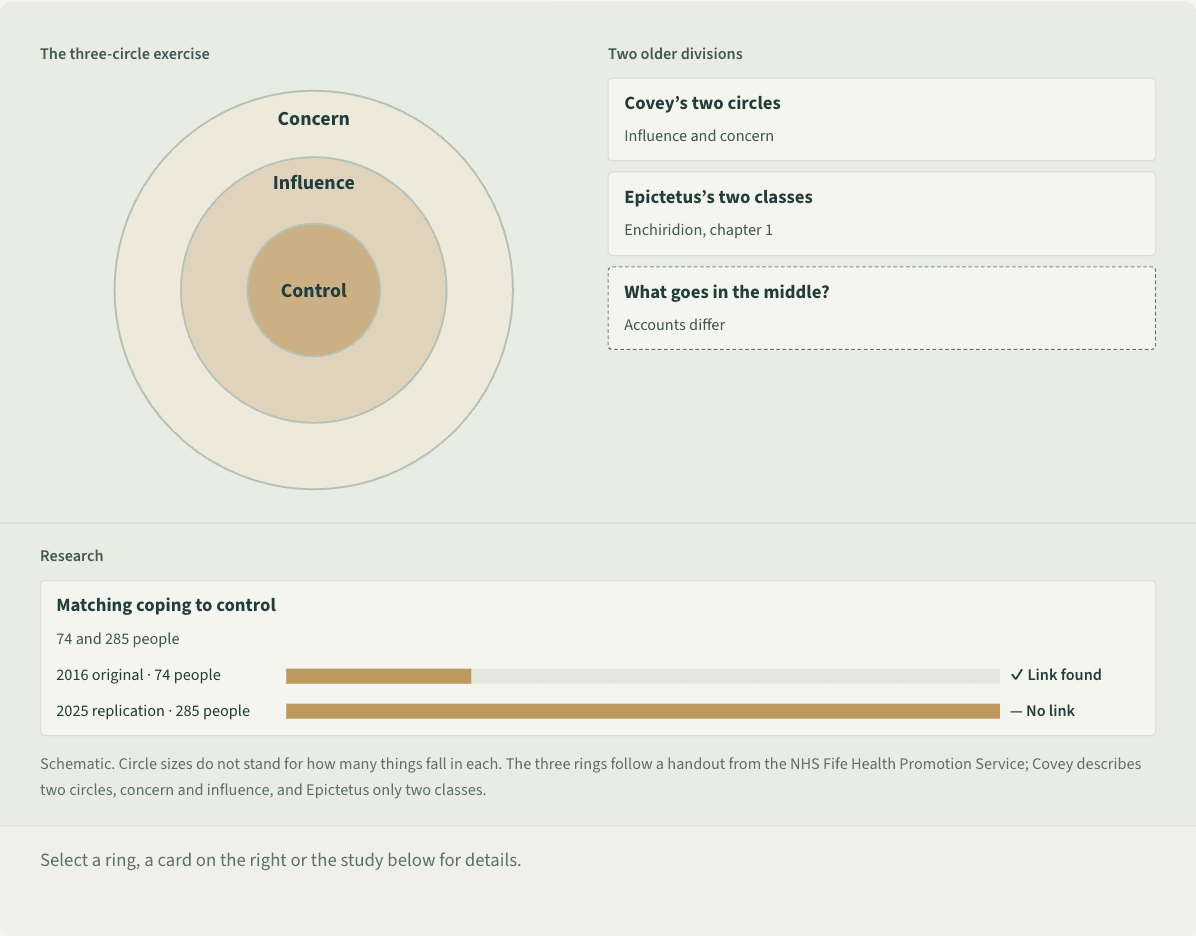
The circle of control is an exercise of drawing three nested circles: what you can control right now in the center, what you care about and can influence in the middle, and what you care about but cannot control or influence outside. You then put your time and energy mainly into the first two.[1]
The three-circle exercise
Two older divisions
Research
Schematic. Circle sizes do not stand for how many things fall in each. The three rings follow a handout from the NHS Fife Health Promotion Service; Covey describes two circles, concern and influence, and Epictetus only two classes.
Schematic. On the left, three nested circles: the center, “can control,” for what you can control right now; the middle ring, “can influence,” for what you care about and can influence; the outer ring, “can only be concerned about,” for what you care about but cannot control or influence. Three cards on the right: Covey calls what you can do something about the circle of influence and what you barely control the circle of concern; Epictetus puts opinion, impulse, desire and aversion in our power and body, property, reputation and office outside it, with only two classes; a third card notes that accounts differ on what belongs in the middle ring. Below, a research card with two sample bars: a 2016 study of 74 people found that those who reappraised more when situations were less controllable reported greater well-being; a 2025 preregistered replication with 285 people, its bar about four times longer, did not reproduce the result.
 Save as image (PNG)
This figure image is licensed CC BY 4.0: reuse it with credit and a link back to this page. How to reuse
Key points
- Covey separates a circle of influence (what you can affect) from a circle of concern (what you can hardly control). Proactive people, he says, work in the first and expand their influence.[2]
- An older split comes from the Stoic philosopher Epictetus: opinion, impulse, desire and aversion, our own acts, are in our power; body, property, reputation and office are not.[3]
- Epictetus has only two classes: ask which one a troubling thing falls in, and if it is not in our power, call it nothing to you. The exercise adds a middle ring.[1][3]
- A related hypothesis: change a situation you can control and rethink one you cannot. A 74-person daily-life study supported it; a preregistered 285-person replication did not.[4]
An example
Jay hears his company may cut jobs and sleeps badly for several nights. He draws three circles: layoffs go in the outer ring; how his manager sees his project goes in the middle, since he can ask to talk; updating his résumé and putting his phone away by 11 p.m. go in the center. He starts there.
Misreadings and limits
A common misreading is that anything outside the center should simply be dropped. The exercise itself keeps a middle ring for what you can influence,[1] and Covey holds that focusing there expands your influence over time.[2] Research has tested matching coping to controllability, not the drawing exercise, with mixed results; it relied on self-rated control, and the authors suspect actual control matters more.[4]
Sources
- 1 NHS Fife Health Promotion Service (2025). How do I focus on what matters to me? Circles of control. NHS Fife Wellbeing Toolkit: wellbeing resources (individuals). View source
- 2 FranklinCovey (n.d.). Habit 1: Be proactive. FranklinCovey. View source
- 3 Epictetus (n.d.). The Encheiridion, or Manual (G. Long, Trans.), chapter I. In A selection from the Discourses of Epictetus with the Encheiridion. Project Gutenberg eBook #10661. View source
- 4 Willroth, E. C., Young, G., Ford, B. Q., Troy, A., Swierzewicz, D., & Mauss, I. B. (2025). Preregistered direct replication and extension of “The wisdom to know the difference: Strategy-situation fit in emotion regulation in daily life is associated with well-being”. Psychological Science, 36(5), 367–383. doi:10.1177/09567976251335567
Last checked against sources: October 28, 2026