Stress, anxiety and fear
压力、焦虑与恐惧
How do stress, anxiety and fear differ?
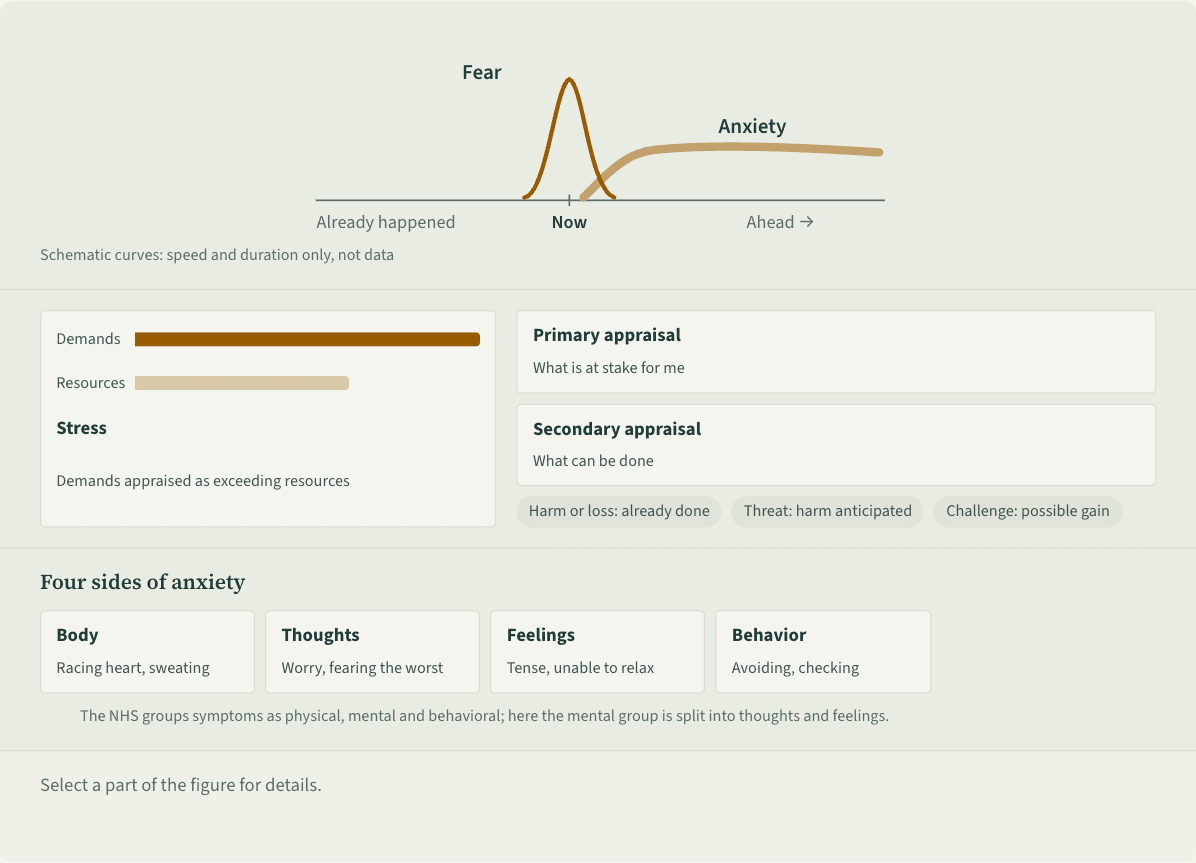
Fear is a brief response to a present, clearly identifiable threat; anxiety is a longer-lasting response to a future, diffuse or uncertain one.[1] Stress, in Lazarus and Folkman’s definition, is a relationship with the environment that a person appraises as taxing or exceeding their resources and endangering their well-being.[3]
Schematic curves: speed and duration only, not data
- Harm or loss: already done
- Threat: harm anticipated
- Challenge: possible gain
Four sides of anxiety
The NHS groups symptoms as physical, mental and behavioral; here the mental group is split into thoughts and feelings.
Three-part schematic. At top, a left-to-right timeline is divided into already happened, now and ahead. Fear sits at now; its curve rises sharply when the threat appears and falls quickly once it is gone. Anxiety spans the future; its curve rises more slowly, stays up longer and falls slowly. In the middle, a balance weighs demands against resources, preceded by a primary appraisal (is this harm or loss, threat, or challenge) and a secondary appraisal (what can be done); when demands outweigh resources it is labeled stress. Harm or loss means damage already done, threat means harm anticipated, challenge means possible gain. At bottom, four boxes: body (racing heart, sweating, breathlessness), thoughts (worry about the future, fearing the worst, poor concentration), feelings (tense, unable to relax, tearful), behavior (avoiding places and situations that cause anxiety, repeated checking).
 Save as image (PNG)
This figure image is licensed CC BY 4.0: reuse it with credit and a link back to this page. How to reuse
Key points
- Their bodily symptoms are similar; what differs is the threat. Fear meets imminent danger, rising and fading quickly. Anxiety meets distant or unpredictable threat and lasts longer.[1][2]
- Rats stay on sustained alert where a predator might be and fight or flee only when it strikes. People who cannot predict when shocks will come show more lasting increases in startle.[2]
- Lazarus and Folkman separate a primary appraisal of what is at stake (harm, threat or challenge) from a secondary appraisal of what can be done; both shape how stressful an event is.[3]
- Anxiety shows up in the body, thoughts, feelings and behavior: a racing heart and sweating, worry about the future, feeling tense or unable to relax, and avoiding places that trigger it.[4]
An example
Lin is juggling two projects and judges she lacks the time and staff for both: stress. Next week’s review could go wrong in ways she cannot pin down, and she lies awake over it: anxiety. Cycling home, a car swerves at her; she brakes hard, heart pounding, and calms down soon after it passes: fear.
Misreadings and limits
Everyday speech often uses fear and anxiety interchangeably.[1] Both are normal, adaptive states that can become pathological when extreme;[2] anxiety that will not go away and disrupts daily life may signal an anxiety disorder, which calls for a professional assessment, not self-diagnosis.[4]
Sources
- 1 American Psychological Association (2018). Anxiety. APA dictionary of psychology (updated April 19, 2018). View source
- 2 Davis, M., Walker, D. L., Miles, L., & Grillon, C. (2010). Phasic vs sustained fear in rats and humans: Role of the extended amygdala in fear vs anxiety. Neuropsychopharmacology, 35(1), 105–135. doi:10.1038/npp.2009.109
- 3 Lazarus, R. S., & Folkman, S. (1984). Stress, appraisal, and coping. Springer Publishing Company. View source
- 4 NHS (2026). Anxiety, fear and panic. NHS website (last reviewed 13 July 2026). View source
Last checked against sources: October 27, 2026