Avoidance cycle
回避的恶性循环
Why does avoiding what you fear keep anxiety going?
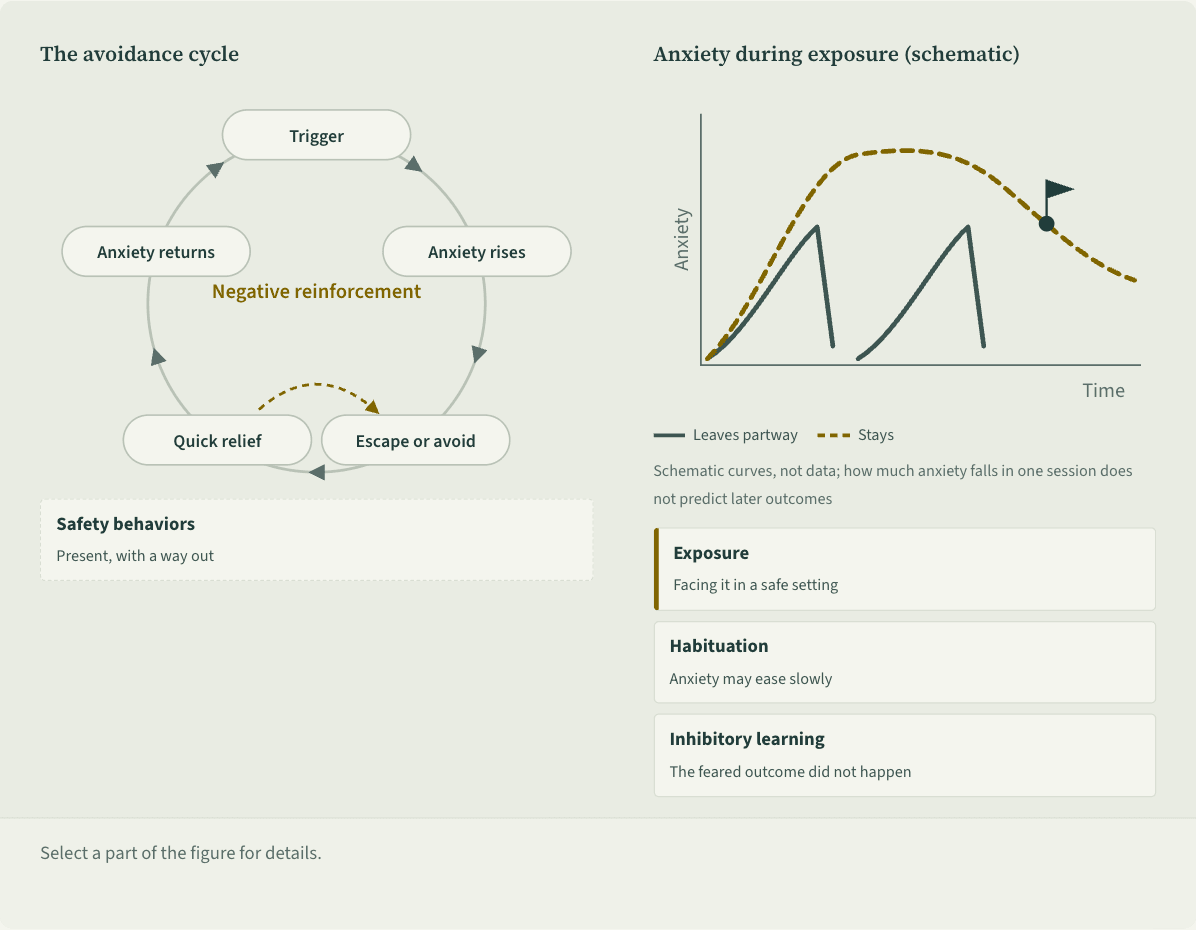
In the avoidance cycle, escaping or avoiding a feared situation brings quick relief. That relief makes avoidance more likely next time and removes the chance to learn that the feared outcome may not happen, so anxiety persists and can worsen.[1][2]
The avoidance cycle
Anxiety during exposure (schematic)
Leaves partway Stays
Schematic curves, not data; how much anxiety falls in one session does not predict later outcomes
Two-part schematic. On the left, a clockwise loop: trigger (a feared cue), rising anxiety, escape or avoidance, quick relief, and the same anxiety next time, which may grow over time, then back to the trigger. The center reads “negative reinforcement,” meaning the relief makes avoidance more likely to recur. A dashed box labeled “safety behaviors” hangs off the escape step, with examples such as carrying medication, going out only with company and controlling one’s breathing. On the right, a schematic graph of anxiety over time: one line plunges partway up when the person leaves; another, for staying, rises to a high point and may then decline slowly, labeled “habituation.” A marker on it reads “the feared outcome did not happen” and points to “inhibitory learning.” A note says the curves are schematic and that how much anxiety falls in one session does not predict later outcomes.
 Save as image (PNG)
This figure image is licensed CC BY 4.0: reuse it with credit and a link back to this page. How to reuse
Key points
- Mowrer’s two-factor theory: a cue first becomes linked with danger through classical conditioning and triggers fear; escaping it lowers fear, and that drop negatively reinforces escape and avoidance.[1]
- Escape ends an aversive event already under way; avoidance prevents one that is coming. Both, like safety behaviors, are learned and kept going through negative reinforcement.[4]
- Safety behaviors ward off the feared outcome: carrying medication, going out only with company, controlling one’s breathing. They ease anxiety now but sustain the belief that the situation is dangerous.[1][4]
- Exposure therapy has people repeatedly face what they fear in a safe setting to reduce fear and avoidance.[2] On the inhibitory learning view, it teaches that the cue no longer predicts harm.[3]
An example
Jay dreads speaking in meetings. Whenever his turn nears, he slips out to the restroom and feels instant relief. That relief makes leaving more tempting next time, and he never finds out that speaking might go fine. Months later, just seeing a meeting invitation makes him tense.
Misreadings and limits
A common rule is to stay in exposure until anxiety drops.[1] Yet how much fear falls during exposure does not predict later outcomes, and the old fear is not erased; it can return with time or a change of setting.[3] Avoiding real danger, meanwhile, is adaptive.[1]
Sources
- 1 Krypotos, A.-M., Effting, M., Kindt, M., & Beckers, T. (2015). Avoidance learning: A review of theoretical models and recent developments. Frontiers in Behavioral Neuroscience, 9, Article 189. doi:10.3389/fnbeh.2015.00189
- 2 American Psychological Association (2017). What is exposure therapy?. PTSD guideline: For patients & families (source: APA Division 12, Society of Clinical Psychology). View source
- 3 Craske, M. G., Treanor, M., Conway, C. C., Zbozinek, T., & Vervliet, B. (2014). Maximizing exposure therapy: An inhibitory learning approach. Behaviour Research and Therapy, 58, 10–23. doi:10.1016/j.brat.2014.04.006
- 4 李涛, 李永红, 宋慧, 高冉, & 冯菲 (2022). 焦虑中的安全行为及其影响. 心理科学进展, 30(9), 2067–2077. doi:10.3724/SP.J.1042.2022.02067
Last checked against sources: October 27, 2026