Hoarding disorder
囤积障碍
What is hoarding disorder?
Hoarding disorder is the build-up of possessions through repeated acquiring and difficulty discarding, driven by a felt need to save and distress at letting go, until the home cannot be used normally or safely, with marked distress or impairment.[1] DSM-5 first listed it as a separate diagnosis in 2013, and ICD-11 includes it too.[1][2][4]
Diagnostic core (ICD-11)
What it is not
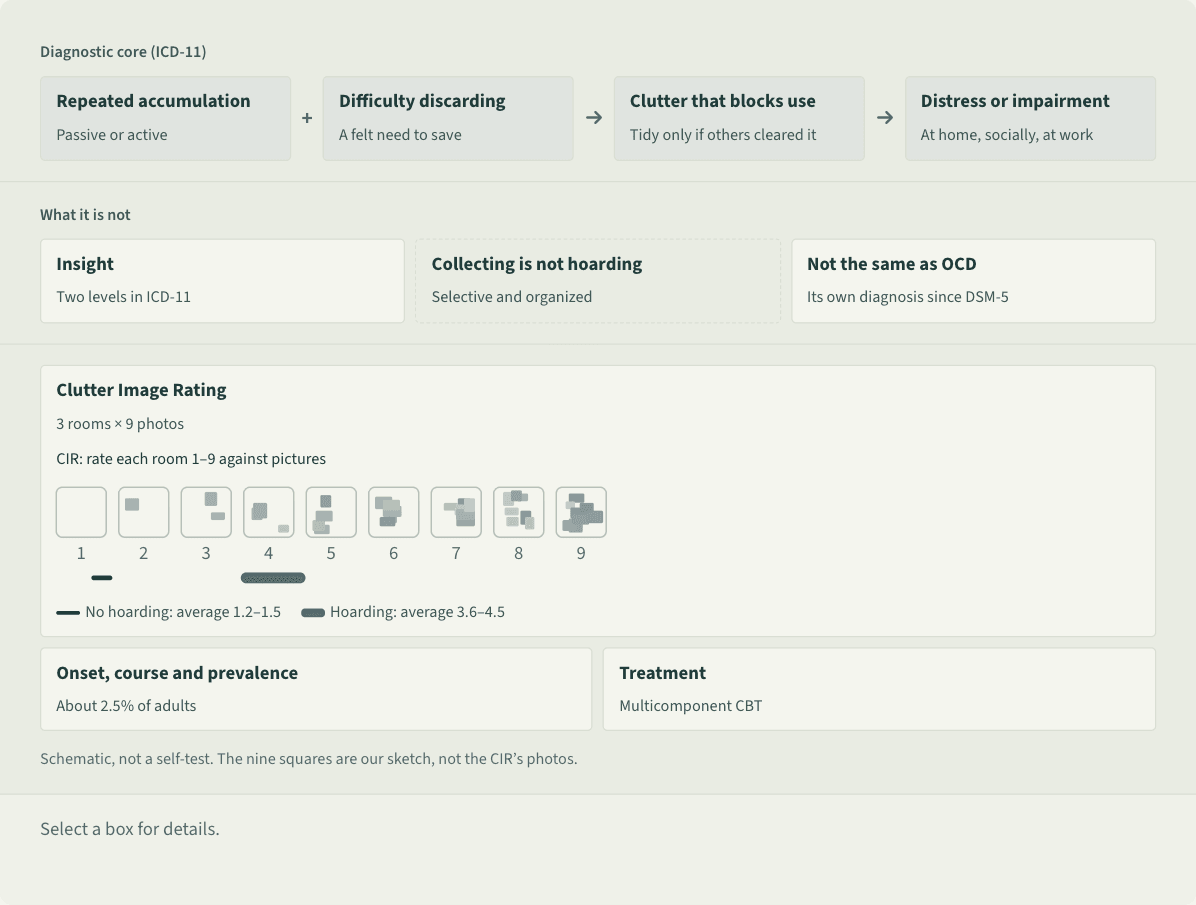
Schematic, not a self-test. The nine squares are our sketch, not the CIR’s photos.
Schematic, not a self-test. At the top, labeled diagnostic core (ICD-11), two cards joined by a plus sign, repeated accumulation (passive or active) and difficulty discarding (a felt need to save), with an arrow to clutter that blocks use of the home and then to distress or impairment. In the middle, labeled what it is not, three cards side by side: insight (two levels in ICD-11), collecting is not hoarding (selective and organized), and not the same as OCD. Below, labeled CIR, rate each room 1 to 9 against pictures, a row of nine squares holding more and more boxes from left to right to show rising clutter; two markers underneath show average scores of about 1.2 to 1.5 for people without hoarding problems and about 3.6 to 4.5 for people with them. At the bottom, two cards: onset, course and prevalence (about 2.5% of adults) and treatment (multicomponent CBT).
 Save as image (PNG)
This figure image is licensed CC BY 4.0: reuse it with credit and a link back to this page. How to reuse
Key points
- Hoarding was long seen as a form of OCD. DSM-5 split it off because most cases cannot be attributed to OCD, the course differs, and OCD treatments work less well.[2]
- Insight varies: some admit the items are useless or the home unsafe; others insist everything must stay. ICD-11 grades it in two levels. Poor insight and shame often deter help-seeking.[1][2]
- A meta-analysis pooling 11 studies of about 53,000 adults put prevalence at about 2.5%, with no sex difference; most of the studies came from Europe and other developed countries.[3]
- The best-supported treatment is multicomponent CBT for hoarding, including home practice in sorting, discarding and not acquiring. Trials are promising, but gains are modest and long-term effects unclear.[2]
An example
Lin collects stamps, buys only planned issues and files them in albums; the rooms stay usable. Ms. Wang’s living room is piled with old newspapers and boxes, and clutter covers the stove. When her daughter offers to help, she says everything will be useful and panics at discarding anything. The difference lies in selectivity, order and whether clutter disrupts life.[1]
Misreadings and limits
Collecting and thrift are not disorders in themselves: collectors are more selective and organized, and ICD-11 warns against mistaking cultural values of saving for disorder.[1] This page is not for self-diagnosis. If clutter gets in the way of cooking, sleeping or moving around, creates fire or other safety risks, or causes real distress, a doctor or mental health professional can help.[1][2]
If you need help now
If you’re struggling to cope or having thoughts of harming yourself:
- US and Canada: call or text 988 (24/7)
- UK and Ireland: Samaritans, 116 123 (free, 24/7)
- Australia: Lifeline, 13 11 14 (24/7)
- Elsewhere: findahelpline.com
If you’re in immediate danger, call your local emergency number.
Psyfield is not a crisis service. Numbers checked October 2026.
Sources
- 1 World Health Organization (2025). 6B24 Hoarding disorder. ICD-11 for mortality and morbidity statistics (2025-01 release). View source
- 2 Mataix-Cols, D., & Fernández de la Cruz, L. (2018). Hoarding disorder has finally arrived, but many challenges lie ahead. World Psychiatry, 17(2), 224–225. doi:10.1002/wps.20531
- 3 Postlethwaite, A., Kellett, S., & Mataix-Cols, D. (2019). Prevalence of hoarding disorder: A systematic review and meta-analysis. Journal of Affective Disorders, 256, 309–316. doi:10.1016/j.jad.2019.06.004
- 4 Dozier, M. E., & Ayers, C. R. (2015). Validation of the Clutter Image Rating in older adults with hoarding disorder. International Psychogeriatrics, 27(5), 769–776. doi:10.1017/S1041610214002403
Last checked against sources: October 28, 2026