Personality disorder
人格障碍
What is a personality disorder?
A personality disorder is a lasting problem (for example, two years or more) with the self, such as identity, self-worth or self-direction, or with relationships, shown in rigid or poorly regulated patterns of thinking, emotion and behavior across many situations and causing marked distress or impairment.[1]
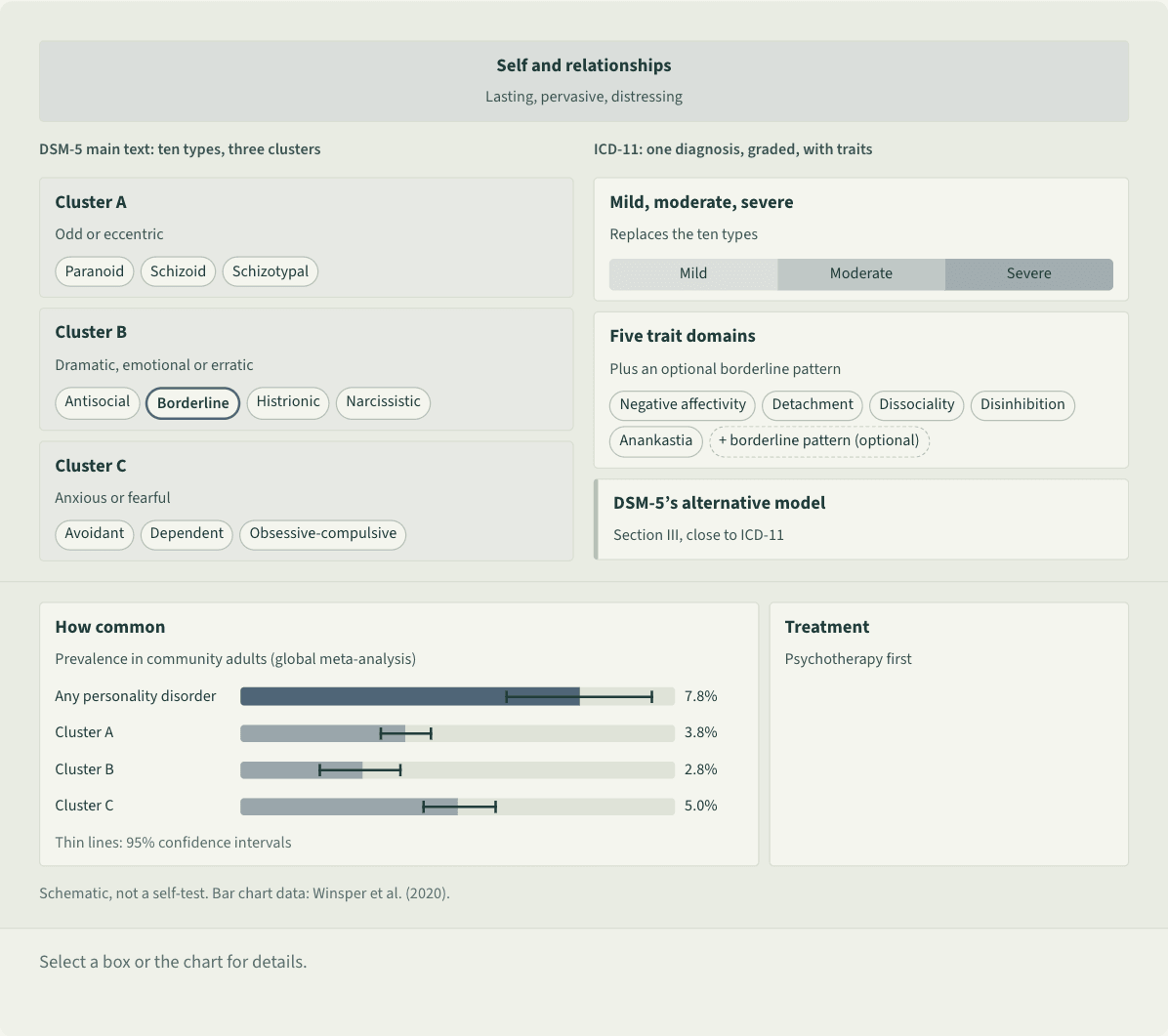
DSM-5 main text: ten types, three clusters
ICD-11: one diagnosis, graded, with traits
Schematic, not a self-test. Bar chart data: Winsper et al. (2020).
Schematic apart from the bar chart, and not a self-test. At the top, a card for self and relationships, subtitled lasting, pervasive, distressing. Below, two columns. The left, labeled DSM-5 main text: ten types, three clusters, has three cards: cluster A (odd or eccentric) listing paranoid, schizoid and schizotypal; cluster B (dramatic, emotional or erratic) listing antisocial, borderline, histrionic and narcissistic; cluster C (anxious or fearful) listing avoidant, dependent and obsessive-compulsive. The right, labeled ICD-11: one diagnosis, graded, with traits, has a bar divided into mild, moderate and severe; five trait domains, negative affectivity, detachment, dissociality, disinhibition and anankastia, plus an optional borderline pattern; and a card for DSM-5’s alternative model. At the bottom, a bar chart titled prevalence in community adults (global meta-analysis): any personality disorder 7.8% (95% CI 6.1–9.5%), cluster A 3.8% (3.2–4.4%), cluster B 2.8% (1.8–3.7%), cluster C 5.0% (4.2–5.9%); beside it a card for treatment, subtitled psychotherapy first.
 Save as image (PNG)
This figure image is licensed CC BY 4.0: reuse it with credit and a link back to this page. How to reuse
Key points
- DSM-5’s main text keeps ten types in three clusters: A (odd or eccentric), B (dramatic or erratic) and C (anxious or fearful). The clusters’ clinical usefulness is not established.[2]
- ICD-11 drops the types: it rates whether a personality disorder is present and how severe, then adds five trait domains and an optional borderline pattern. DSM-5’s Section III model is similar.[1][4]
- A global meta-analysis of community studies estimated that 7.8% of adults have a personality disorder: cluster C 5.0%, A 3.8% and B 2.8%, with wide variation between studies.[3]
- Psychotherapy is the main treatment; medication is used only in some cases, for symptoms such as depression or anxiety.[2] Research centers on borderline and antisocial types; the rest are little studied.[3]
An example
At every job, Jay feels colleagues are plotting against him and takes jokes as attacks. He keeps falling out with bosses and friends, has had five jobs in a few years and is unhappy about it. Whether this is a lasting pattern across situations, or has another explanation, is for a psychiatrist or mental health professional to assess.[1]
Misreadings and limits
A personality disorder is not a flaw of character; genes and environment both contribute.[2] It need not be lifelong: some people no longer meet the criteria by middle age, and behavior seen in only one relationship does not qualify.[1] This page is not for self-diagnosis or labeling others. If emotional or relationship problems keep disrupting life, a psychiatrist or mental health professional can help.
If you need help now
If you’re struggling to cope or having thoughts of harming yourself:
- US and Canada: call or text 988 (24/7)
- UK and Ireland: Samaritans, 116 123 (free, 24/7)
- Australia: Lifeline, 13 11 14 (24/7)
- Elsewhere: findahelpline.com
If you’re in immediate danger, call your local emergency number.
Psyfield is not a crisis service. Numbers checked October 2026.
Sources
- 1 World Health Organization (2025). 6D10 Personality disorder; 6D11 Prominent personality traits or patterns. ICD-11 for mortality and morbidity statistics (2025-01 release). View source
- 2 Zimmerman, M. (2023). Overview of personality disorders. MSD Manual Professional Version (full review September 2023, last updated January 2026). View source
- 3 Winsper, C., Bilgin, A., Thompson, A., Marwaha, S., Chanen, A. M., Singh, S. P., Wang, A., & Furtado, V. (2020). The prevalence of personality disorders in the community: A global systematic review and meta-analysis. The British Journal of Psychiatry, 216(2), 69–78. doi:10.1192/bjp.2019.166
- 4 Bach, B., & First, M. B. (2018). Application of the ICD-11 classification of personality disorders. BMC Psychiatry, 18, 351. doi:10.1186/s12888-018-1908-3
Last checked against sources: October 28, 2026