Intrusive thoughts
闯入性思维
What are intrusive thoughts?
Intrusive thoughts are unwanted thoughts, images or urges that enter the mind involuntarily.[1][2] Nearly everyone has them from time to time. Cognitive models of OCD hold that the intrusions themselves are not the problem; misreading them, or trying to control them in unhelpful ways, is.[1]
Passes
Keeps coming back
Back again
Related
Schematic, not a self-test.
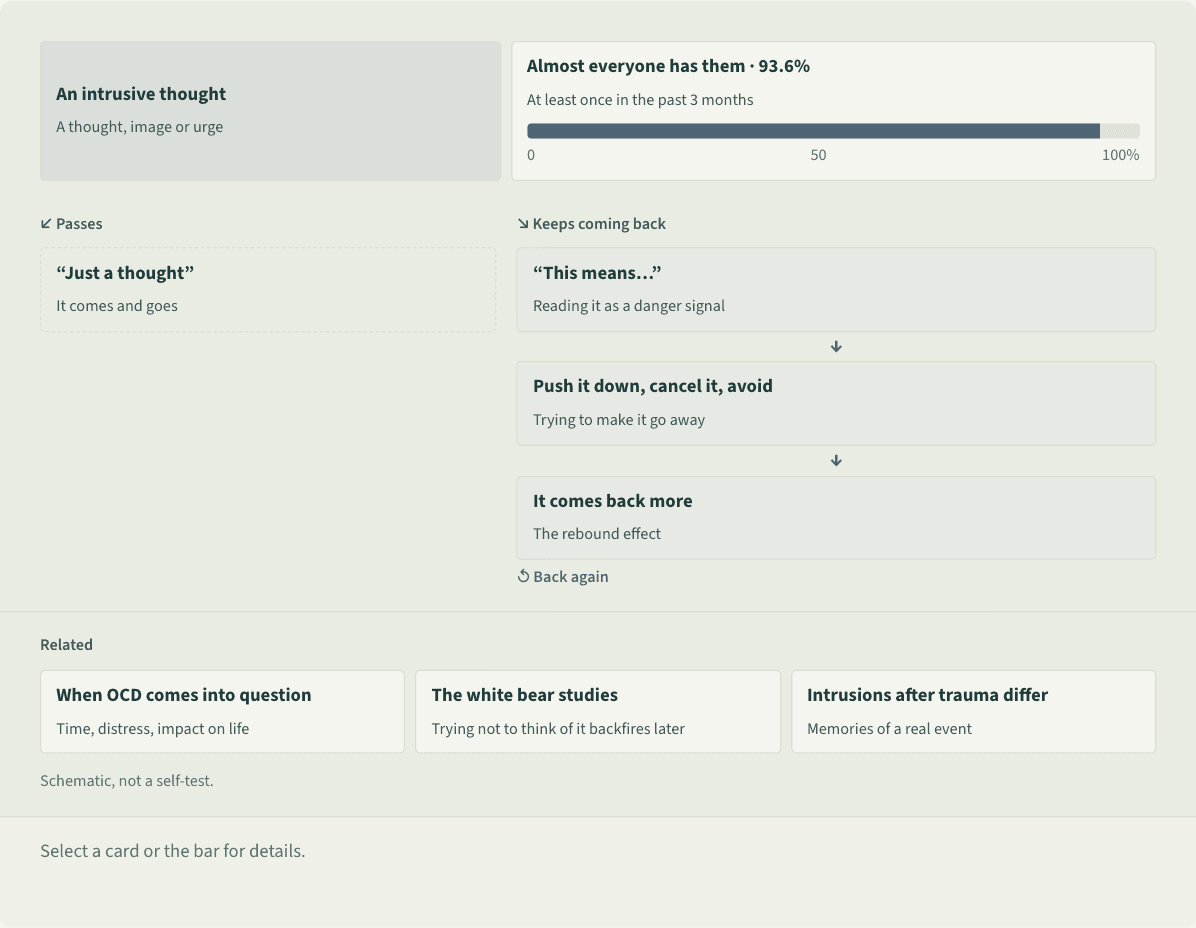
Schematic. At the top, a card labeled intrusive thought (a thought, image or urge), beside a 0–100% bar filled to 93.6% and labeled “at least once in the past three months.” Below it the diagram splits in two. On the left, labeled “passes,” a single card, “just a thought”: the thought itself is normal and usually harmless if left alone. On the right, labeled “keeps coming back,” three cards in sequence: “this means…” (reading the thought as a danger signal, such as inflated responsibility, overestimated threat, or feeling that thinking it is as bad as doing it), “push it down, cancel it out, avoid,” and “comes back more” (the rebound effect), with an arrow looping from the last card back to the thought at the top. At the bottom, three cards: when OCD comes into question (over an hour a day or marked distress); the white bear studies (trying not to think of something makes it return more later); and intrusions after trauma, which are memories of a real event. A note says the figure is a schematic, not a self-test.
 Save as image (PNG)
This figure image is licensed CC BY 4.0: reuse it with credit and a link back to this page. How to reuse
Key points
- Across 13 countries on six continents, 93.6% of 777 students reported an intrusion in the past three months; doubts were most common, sexual or blasphemous ones least.[1]
- ICD-11 notes that thoughts of harming a loved one are common in the general population; OCD is considered only when they take over an hour a day or cause marked distress.[2]
- Cognitive models hold that whether a thought passes harmlessly or causes trouble depends on how it is interpreted and handled.[3] Common OCD beliefs include inflated responsibility, overestimated threat and intolerance of uncertainty.[2]
- In Wegner’s “white bear” studies, people who first suppressed the thought later had it more often.[4] A meta-analysis put this rebound at small to medium; suppression often holds at first.[3]
An example
In a team meeting, a thought pops into Jay’s head: “What if I shouted right now?” Startled, he stays quiet, of course, and keeps telling himself not to think about it. He holds it off through the meeting, but afterward the thought keeps coming back.
Misreadings and limits
Some people take such a thought as proof that, deep down, they want to act on it. Yet thoughts of harming a loved one are common, and treating a thought as being as bad as the act is a typical OCD belief.[2] Images that keep returning after trauma are memories of the event itself; see PTSD.[2] Time-consuming, distressing thoughts merit an assessment.[2]
Sources
- 1 Radomsky, A. S., Alcolado, G. M., Abramowitz, J. S., Alonso, P., Belloch, A., Bouvard, M., Clark, D. A., Coles, M. E., Doron, G., Fernández-Álvarez, H., Garcia-Soriano, G., Ghisi, M., Gomez, B., Inozu, M., Moulding, R., Shams, G., Sica, C., Simos, G., & Wong, W. (2014). Part 1—You can run but you can’t hide: Intrusive thoughts on six continents. Journal of Obsessive-Compulsive and Related Disorders, 3(3), 269–279. doi:10.1016/j.jocrd.2013.09.002
- 2 World Health Organization (2025). 6B20 Obsessive-compulsive disorder. ICD-11 for mortality and morbidity statistics (2025-01 release). View source
- 3 Magee, J. C., Harden, K. P., & Teachman, B. A. (2012). Psychopathology and thought suppression: A quantitative review. Clinical Psychology Review, 32(3), 189–201. doi:10.1016/j.cpr.2012.01.001
- 4 Wenzlaff, R. M., & Wegner, D. M. (2000). Thought suppression. Annual Review of Psychology, 51, 59–91. doi:10.1146/annurev.psych.51.1.59
Last checked against sources: October 28, 2026