Exposure and response prevention
暴露与反应预防
What is exposure and response prevention (ERP)?
Exposure and response prevention (ERP) is the first-line psychotherapy for obsessive-compulsive disorder (OCD): with a therapist, the person repeatedly faces situations that trigger obsessions, from easier to harder, without performing the compulsions that ease the anxiety.[1] UK NICE guidance includes it in the recommended treatment for adults at every level of severity.[2]
The OCD cycle
Negative reinforcement
ERP breaks the cycle here
How ERP proceeds
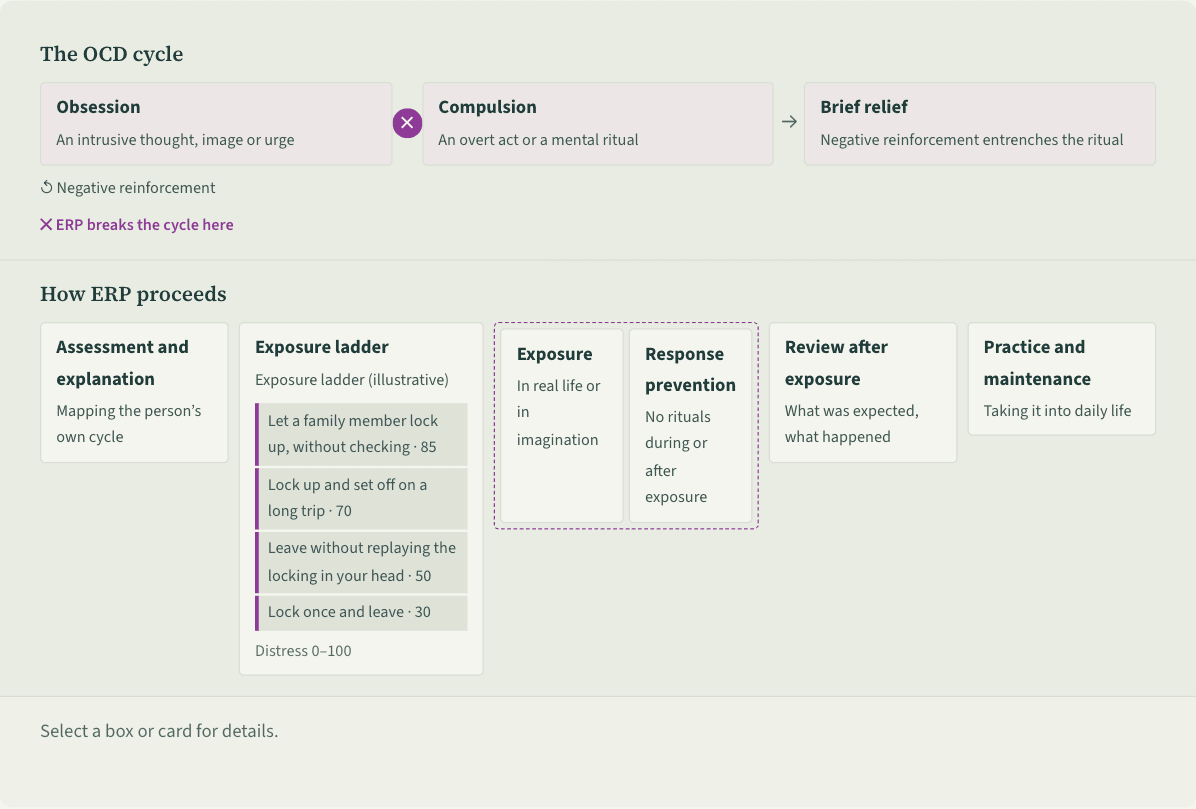
Schematic in two parts. At the top, a cycle of three boxes: obsession (an intrusive thought, image or urge) points to compulsion (an overt act or a mental ritual), which points to brief relief, labeled negative reinforcement, and the arrow returns to the obsession. The arrow from obsession to compulsion carries a cut mark labeled “ERP breaks the cycle here.” Below are ERP’s five steps, left to right: assessment and explanation; the exposure ladder; exposure and response prevention, shown as two cards side by side; review after exposure; practice and maintenance. The ladder has four rungs, bottom to top: lock once and leave (30); leave without replaying the locking in your head (50); lock up and set off on a long trip (70); let a family member lock up, without checking (85). The numbers are illustrative distress ratings from 0 to 100.
 Save as image (PNG)
This figure image is licensed CC BY 4.0: reuse it with credit and a link back to this page. How to reuse
Key points
- DSM-5 moved OCD out of the anxiety disorders.[4] Compulsions briefly relieve the anxiety obsessions cause, and that relief reinforces them, as in the avoidance cycle.[1]
- Triggers are ranked by distress and faced step by step, in real life or in imagination.[1] For people without overt compulsions, NICE advises exposure to the obsessions while preventing mental rituals.[2]
- On the inhibitory learning view, the aim is tolerating distress and uncertainty without rituals, not waiting for anxiety to fall; after each exposure, expectations are compared with what happened.[1]
- In a meta-analysis of 36 randomized trials, ERP beat psychological placebo but not other active psychotherapies, and three quarters of the trials showed signs of researcher allegiance.[3]
An example
Jay goes back to check his door lock a dozen times before leaving. In therapy he starts low on his ladder: lock once, walk away, and don’t replay the locking in his head. The first few times he feels restless. Afterward he writes down that nothing happened at home and that he got through the unease.
Misreadings and limits
ERP is often pictured as forcing yourself to quit every ritual at once, something you can learn from an online guide. It is a graded treatment, and NICE expects those who deliver it to be trained and supervised.[2] Even so, 20–30% of people drop out and about half reach remission.[1] Whether symptoms amount to OCD also needs a professional assessment.
Sources
- 1 Hezel, D. M., & Simpson, H. B. (2019). Exposure and response prevention for obsessive-compulsive disorder: A review and new directions. Indian Journal of Psychiatry, 61(Suppl 1), S85–S92. doi:10.4103/psychiatry.IndianJPsychiatry_516_18
- 2 National Institute for Health and Care Excellence (2005). Obsessive-compulsive disorder and body dysmorphic disorder: Treatment (CG31). NICE clinical guideline (presentational update May 2024). View source
- 3 Reid, J. E., Laws, K. R., Drummond, L., Vismara, M., Grancini, B., Mpavaenda, D., & Fineberg, N. A. (2021). Cognitive behavioural therapy with exposure and response prevention in the treatment of obsessive-compulsive disorder: A systematic review and meta-analysis of randomised controlled trials. Comprehensive Psychiatry, 106, 152223. doi:10.1016/j.comppsych.2021.152223
- 4 Fineberg, N. A., Apergis-Schoute, A. M., Vaghi, M. M., Banca, P., Gillan, C. M., Voon, V., Chamberlain, S. R., Cinosi, E., Reid, J., Shahper, S., Bullmore, E. T., Sahakian, B. J., & Robbins, T. W. (2018). Mapping compulsivity in the DSM-5 obsessive compulsive and related disorders: Cognitive domains, neural circuitry, and treatment. International Journal of Neuropsychopharmacology, 21(1), 42–58. doi:10.1093/ijnp/pyx088
Last checked against sources: October 28, 2026