Self-esteem
自尊
What is self-esteem?
Self-esteem is a person’s subjective evaluation of their worth as a person, which need not match their actual abilities. It usually means global self-esteem, as distinct from self-ratings in domains such as school or appearance. The most widely used measure is Rosenberg’s 1965 Self-Esteem Scale.[1]
Change since age 4 (SD)
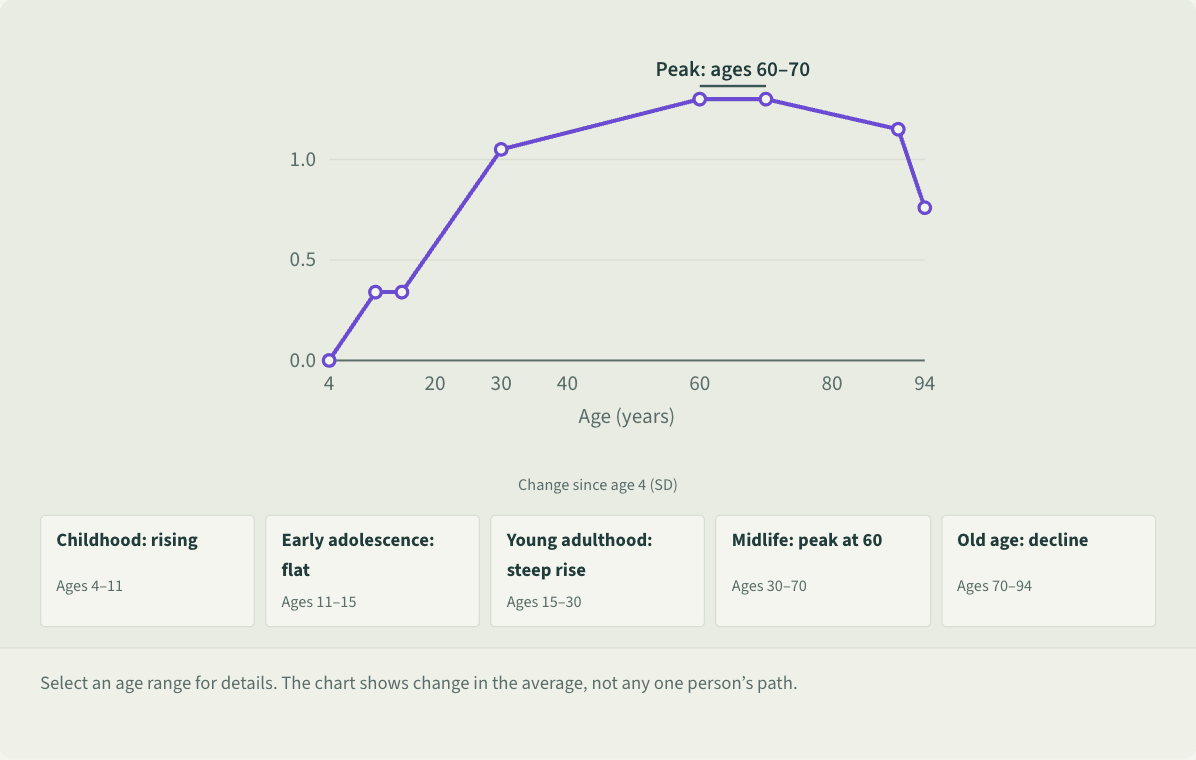
A line chart. The horizontal axis is age, from 4 to 94; the vertical axis is cumulative change relative to age 4, in standard deviations, from 0 to 1.4. The line rises from 0 at age 4 to 0.34 at 11, stays at 0.34 until 15, climbs steeply to 1.05 at 30, rises slowly to 1.30 at 60 and holds there until 70, falls to 1.15 at 90, then drops faster to 0.76 at 94. Five segments below the chart, childhood, early adolescence, young adulthood, midlife and old age, can be selected for details.
 Save as image (PNG)
This figure image is licensed CC BY 4.0: reuse it with credit and a link back to this page. How to reuse
Key points
- A meta-analysis of 331 longitudinal samples found that self-esteem rises in childhood, holds steady from 11 to 15, keeps rising through adulthood, peaks around 60, and declines after 70.[2]
- High self-esteem is not narcissism. Self-esteem is self-acceptance and self-respect; narcissism is superiority, grandiosity and entitlement. The two correlate only about .30 to .40.[1]
- People stake their worth on different domains, such as looks, others’ approval, grades or virtue. In first-year students, basing worth on external domains like looks or approval went with more problems.[4]
- High self-esteem comes in kinds. People whose high self-esteem is unstable score higher on hostility than people with low self-esteem; those whose high self-esteem is stable score lowest.[3]
An example
Jay is applying to graduate programs. Each acceptance makes him feel he is worth something; each rejection leaves him low for days. In Crocker’s study of college seniors, the more students based their self-esteem on academics, the more it rose on acceptance days and the more it fell after rejections.[4]
Misreadings and limits
In 1986 California funded a self-esteem task force, hoping that raising self-esteem would reduce crime and school failure. A 2003 review found only modest links with grades, partly because doing well raises self-esteem, and no evidence that boosting programs improved achievement.[3] Later longitudinal studies put self-esteem’s average effect on later outcomes at about .10, a small effect.[1]
Sources
- 1 Orth, U., & Robins, R. W. (2022). Is high self-esteem beneficial? Revisiting a classic question. American Psychologist, 77(1), 5–17. doi:10.1037/amp0000922
- 2 Orth, U., Erol, R. Y., & Luciano, E. C. (2018). Development of self-esteem from age 4 to 94 years: A meta-analysis of longitudinal studies. Psychological Bulletin, 144(10), 1045–1080. doi:10.1037/bul0000161
- 3 Baumeister, R. F., Campbell, J. D., Krueger, J. I., & Vohs, K. D. (2003). Does high self-esteem cause better performance, interpersonal success, happiness, or healthier lifestyles?. Psychological Science in the Public Interest, 4(1), 1–44. doi:10.1111/1529-1006.01431
- 4 Crocker, J., & Park, L. E. (2004). The costly pursuit of self-esteem. Psychological Bulletin, 130(3), 392–414. doi:10.1037/0033-2909.130.3.392
Last checked against sources: October 27, 2026