Eating disorders
进食障碍
What are eating disorders?
Eating disorders are mental disorders of abnormal eating behavior and preoccupation with food, usually with intense concern about weight or shape, that harm health, cause marked distress or disrupt daily life. The main types are anorexia nervosa, bulimia nervosa and binge eating disorder.[1]
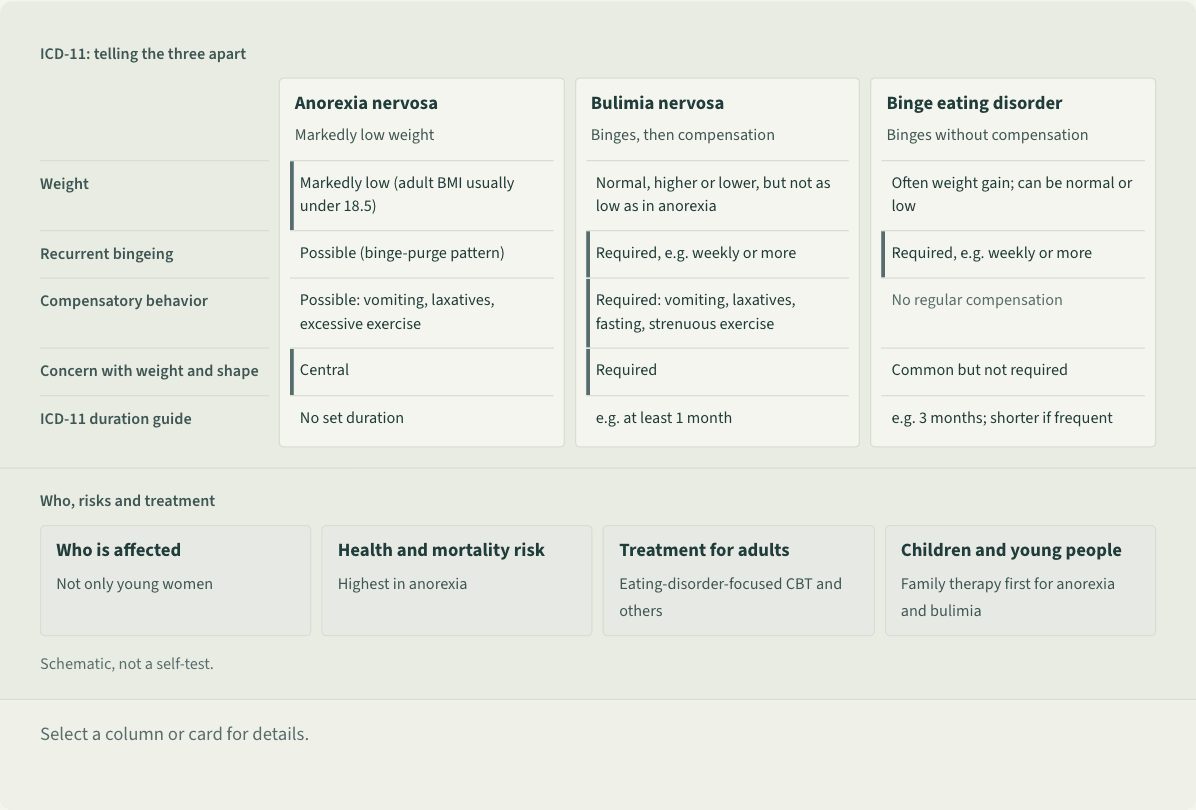
ICD-11: telling the three apart
Who, risks and treatment
Schematic, not a self-test.
Schematic. At the top, a three-column table compares anorexia nervosa, bulimia nervosa and binge eating disorder across five rows: weight, recurrent bingeing, compensatory behavior, concern with weight and shape, and ICD-11 duration guide. Anorexia nervosa: markedly low weight (adult BMI usually under 18.5); bingeing possible (binge-purge pattern); vomiting, laxatives or excessive exercise possible; concern with weight and shape central; no set duration. Bulimia nervosa: weight normal, higher or lower but not as low as in anorexia; recurrent bingeing required; compensation such as vomiting, laxatives, fasting or strenuous exercise required; concern with weight and shape required; for example at least 1 month. Binge eating disorder: often weight gain, but weight can be normal or low; recurrent bingeing required; no regular compensation; concern with weight and shape common but not required; for example 3 months, shorter if episodes are frequent. Below the table, four cards: who is affected (any age, highest risk at 13–17 in both sexes, about 30% of the health loss in men); health and mortality risk (highest in anorexia); treatment for adults (eating-disorder-focused CBT and others); treatment for children and young people (family therapy first for anorexia and bulimia). A note says the figure is a schematic, not a self-test.
 Save as image (PNG)
This figure image is licensed CC BY 4.0: reuse it with credit and a link back to this page. How to reuse
Key points
- Anorexia nervosa centers on markedly low weight; bulimia nervosa on binges followed by vomiting, fasting or other compensation; binge eating disorder on recurrent binges without regular compensation.[1]
- About 55.5 million people had an eating disorder in 2019, binge eating disorder outnumbering anorexia and bulimia combined.[2] They can start at any age; risk is highest at 13–17 in both sexes.[3]
- Anorexia carries the highest risk, often via starvation complications or suicide.[1] After inpatient treatment, death rates exceed five times those of same-age, same-sex peers; in outpatient anorexia and bulimia, about double.[4]
- NICE puts psychological treatment first: eating-disorder-focused CBT for adults, family therapy first for young people with anorexia or bulimia, and never medication alone.[3]
An example
Ms. Wang is in her forties. For six months she has often eaten a whole bag of bread and snacks alone after working late, unable to stop though not hungry, then felt ashamed. At work the next day no one can tell. She mentions it at a checkup, and her doctor suggests a mental health assessment.
Misreadings and limits
A common misconception is that only thin young women are affected: about 30% of the global health loss from eating disorders falls on men,[2] and people with bulimia or binge eating disorder can be of normal weight.[1] Online screening quizzes cannot diagnose. Worries about yourself or a relative warrant seeing a doctor soon; fainting, palpitations or thoughts of suicide need help right away.[3]
If you need help now
If you’re struggling to cope or having thoughts of harming yourself:
- US and Canada: call or text 988 (24/7)
- UK and Ireland: Samaritans, 116 123 (free, 24/7)
- Australia: Lifeline, 13 11 14 (24/7)
- Elsewhere: findahelpline.com
If you’re in immediate danger, call your local emergency number.
Psyfield is not a crisis service. Numbers checked October 2026.
Sources
- 1 World Health Organization (2025). Feeding or eating disorders: 6B80 Anorexia nervosa; 6B81 Bulimia nervosa; 6B82 Binge eating disorder. ICD-11 for mortality and morbidity statistics (2025-01 release). View source
- 2 Santomauro, D. F., Melen, S., Mitchison, D., Vos, T., Whiteford, H., & Ferrari, A. J. (2021). The hidden burden of eating disorders: An extension of estimates from the Global Burden of Disease Study 2019. The Lancet Psychiatry, 8(4), 320–328. doi:10.1016/S2215-0366(21)00040-7
- 3 National Institute for Health and Care Excellence (2017). Eating disorders: Recognition and treatment (NG69). NICE guideline (published May 23, 2017; last updated December 16, 2020). View source
- 4 van Hoeken, D., & Hoek, H. W. (2020). Review of the burden of eating disorders: Mortality, disability, costs, quality of life, and family burden. Current Opinion in Psychiatry, 33(6), 521–527. doi:10.1097/YCO.0000000000000641
Last checked against sources: October 28, 2026