Attachment strategies
依恋策略
What are hyperactivating and deactivating attachment strategies?
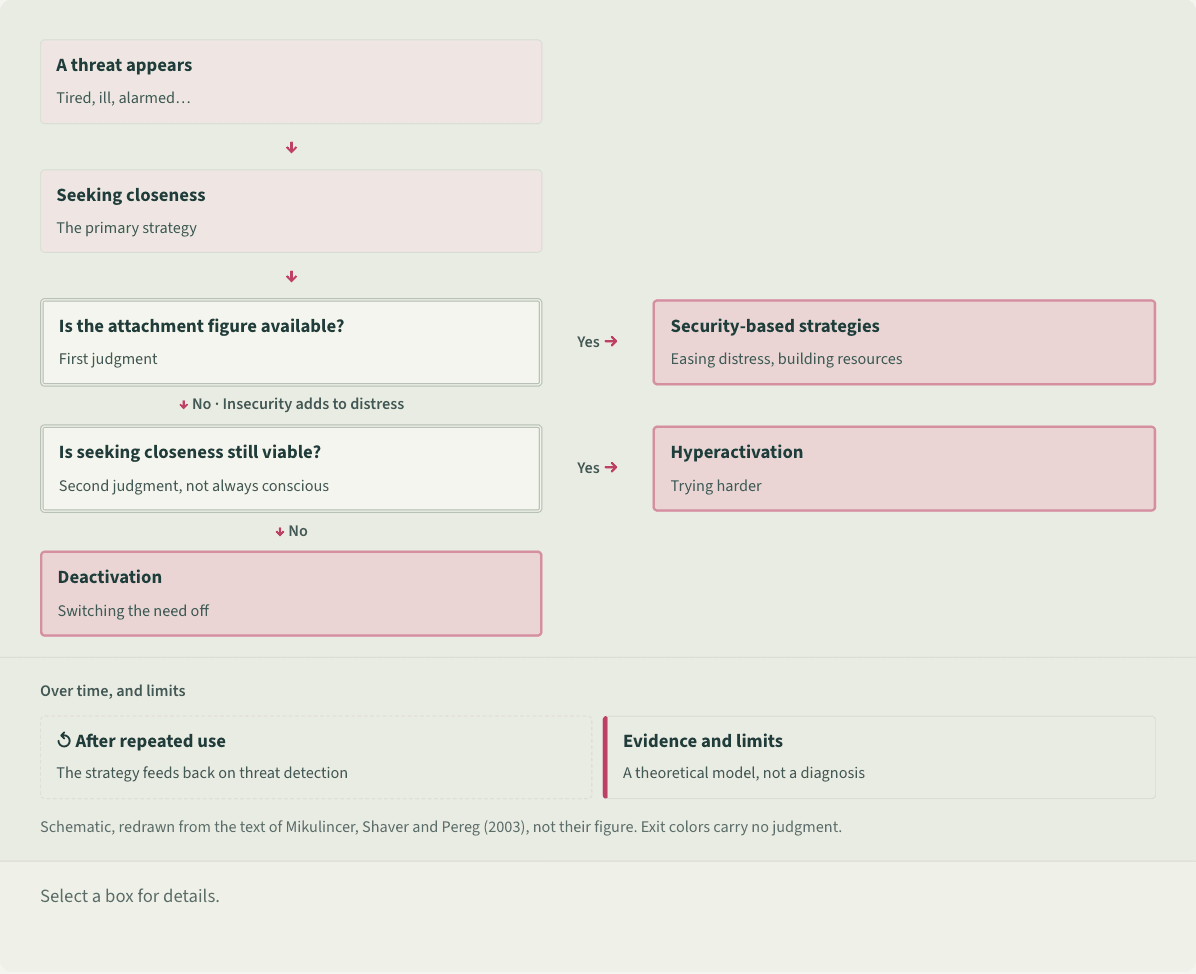
Attachment strategies are the ways people regulate distress once a threat activates the attachment system. In Mikulincer and colleagues’ model, an available attachment figure leads to security-based strategies; when the figure is unavailable, people hyperactivate if seeking closeness still seems viable and deactivate if it does not.[1]
Over time, and limits
Schematic, redrawn from the text of Mikulincer, Shaver and Pereg (2003), not their figure. Exit colors carry no judgment.
Schematic flowchart, top to bottom: threat appears, arrow to seeking closeness, arrow to a first diamond asking whether the attachment figure is available. Yes leads right to the exit security-based strategies; no leads down, labeled insecurity adds to distress, to a second diamond asking whether seeking closeness is still viable. Yes leads right to the exit hyperactivation; no leads down to the exit deactivation. Below the chart, two cards: a dashed one, after repeated use, and evidence and limits.
 Save as image (PNG)
This figure image is licensed CC BY 4.0: reuse it with credit and a link back to this page. How to reuse
Key points
- With an available figure, people acknowledge and show distress, seek support and work on the problem; with development these functions are internalized, so adults can also draw on inner resources.[1]
- Hyperactivation means insistent efforts to win closeness, care and love, such as clinging or controlling, with vigilance for signs of waning interest and rumination on threats; it marks high attachment anxiety.[1]
- Deactivation means suppressing the urge to seek closeness, denying attachment needs and keeping distance through self-reliance, while tuning out threats and suppressing painful thoughts; it marks high attachment avoidance.[1]
- They are thought to grow from different histories: closeness met with disapproval or punishment fosters deactivation, while a figure who responds only sometimes, so persistence occasionally pays off, fosters hyperactivation.[2]
An example
Ms. Wang gets an abnormal test result and calls her husband, away on business; he doesn’t pick up. One response: calling every few minutes and sending message after message, growing sure he doesn’t care. Another: turning the phone face down, deciding “There’s nothing to say,” and coping alone. The first resembles hyperactivation, the second deactivation.
Misreadings and limits
These strategies describe tendencies, not fixed personality labels. The authors note that their framework for how the strategies form has not been tested as a whole.[1] In experiments, “security priming” with reminders of supportive figures improves mood, but samples are mostly students and single primes tend to have short-lived effects.[3]
Sources
- 1 Mikulincer, M., Shaver, P. R., & Pereg, D. (2003). Attachment theory and affect regulation: The dynamics, development, and cognitive consequences of attachment-related strategies. Motivation and Emotion, 27(2), 77–102. doi:10.1023/A:1024515519160
- 2 Mikulincer, M., & Shaver, P. R. (2012). An attachment perspective on psychopathology. World Psychiatry, 11(1), 11–15. doi:10.1016/j.wpsyc.2012.01.003
- 3 Rowe, A. C., Gold, E. R., & Carnelley, K. B. (2020). The effectiveness of attachment security priming in improving positive affect and reducing negative affect: A systematic review. International Journal of Environmental Research and Public Health, 17(3), Article 968. doi:10.3390/ijerph17030968
Last checked against sources: October 28, 2026