Internal working models
内部工作模型
What are internal working models in attachment theory?
Internal working models are a cornerstone of Attachment theory: mental representations, formed through interactions with attachment figures, of the self (am I acceptable in their eyes?) and of others (are they accessible, and how will they respond?), which people use to understand and predict relationship events.[1]
Working models
Structure and evidence
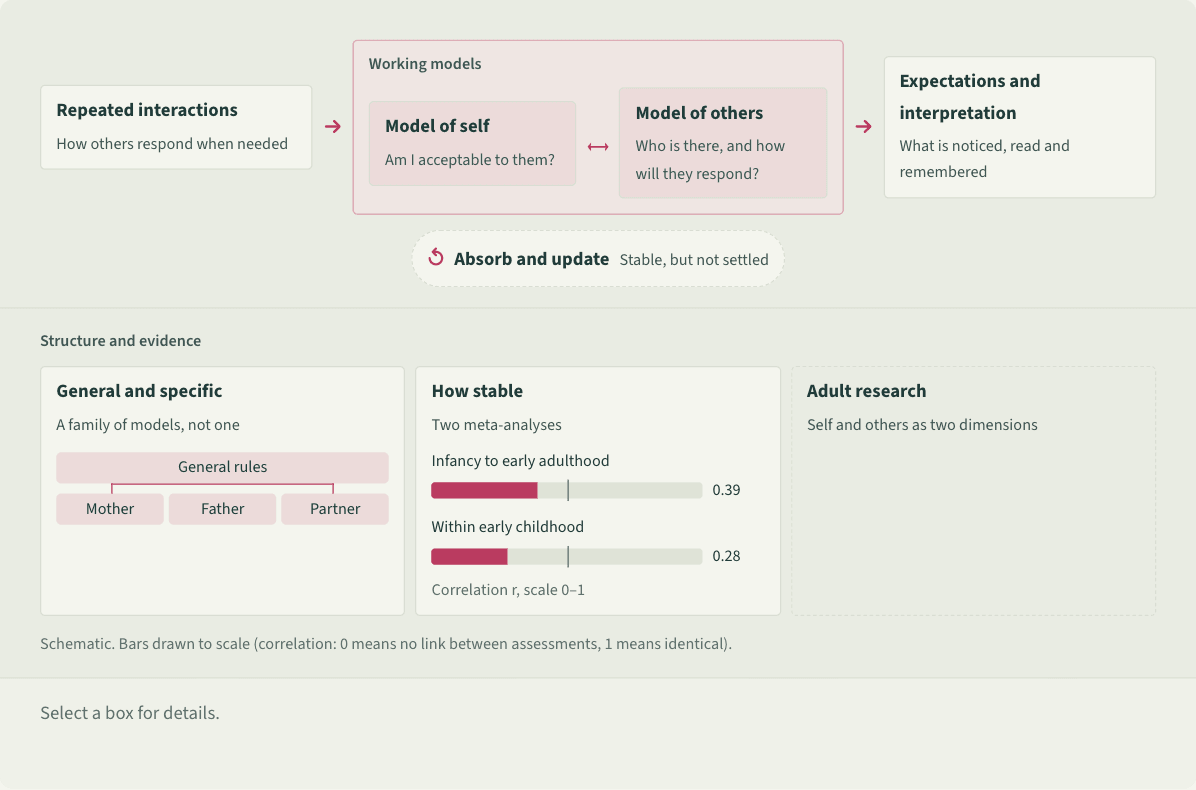
Schematic. Bars drawn to scale (correlation: 0 means no link between assessments, 1 means identical).
Schematic. At the top, three cards form a loop from left to right: repeated interactions; in the middle, working models, split into a model of self and a model of others; on the right, expectations and interpretation, with an arrow labeled absorb and update curving back to repeated interactions. Below, labeled structure and evidence, three cards: general and specific, showing a layer of general rules above three small boxes for mother, father and partner; how stable, with two bars drawn to scale on a correlation axis from 0 to 1, infancy to early adulthood 0.39 and within early childhood 0.28; and adult research.
 Save as image (PNG)
This figure image is licensed CC BY 4.0: reuse it with credit and a link back to this page. How to reuse
Key points
- Theory holds that children with available, responsive and reliable caregivers come to see themselves as acceptable and worthwhile; inconsistent or unresponsive care is thought to leave a sense of being unacceptable.[1]
- Working models are thought to steer what people notice, how they read events and what they remember, increasingly automatically and outside awareness. Because they absorb fitting information, they tend to stay stable.[1]
- They are thought to form a hierarchy, from general rules about attachment relationships to models of specific people like a parent or partner; general and specific measures correlate below .40.[1]
- Meta-analyses find an average correlation of .39 between repeated assessments of attachment security from infancy to early adulthood, not significant over gaps longer than 15 years;[2] in early childhood, .28.[3]
An example
When Jay hits a problem at work, he calls his sister first and rarely tells his father. He expects his sister to hear him out and his father to say only, “Figure it out yourself.” Jay already holds expectations about who will respond and how, and they differ by person: the “others” side of a working model.
Misreadings and limits
A common claim is that attachment patterns, once formed, are fixed for life. Bowlby held that meaningful relationships in adolescence and adulthood can shift them, and studies find attachment changing with recent experiences and relationships.[4] The concept itself also remains loosely specified, with many core features not yet shown empirically.[1]
Sources
- 1 Pietromonaco, P. R., & Barrett, L. F. (2000). The internal working models concept: What do we really know about the self in relation to others?. Review of General Psychology, 4(2), 155–175. doi:10.1037/1089-2680.4.2.155
- 2 Pinquart, M., Feußner, C., & Ahnert, L. (2013). Meta-analytic evidence for stability in attachments from infancy to early adulthood. Attachment & Human Development, 15(2), 189–218. doi:10.1080/14616734.2013.746257
- 3 Opie, J. E., McIntosh, J. E., Esler, T. B., Duschinsky, R., George, C., Schore, A., Kothe, E. J., Tan, E. S., Greenwood, C. J., & Olsson, C. A. (2021). Early childhood attachment stability and change: A meta-analysis. Attachment & Human Development, 23(6), 897–930. doi:10.1080/14616734.2020.1800769
- 4 Mikulincer, M., & Shaver, P. R. (2012). An attachment perspective on psychopathology. World Psychiatry, 11(1), 11–15. doi:10.1016/j.wpsyc.2012.01.003
Last checked against sources: October 28, 2026