Acceptance and commitment therapy
接纳承诺疗法
A mindfulness- and acceptance-based behavior therapy introduced by Steven C. Hayes in the early 1990s. It aims to raise psychological flexibility by balancing acceptance with change.[1][2]
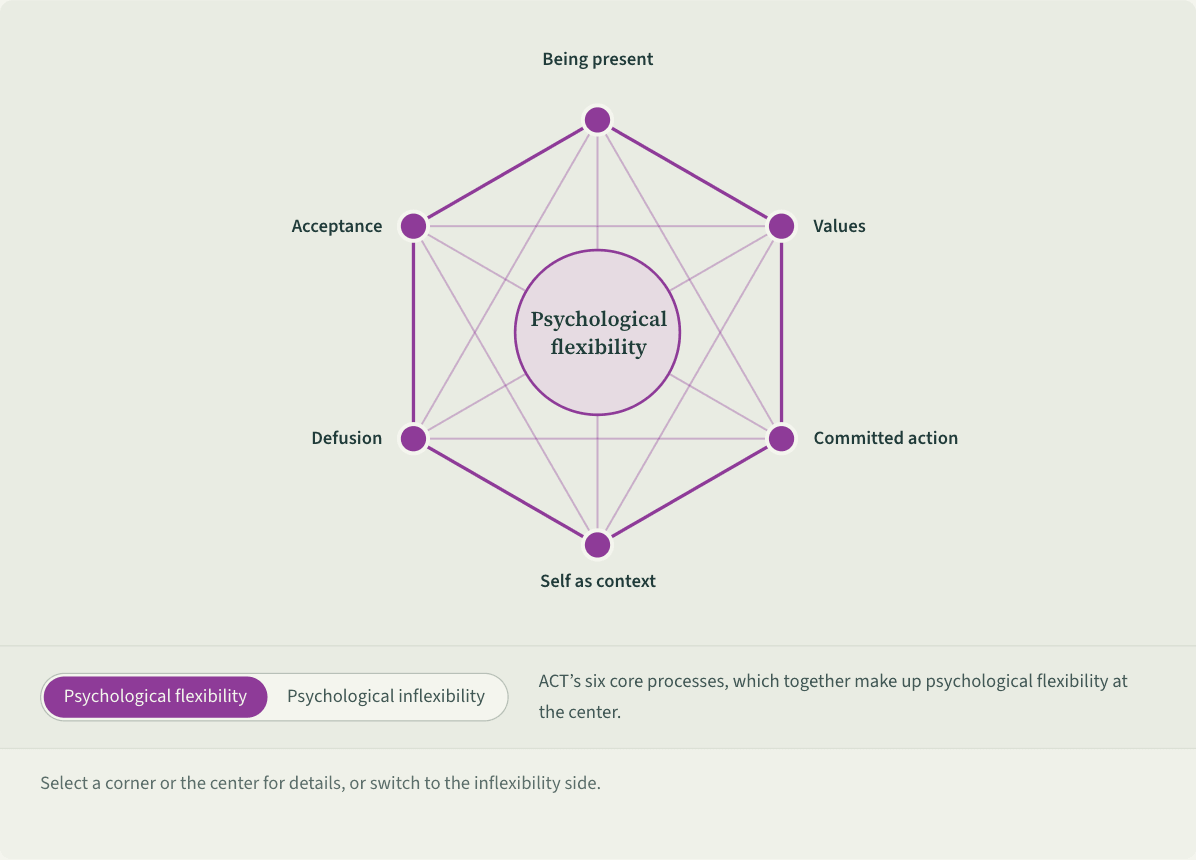
A hexagon. At the center is “psychological flexibility”; the six corners, clockwise from the top, are being present, values, committed action, self as context, defusion and acceptance, each linked to the others. Switched to the inflexibility side, the center reads “psychological inflexibility” and the corners become: conceptualized past and future, lack of values clarity, inaction or impulsivity, attachment to the conceptualized self, cognitive fusion and experiential avoidance. Selecting a corner describes that process and its inflexible counterpart.
 Save as image (PNG)
Key points
- It names six core processes: acceptance, cognitive defusion, being present, self as context, values and committed action.[1]
- It traces psychological inflexibility to processes such as avoiding inner experiences, fusing with thoughts, and living in a conceptualized past or future.[1]
- A review of 20 meta-analyses (12,477 participants) found ACT effective for anxiety, depression, substance use and pain, but it was not shown to outperform CBT.[3]
- A Chinese meta-analytic structural equation study found that psychological flexibility, acceptance, present-moment contact and values were significant mediators, while defusion was not.[4]
An example
Before every presentation Zhou thinks, “I’ll embarrass myself.” Practicing ACT, he restates it as “I notice I’m having the thought that I’ll embarrass myself,” and keeps preparing despite the nerves, because doing good work with his team matters to him.
Misreadings and limits
Acceptance here does not mean resignation. ACT pairs acceptance with change, persisting in or changing behavior when that serves one’s values.[1][2] Reviews find it effective for several conditions, but not that it beats traditional CBT.[3]
Sources
- 1 Hayes, S. C., Luoma, J. B., Bond, F. W., Masuda, A., & Lillis, J. (2006). Acceptance and commitment therapy: Model, processes and outcomes. Behaviour Research and Therapy, 44(1), 1–25. doi:10.1016/j.brat.2005.06.006
- 2 曾祥龙, 刘翔平, 于是 (2011). 接纳与承诺疗法的理论背景、实证研究与未来发展 [The theoretical background, empirical study and future development of the acceptance and commitment therapy]. 心理科学进展 (Advances in Psychological Science), 19(7), 1020–1026. View source
- 3 Gloster, A. T., Walder, N., Levin, M. E., Twohig, M. P., & Karekla, M. (2020). The empirical status of acceptance and commitment therapy: A review of meta-analyses. Journal of Contextual Behavioral Science, 18, 181–192. doi:10.1016/j.jcbs.2020.09.009
- 4 任志洪, 赵春晓, 卞诚, 朱文臻, 江光荣, 祝卓宏 (2019). 接纳承诺疗法的作用机制——基于元分析结构方程模型 [The mechanism of acceptance and commitment therapy: A meta-analytic structural equation model]. 心理学报 (Acta Psychologica Sinica), 51(6), 662–676. doi:10.3724/SP.J.1041.2019.00662
Last checked against sources: October 26, 2026