Models of communication
沟通模式
What are models of communication?
Models of communication are simplified diagrams of the communication process that make its parts and steps visible.[2] An introductory textbook presents three: the one-way transmission (linear) model, the interaction model, which adds feedback, and the transaction model, in which people send and receive at once.[2]
Three models
Four kinds of noise
A common diagram, and an experiment
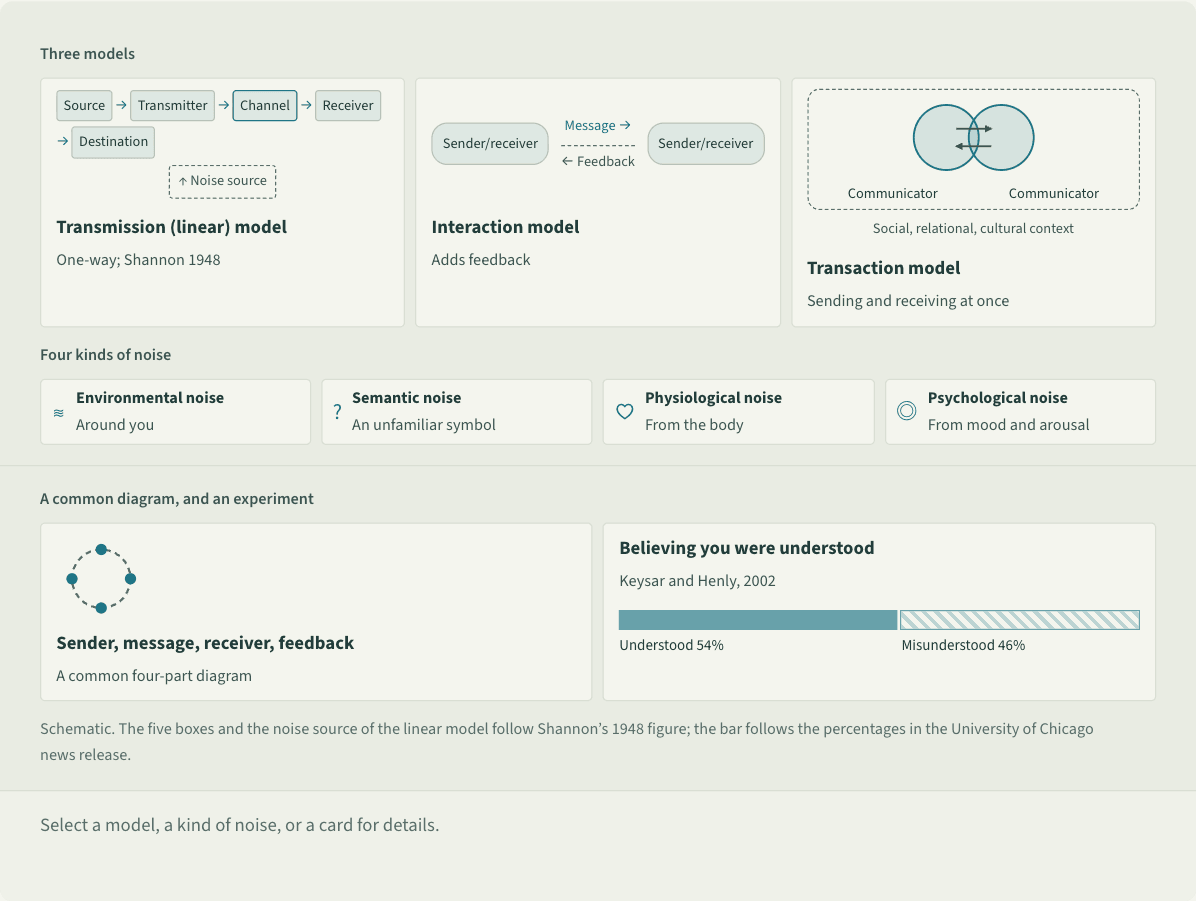
Schematic. The five boxes and the noise source of the linear model follow Shannon’s 1948 figure; the bar follows the percentages in the University of Chicago news release.
Three cards at the top each hold a sketch. Linear model: five boxes in a row, left to right, for source, transmitter, channel, receiver and destination, with a noise source pointing at the signal above the channel. Interaction model: a message arrow runs between two figures and a feedback arrow loops back beneath it; both figures are labeled sender/receiver. Transaction model: two overlapping circles labeled communicator, joined by two arrows running both ways at once, inside a ring of social, relational and cultural context. Four tags in the middle name four kinds of noise: environmental, semantic, physiological and psychological. Two cards at the bottom: the common diagram with sender, message, receiver and feedback in a loop, and a 2002 experiment, with one bar showing that of the times speakers believed they had been understood, about 54% they were and 46% they were misunderstood.
 Save as image (PNG)
This figure image is licensed CC BY 4.0: reuse it with credit and a link back to this page. How to reuse
Key points
- The linear model traces to Shannon’s 1948 telecom diagram: a source’s message becomes a signal sent over a channel, and a receiver rebuilds it for the destination while a noise source interferes.[1]
- The interaction model adds feedback: people take turns sending and receiving, and a reply, spoken or nonverbal (pointing at the sofa), is itself a message. Physical and psychological context count too.[2]
- The transaction model holds that people send and receive at once, adjusting mid-sentence to the other’s face. It adds social, relational and cultural context, and sees communication as building relationships and self-concepts.[2]
- Anything that interferes with a message is noise: environmental (a noisy room), semantic (an unfamiliar word or symbol), physiological (a headache, illness) or psychological (stress, strong emotion).[2]
An example
Ms. Wang answers a colleague in a work chat with “Fine, I guess,” meaning yes; the colleague reads reluctance. In the transmission model this is semantic noise. In the interaction model, the colleague’s reply, “Do you have concerns?”, is feedback that lets her explain at once.
Misreadings and limits
A common misreading is that a clear sender guarantees understanding. When speakers read ambiguous sentences in one experiment, nearly half the times they believed they had been understood, they had not.[3] The models also simplify: Shannon called meaning irrelevant to his engineering problem,[1] and the textbook notes that no model recreates communication as experienced.[2]
Sources
- 1 Shannon, C. E. (1948). A mathematical theory of communication. Bell System Technical Journal, 27(3), 379–423. doi:10.1002/j.1538-7305.1948.tb01338.x The link is the Bell Labs reprint with corrections (both parts), hosted by the Harvard mathematics department.
- 2 University of Minnesota Libraries Publishing (2016). Communication in the real world: An introduction to communication studies (§1.2 The communication process; §5.2 Barriers to effective listening). Open textbook (CC BY-NC-SA), SUNY / Lumen Learning edition. View source An open textbook adapted from a 2013 commercial text whose publisher asked not to be credited. The University of Minnesota has withdrawn it; the link is the State University of New York edition on Lumen Learning.
- 3 Keysar, B., & Henly, A. S. (2002). Speakers’ overestimation of their effectiveness. Psychological Science, 13(3), 207–212. doi:10.1111/1467-9280.00439 The sample size and percentages are from the University of Chicago news release of May 9, 2002 (University of Chicago Chronicle).
Last checked against sources: October 28, 2026