Nonverbal communication
非言语沟通
What is nonverbal communication?
Nonverbal communication is conveying information without words, through facial expressions, gestures, body language, tone of voice and other signs of mood, attitude or approval. Some of these signals take knowledge of the culture to understand.[1]
Four kinds of nonverbal cue
How often people tell lies from truths
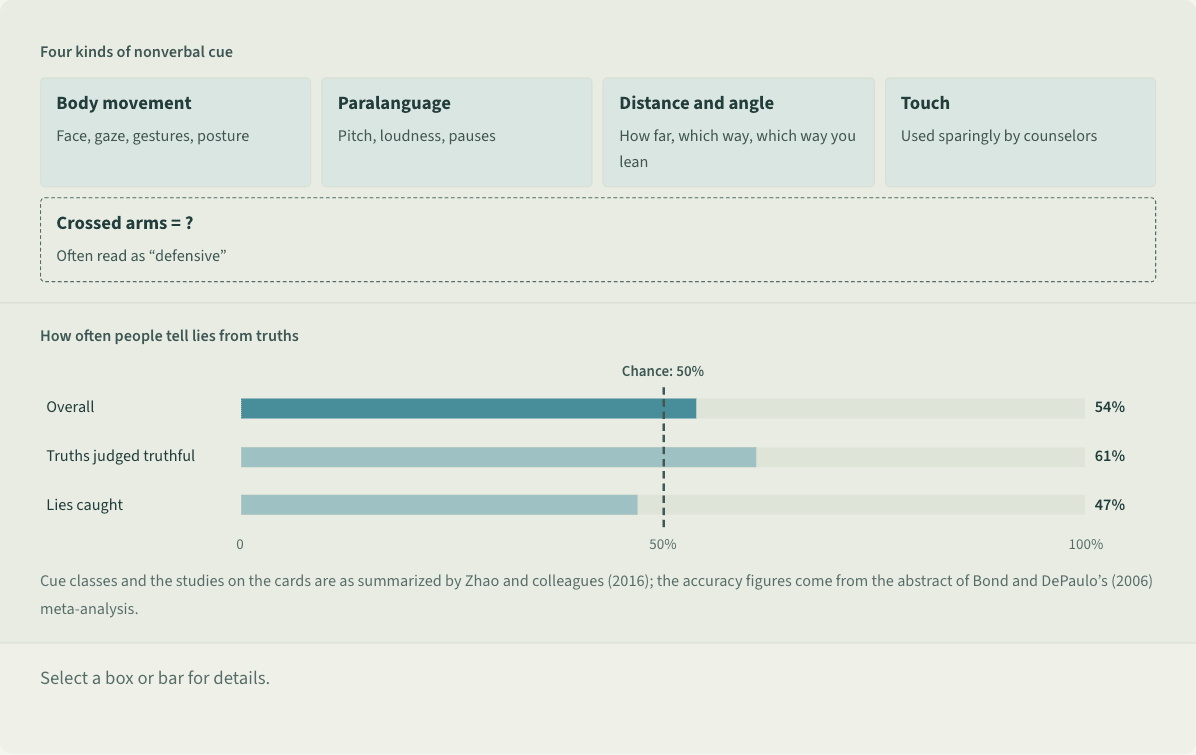
Cue classes and the studies on the cards are as summarized by Zhao and colleagues (2016); the accuracy figures come from the abstract of Bond and DePaulo’s (2006) meta-analysis.
Schematic with real data. At the top, labeled four kinds of nonverbal cue, four cards: body movement (face, gaze, gestures, posture); paralanguage (pitch, loudness, pauses); distance and angle (how far, which way, which way you lean); touch (used sparingly by counselors). Below them a card reads crossed arms = ?, subtitled often read as defensive. At the bottom, labeled how often people tell lies from truths, three horizontal bars drawn to scale from 0 to 100%: overall 54%, truths judged truthful 61%, lies caught 47%, with a dashed line at 50% labeled chance.
 Save as image (PNG)
This figure image is licensed CC BY 4.0: reuse it with credit and a link back to this page. How to reuse
Key points
- One common scheme has four classes: body movement (face, gaze, head, hands, legs), paralanguage (pitch, loudness, pauses), interpersonal distance and angle, and touch.[2]
- Unlike certain facial expressions, few if any body movements have a fixed meaning within or across cultures,[3] and what one means shifts with gender, culture and setting.[2]
- A meta-analysis of 206 documents and 24,483 judges found that people telling lies from truths on the spot were right 54% of the time, against 50% by chance.[4]
- In studies rating counseling videos, counselors who kept eye contact and leaned forward came across as more empathic, and crossed arms was rated the coldest arm position.[2]
An example
During a meeting, Ms. Wang notices Jay sitting with his arms crossed the whole time. Rather than deciding he is resisting the new plan, she asks him afterward what he thinks of it. Jay says he likes the plan; the meeting room was just cold.
Misreadings and limits
The usual misreading treats single gestures as a code: crossed arms mean defensive, lip-biting means worry. Such body-reading claims spread widely online and in popular books but lack scientific support.[3] Counseling research likewise says a gesture’s meaning depends on context, and a cue is a reason to ask more.[2]
Sources
- 1 American Psychological Association (2018). Nonverbal communication (NVC). APA Dictionary of Psychology (updated April 19, 2018). View source
- 2 赵春晓, 江光荣, & 林秀彬 (2016). 心理咨询中的非言语行为. 心理科学进展, 24(8), 1257–1265. doi:10.3724/SP.J.1042.2016.01257
- 3 Denault, V., Plusquellec, P., Jupe, L. M., St-Yves, M., Dunbar, N. E., Hartwig, M., Sporer, S. L., Rioux-Turcotte, J., Jarry, J., Walsh, D., Otgaar, H., Viziteu, A., Talwar, V., Keatley, D. A., Blandón-Gitlin, I., Townson, C., Deslauriers-Varin, N., Lilienfeld, S. O., Patterson, M. L., … van Koppen, P. J. (2020). The analysis of nonverbal communication: The dangers of pseudoscience in security and justice contexts. Anuario de Psicología Jurídica, 30(1), 1–12. doi:10.5093/apj2019a9
- 4 Bond, C. F., Jr., & DePaulo, B. M. (2006). Accuracy of deception judgments. Personality and Social Psychology Review, 10(3), 214–234. doi:10.1207/s15327957pspr1003_2
Last checked against sources: October 28, 2026