Therapeutic silence
沉默技术
What is therapeutic silence?
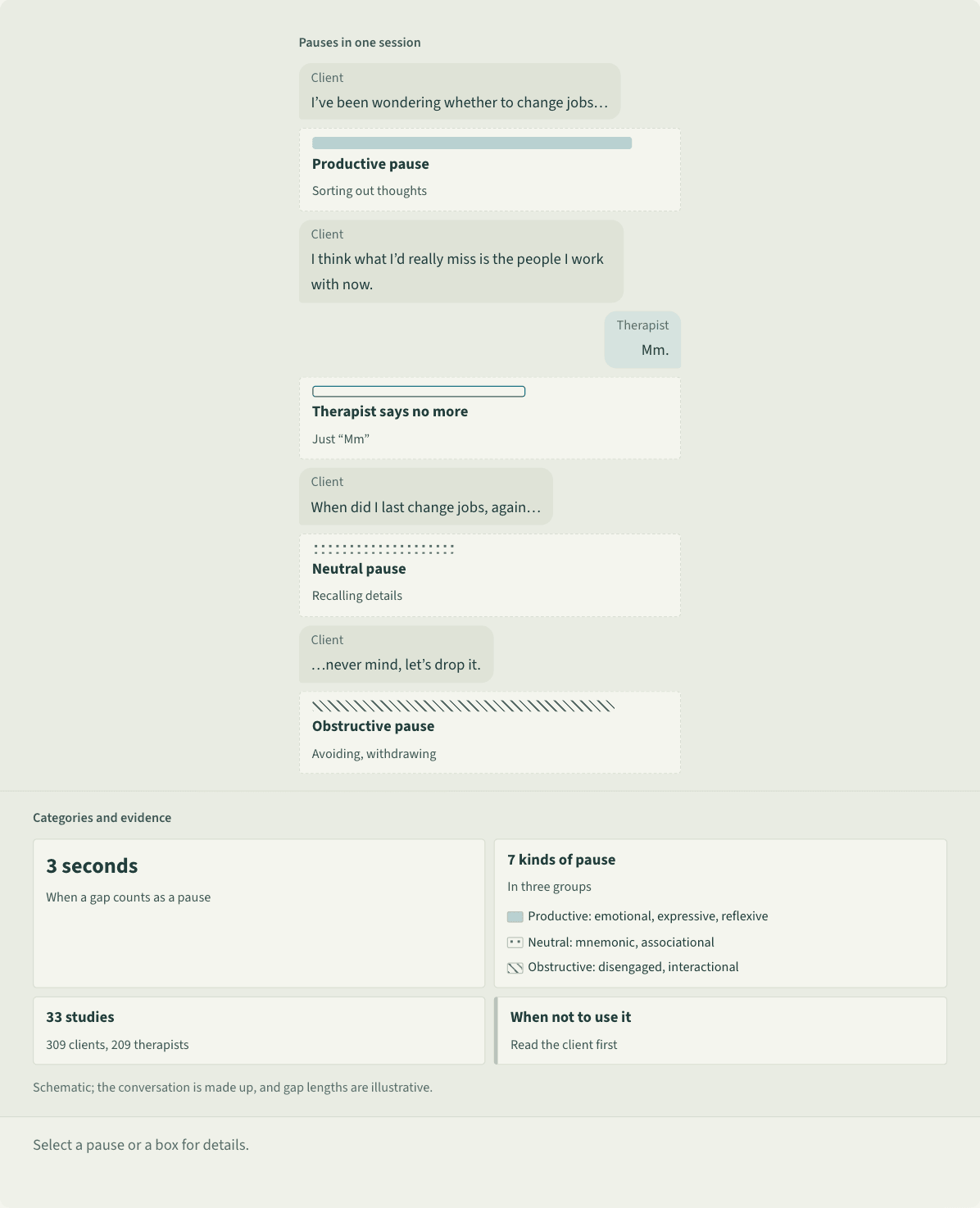
Therapeutic silence is a pause in counseling, with neither person speaking, that the therapist deliberately leaves unbroken so the client has room to think, feel and go on.[1][3] Research usually counts pauses of 3 seconds or more.[3]
Pauses in one session
- Client I’ve been wondering whether to change jobs…
- Client I think what I’d really miss is the people I work with now.
- Therapist Mm.
- Client When did I last change jobs, again…
- Client …never mind, let’s drop it.
Categories and evidence
Schematic; the conversation is made up, and gap lengths are illustrative.
Schematic. At the top, labeled pauses in one session, a conversation running down the page. Client: “I’ve been wondering whether to change jobs…”, then a gap labeled productive pause: sorting out thoughts. Client: “I think what I’d really miss is the people I work with now.” Therapist: “Mm.”, then a gap labeled therapist says no more. Client: “When did I last change jobs, again…”, then a gap labeled neutral pause: recalling details. Client: “…never mind, let’s drop it.”, then a gap labeled obstructive pause: avoiding, withdrawing. Below, labeled categories and evidence, four cards: 3 seconds (the threshold for a pause); 7 kinds of pause in three rows: productive: emotional, expressive, reflexive; neutral: mnemonic, associational; obstructive: disengaged, interactional; 33 studies (309 clients, 209 therapists); and when not to use it.
 Save as image (PNG)
This figure image is licensed CC BY 4.0: reuse it with credit and a link back to this page. How to reuse
Key points
- In a survey of 81 therapists, silence was used mainly to encourage reflection, encourage responsibility, help clients express feelings, avoid interrupting the flow, and convey empathy.[1]
- Levitt interviewed 7 clients and sorted their in-session pauses into 7 kinds, such as emotional, reflexive, mnemonic and disengaged,[2] grouped as productive, neutral or obstructive.[3]
- A review of 33 studies (309 clients) links silences to both good and poor outcomes, with better outcomes when therapists respond to what a particular silence is doing.[4]
- The surveyed therapists would use silence with clients actively working on a problem but not with very disturbed clients, and learned it mostly through clinical experience.[1]
An example
Ms. Wang is weighing a job change when she stops mid-sentence and stares at her cup. Jay doesn’t fill the gap or offer advice; he just looks at her and waits. After ten seconds or so, she says, “I think what I’d really miss is the people I work with now.”
Misreadings and limits
Silence is not doing nothing, and it is not always helpful. A quiet client may be feeling something, or may be avoiding or withdrawing;[2][3] what a silence means depends on how both people talk around it.[3] Telling these apart and responding well is the hard part, and therapists may find it challenging.[4]
Sources
- 1 Hill, C. E., Thompson, B. J., & Ladany, N. (2003). Therapist use of silence in therapy: A survey. Journal of Clinical Psychology, 59(4), 513–524. doi:10.1002/jclp.10155
- 2 Levitt, H. M. (2001). Sounds of silence in psychotherapy: The categorization of clients’ pauses. Psychotherapy Research, 11(3), 295–309. doi:10.1080/713663985
- 3 Knol, A. S. L., Koole, T., Desmet, M., Vanheule, S., & Huiskes, M. (2020). How speakers orient to the notable absence of talk: A conversation analytic perspective on silence in psychodynamic therapy. Frontiers in Psychology, 11, 584927. doi:10.3389/fpsyg.2020.584927
- 4 Levitt, H. M., & Morrill, Z. (2023). Silences in psychotherapy: An integrative meta-analytic research review. Psychotherapy, 60(3), 320–341. doi:10.1037/pst0000480
Last checked against sources: October 28, 2026